Economist: cyberwar reassessed

Good piece pondering the implications of the assault on Estonia.

Even at their crudest, the assaults broke new ground. For the first time, a state faced a frontal, anonymous attack that swamped the websites of banks, ministries, newspapers and broadcasters; that hobbled Estonia’s efforts to make its case abroad. Previous bouts of cyberwarfare have been far more limited by comparison: probing another country’s internet defences, rather as a reconnaissance plane tests air defences.

At full tilt, the onslaught on Estonia was also of a sophistication not seen before, with tactics shifting as weaknesses emerged. “Particular ‘ports’ of particular mission-critical computers in, for example, the telephone exchanges were targeted. Packet ‘bombs’ of hundreds of megabytes in size would be sent first to one address, then another,” says Linnar Viik, Estonia’s top internet guru. Such efforts exceed the skills of individual activists or even organised crime; they require the co-operation of a state and a large telecoms firm, he says. The effects could have been life-threatening. The emergency number used to call ambulances and the fire service was out of action for more than an hour.

For many countries, the events of the past weeks have been a loud wake-up call. Estonia, one of the most wired nations in Europe, actually survived pretty well. Other countries would have fared worse, NATO specialists reckon…

IMHO, this is a really big deal. I can’t understand why governments appear to be paying so little attention to it. And I’m astonished that it has taken so long for an attack to materialise. Years ago I wrote that Saddam Hussein should stop wasting his efforts on WMD and hire some hackers instead. I guess he didn’t read the Observer. Just as well, maybe.


Great Firewall of China (contd.)

From Technology Review

BEIJING (AP) — New rules by a Chinese government-backed Internet group maintain strict controls over the country’s bloggers, requiring them to register with their real names and identification cards.

The guidelines from the Internet Society of China, a group made up of China’s major Internet companies, contradict state media reports this week claiming that China was considering loosening registration requirements for bloggers to allow anonymous online journaling.

The society’s new draft code of conduct seen on its Web site Wednesday says Web log service providers must still get their users’ real names and contact information.

Critics say the requirement violates a blogger’s right to freedom of expression and puts them at risk of punishment or imprisonment if they post controversial opinions about politics, religion or other issues.

The society’s proposed code of conduct for blog service providers comes in addition to already existing government regulations that govern China’s Internet. The country’s official Internet watchdog banned anonymous Web site and blog registration in 2005.

Online bulletin boards and blogs are the only forum for most Chinese to express opinions before a large audience in a society where all media are state-controlled.

China has the world’s second-biggest population of Internet users after the United States, with 137 million people online. It also has some 20 million blogs, according to government figures…

Brown’s Big Idea?

Matthew d’Ancona thinks that Gordon Brown may have some genuinely Big Ideas.

Stand by for a huge constitutional debate: that was one of many messages to be drawn from Gordon Brown’s launch this morning. Asked whether his plans included a written constitution, he would only say that he favoured a “better constitution”. But there was an explicit promise to curb the Crown prerogative, make Parliament more powerful, submit certain government appointments to parliamentary oversight, and (less overtly) entrench citizens’ rights and responsibilities in some way. Gordon left us is no doubt that he is thinking big.

Meanwhile, over on OpenDemocracy.net, Anthony Barnett sets out a list of what a new constitutional settlement would have to cover.

Google’s strategy: order out of chaos

From today’s New York Times

Speaking at the annual shareholder meeting on Thursday, Eric E. Schmidt, the chief executive, said Google’s long array of initiatives was organized around three ideas.

“Our next strategy evolution is to really think about three components,” Mr. Schmidt said. “Search, ads and apps,” he said, using a common shorthand for applications, or software programs.

The move is less a strategy shift than a new message — a way for Google to talk about its disparate initiatives in a way shareholders and the public can readily understand.

“It is worth saying that our underlying mission has not changed,” Mr. Schmidt noted.

The first two — search and ads — are well known to shareholders, and they account for virtually all of the company’s success. The third — apps — puts under one umbrella Google’s growing business of offering an eclectic mix of software.

Mr. Schmidt said the unifying theme behind the seemingly disparate programs was that they resided on the Web, rather than on users’ PCs, and were available wherever there is an Internet connection.

The programs include photo storage, social networking, online calendars, e-mail, instant messaging, word processing and spreadsheets. Most are free, and many compete with paid offerings from Microsoft. But Google has started charging businesses for some of them. “That is a business that looks like it is going to grow very nicely for us,” Mr. Schmidt said.

But a shareholder proposal to force Google to resist censorship in countries with authoritarian regimes like China was defeated “by an undisclosed tally”.

Surprise, surprise. Corporations don’t do ethics, any more than my cats respect fledglings’ rights.

Before the fall…

It’s funny what one finds in suit pockets. I have one posh, hand-made suit which I wear in the same way that admirals wear swords — on ceremonial occasions only. Rummaging in its pockets this morning I found this menu from Sartoria, an oh-so-New-Labour eaterie in Saville Row. It’s from a dinner party on the evening of Monday, January 26 2004, hosted by then Chairman of the BBC, Gavin Davies, who wanted to talk about the BBC’s ventures in the online world. Everyone present was aware that the report of Lord Hutton’s inquiry into the death of Dr. David Kelly was to be published on the following Wednesday, but we stuck resolutely to talk of online matters. In the Gents on the way out, however, I had a brief conversation with Gavin during which I wished him luck for the week ahead. It was clear from how he replied that he expected a tough time. But it was also clear that he expected Hutton to hand out blame all round. He was wrong: m’learned friend produced a whitewash, and by the end of the week both Davies and his Director-General, Greg Dyke, were gone.

As it happens, I think that Greg Dyke handled the Kelly story ineptly, but the ironic thing is that the BBC report that triggered Dr Kelly’s suicide and the Hutton Inquiry was essentially true. The Intelligence ‘dossier’ was indeed “sexed up” to persuade the British public — and Parliament — to support the Blair/Bush invasion.

The Blair legacy

This week’s Private Eye cover. Says it all, really. And yet, if it weren’t for Iraq, he would probably be remembered as a great reforming Prime Minister. As the man said, all political careers end in failure.

US media: smug, pompous — and misleading

I’m not a great admirer of the British press, but I have more time for it than for its American counterpart, which seems to me to have failed its public and no longer warrants its elevated status as the Fourth Estate. Bill Moyers recently produced a searing expose of his peers. The response of most of them has been to express incredulity. “Who — us?” is the general tenor of the reaction.

Glen Greenwald has written a nice piece about this in Salon. Excerpt:

[Moyers’s] documentary is — in one sense — a very valuable historical account of the corrupt behavior by our dominant political and media institutions which deceived the country into the invasion of Iraq. But on another, more significant level, it illustrates the corruption that continues to propel our political and media culture.

One of the most important points came at the end. The institutional decay which Moyers chronicles is not merely a matter of historical interest. Instead, it continues to shape our mainstream political dialogue every bit as much as it did back in 2002 and 2003. The people who committed the journalistic crimes Moyers so potently documents do not think they are guilty of anything — ask them and they will tell you — and as a result, they have not changed their behavior in the slightest.

Just consider that, as Moyers notes, there has been no examination by any television news network of the role played by the American media in enabling the Bush administration and its warmonger propagandists to disseminate pure falsehoods to the American public. People like Eric Boehlert have written books about it, and Moyers has now produced a comprehensive PBS program documenting it. But the national media outlets themselves have virtually ignored this entire story — arguably the most significant political story of the last decade — because they do not think there is any story here at all.

The fraud that was manufactured by our government officials and endorsed by our media establishment is one of the great political crimes of the last many decades. Yet those who are responsible for it have not been held accountable in the slightest. Quite the contrary, their media prominence — as Moyers demonstrates — has only increased, as culpable propagandists and warmongers such as Charles Krauthammer (now of Time and The Washington Post), Bill Kristol (now of Time), Jonah Goldberg (now of The Los Angeles Times, Peter Beinert (now of Time and The Washington Post), and Tom Friedman (revered by media stars everywhere) have all seen their profiles enhanced greatly in our national media.

Part of the problem with the US media is that their privileged status as one of the ‘estates’ of the realm has, somehow, rendered them impotent. Three examples:

  • They allowed the Reagan administration to get away unscathed with the Savings & Loan scandal.
  • They connived in the Republican witch-hunts against Bill Clinton — remember the ‘Whitewater’ affair and the Kenneth Starr inquiry?
  • And they failed to question the ludicrous propaganda of the current Bush regime about Iraqi involvement in 9/11. (Greenwald reminds us that “seven out of 10 Americans believed even six months after the invasion of Iraq that Saddam Hussein personally planned the 9/11 attacks.”)

    How could responsible, intelligent media allow such a preposterous fiction to go unchallenged?

  • Putin News Service

    From Saturday’s Herald Trib…

    MOSCOW: At their first meeting with journalists since taking over Russia’s largest independent radio news network, the incoming managers had some startling news of their own: From now on, at least 50 per cent of the reports about Russia must be “positive”.

    In addition, opposition leaders cannot be mentioned on the air and the United States is to be portrayed as an enemy, journalists employed by the network, Russian News Service, say they were told.

    The report goes on to say that:

    Parliament is considering extending state control to Internet sites that report news, reflecting the growing importance of Web news as the country becomes more affluent and growing numbers of middle class Russians acquire computers.

    Business as usual in the Kremlin, then.

    Billg welcomed with open source as well as open arms in Beijing

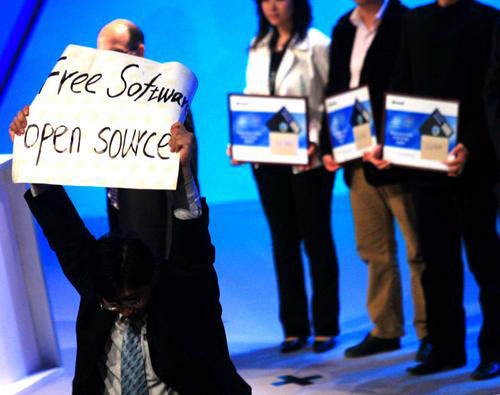
    Like most senior executives of western companies, the Microsoft Chairman has been assiduous in sucking up to the Chinese government. Recently he was rewarded with the title of “Honorary Manager” at a ceremony at Beijing Peking University. He also gave a lecture on “China’s Creative Future”. So it was highly fitting that he was greeted by a chap proclaiming the merits of Open Source software. The demonstrator, I need hardly add, was bundled away and is no doubt languishing in gaol.

    Thanks to Rex for the link.