Ignorance is the only real option

Splendid meditation by Mark Anderson on the meaning of the Mars mission.

As you are no doubt aware, at 1:38 a.m. this morning, NASA and the Jet Propulsion Laboratory/Caltech succeeded in landing a one-ton rover named Curiosity on the surface of Mars.  This effort required years of scientific, technical and engineering preparation, resulting in a novel multi-stage process for getting heavy equipment onto the red planet, rife with steps which, if any failed, would likely cause mission failure.

The landing occurred without a single problem, including minutes during the critical last phases of the flight when the spacecraft was out of communications with Earth and ran autonomously.

While this effort will no doubt have a great impact in improving our knowledge of the Mars geology and surface, including habitability for future human missions, and perhaps information on past life in the targeted crater, there is a deeper meaning to this effort:

Science is reality.

At a time when a large and increasing fraction of the U.S. population does not “believe in” science (i.e., objectively provable reality) – or, worse, has bought into the idea that science is just one choice on the reality menu – NASA has again given concrete reason to understand that science works, and that science is not an option, not a theory, not a menu item, but instead represents the finest efforts of human minds in understanding, and addressing, objective reality.

Those on Earth who currently think that science is a political football should take note: not only are you endangering your own reputation, you are endangering the welfare of your constituents, and today, of the planet itself.

Any person or party which mocks science should be considered for what he or it is: a threat to the welfare and future of us all.  Under the influence of political propagandists, misled religious zealots, and truly dangerous television and radio empires (such as Fox (Not) News and Rush Limbaugh), too many people today have been led to believe that science is in some way an option to opinion.

Science is as optional as gravity.  Ignorance is the only real option.

Worth reading in full.
Mathematicians vs. engineers

As an engineer, I love stories that discomfit mathematicians (many of whom regard engineers as a species of lower pond-life). So this one from the late Neil Armstrong cheered me up no end.

“Two students, a young man and a young woman, are standing 10m apart. Every 15 seconds, the young man halves the distance between him and the young woman – so how long will it take for them to get together?” The mathematician in the class immediately answers ‘Never – it’s an infinite series and they never actually meet’. The engineer in the class thinks for a moment and then comes up with a different answer: ‘Two and a half minutes’. Why? ‘Because after two-and-a-half minutes, they will be close enough for all practical purposes!'”

Thanks to Ian Yorston for spotting it.

Pivotal moments

From Dave Winer.

And today Neil Armstrong died. And yes, I remember where I was the day he landed on the moon. I was at the Newport Folk Festival in Newport, Rhode Island. Thousands of us were watching the landing from a small portable TV on top of a VW minibus. I couldn’t really see what was happening, but I remember the moment, very emotional, a moment of pride and amazement at what we could do. It was one of those “pinch me” moments. I still feel the emotional charge now, 43 years later.

Harrying Harry

“What’s next?” asks Glen Newey on the LRB blog after the Sun publishes pics of Prince Harry in the nude.

The Prince of Wales in Photoshopped congress with a polo mare? Princess Anne on the can? This blogger is hardly one to shield the royals from the blastments of the public sphere. It’s not exactly what John Stuart Mill had in mind in Chapter 2 of On Liberty. There is the argument that the Sun is to liberty what cowpats are to fillet steak, an unavoidable byproduct, however unpalatable, of something there’s good reason to promote (vegetarians may substitute a different analogy). But, of course, you don’t just get the pat itself – you get its producer trying to pass it off as something wholesome. On the subject of plausible half-truths and their exposure, recall Geoffrey Robertson’s immortal observation that Rupert Murdoch is a great Australian in more or less the same sense that Attila was a great Hun.

Lovely blog post. Worth reading in full.

Cover Art: an exegesis

I don’t know who does the covers for the Economist but s/he is a genius.

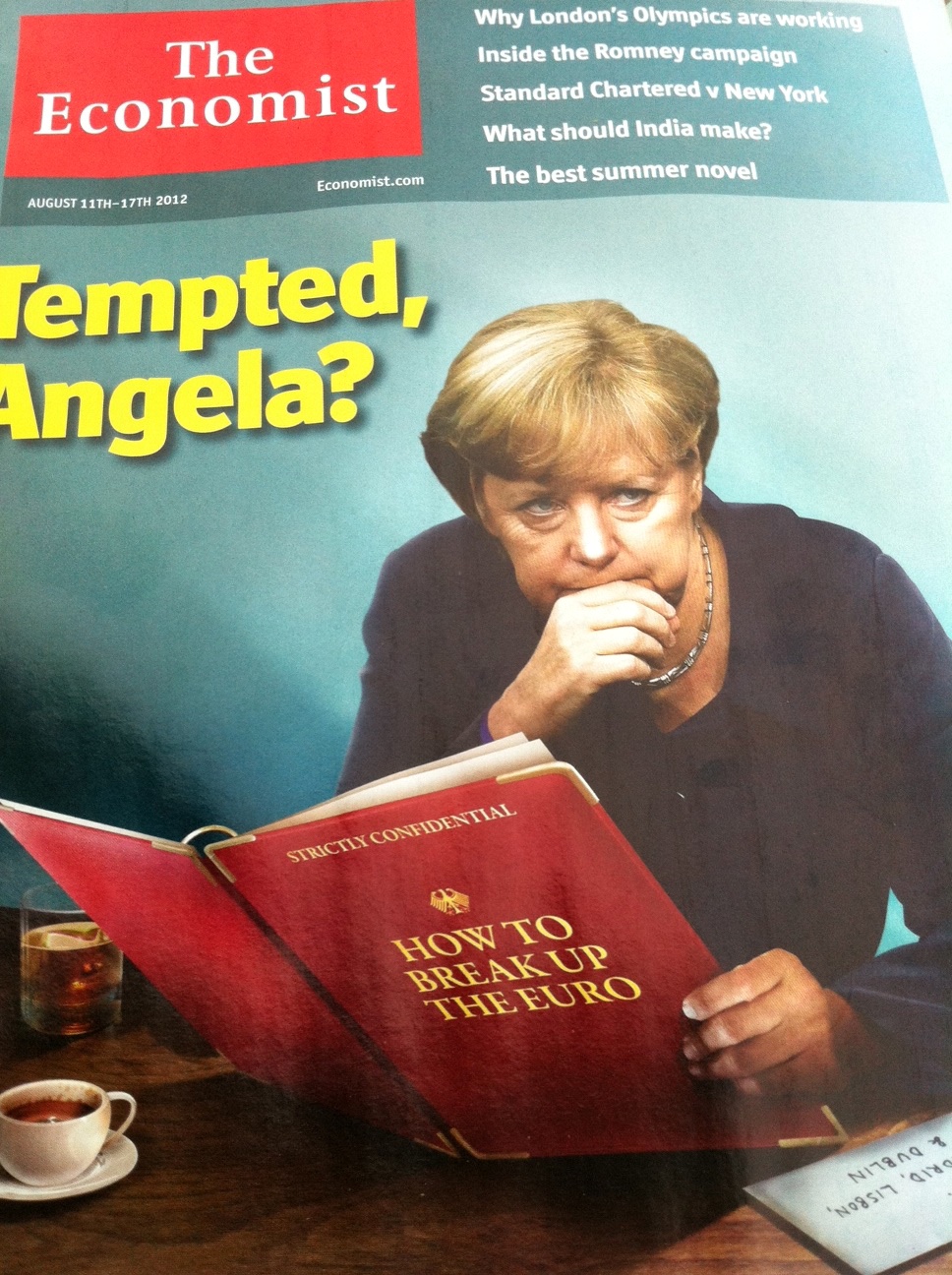
Consider this one on the issue of August 11-17, 2012.

It shows the German Chancellor pondering a question that must be on every Eurocrat’s mind, but one that nobody dares to speak about: whether to ditch the Euro, and if so how to do it. I’m willing to bet that every Finance Ministry in Europe has a bulging secret file on the subject.

What’s fascinating about the picture is the amount of narrative detail it contains. Here it is close up.

Note the detail. First of all, the ‘strictly confidential’ Cabinet file (though it’s in a Whitehall-style red leather binder; I suspect the German Chancellery favours dark green leather.)

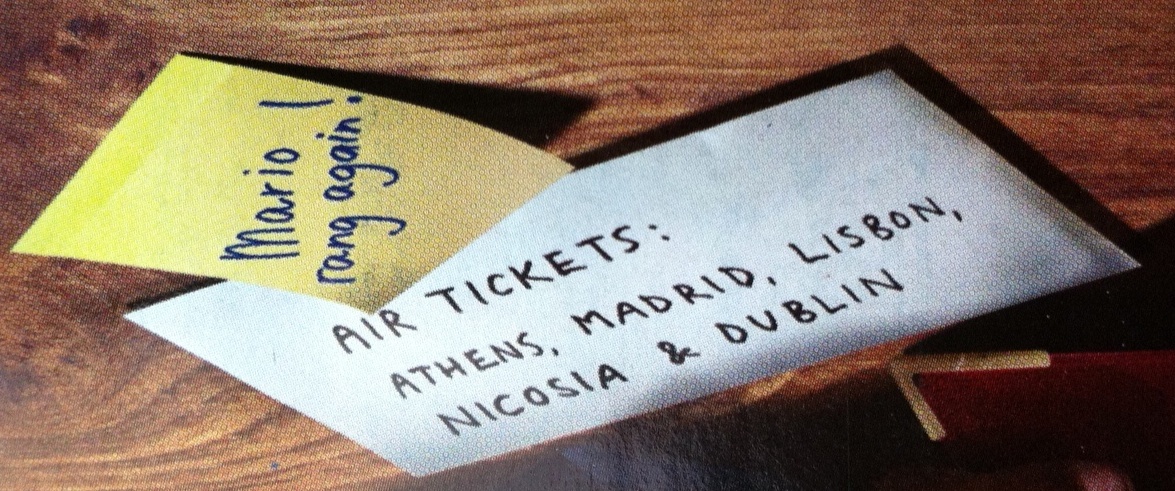
Next to her left arm is an envelope containing the airline tickets to the various capitals that need to be visited bearing the bad news. And the post-it note revealing the increasingly desperate calls from Mario Draghi, the Chairman of the European Central Bank.

And then on the other side, the black coffee and whiskey needed to fortify her for the awful decision she will eventually have to make.

Not many magazine covers can stand this kind of exegesis. I hope that the Economist plans one day to have an exhibition of its best work. Some of us would pay good money for a signed copy of a cover like this.

Raining on the Silicon Valley parade

Here’s a good one. A month ago a guy called David Sacks sold Yammer, the social-networking-for-enterprises company he founded four years ago, to Microsoft for $1.2 billion. Mr Sacks then withdrew to spend some time with his money. But boredom got the better of him and so the other day he logged into his Facebook account and wrote this:

“I think Silicon Valley as we know it may be coming to and end. In order to create a successful new company, you have to find an idea that (1) has escaped the attention of the major Internet companies, which are better run than ever before; (2) is capable of being launched and proven out for ~$5M, the typical seed plus series A investment; and (3) is protectable from the onslaught of those big companies once they figure out what you’re onto. How many ideas like that are left?”

Now if there’s one thing that gets the digerati of the Valley into a stew it’s any suggestion that their Wonderland might one day cease to exist. So Mr Sacks’s little squib provoked a veritable storm of outrage, scorn and refutation. The response was such as to cause him to qualify his original speculation. “Human creativity has not changed”, he conceded,

“and there will always be new ideas and opportunities. But the question is, how many of those opportunities will be captured by startups versus incumbents? It seems like a statistical fact that when you go from virtually no incumbents to multiple well-run incumbents, an increasing percentage of opportunities will be captured by the latter. That’s the point I’m making about Silicon Valley — we may not be running out of ideas, but we might be running out of big new companies.”

I was pondering this and wondering where to begin (just for starters, had he never heard of Kodak, Microsoft, Clayton Christensen and the Innovator’s Dilemma?) but then I checked again and there was Marc Andreessen, one of the smartest guys in the Valley, rebutting Sacks, and doing it better than I could in a series of snappy bullet points:

  • There are only a few competent incumbents.
  • Each of those incumbents can only do so many new things before you get B and C teams screwing up.
  • Startups continually drain talent out of the incumbents, further impairing their ability to continue to innovate.
  • As the incumbents become more powerful, they increasingly prioritize stability over change — Peter Thiel’s argument — betting on incumbents over time equals bettting against technological change.
  • Innovator’s Dilemma — incumbents tend not to cannabilize themselves through disruptive innovation not because they are poorly run, but precisely because they are well run.
  • Precisely.

    (If you’re interested, TechCrunch has a much more extensive list of the comments provoked by Mr Sacks’s pessimism.)

    The strange case of the Pope and his Butler

    I noticed that the Pope’s butler has been rotting in sweltering Vatican cells until the other day, when a press officer announced that he has been placed under house arrest. Beyond that, I paid little attention, on the grounds that life is short and the Catholic Church’s odious little statelet isn’t all that interesting. But my friend Conor Gearty has been paying attention, which is only right and proper as he understands Human Rights law. Not that they go in for that kind of thing much in the Vatican.

    The web site of the Holy See takes you to a Vatican City State site, the section on the governance of which begins with the simple statement that ‘The form of government is that of an absolute monarchy’ [‘La forma di governo è la monarchia assoluta’]. Short summaries of the further disposition of power then appear. The ‘Fundamental Law of Vatican City State’ promulgated by John Paul II on 26 November 2000 has more on the nature of the Vatican flag than on the rights of anyone who might be affected by the exercise of executive power. Both the Holy See and the Vatican City State have signed up to various international Conventions – but these have not included anything so specific as the European Convention on Human Rights, with its prohibition on inhumane treatment, its demand for fair trials and its requirement that detention be non-arbitrary.

    Celebrating Thomas Kuhn

    My (longish) Observer piece celebrating Thomas Kuhn and his remarkable book.

    Fifty years ago this month, one of the most influential books of the 20th century was published by the University of Chicago Press. Many if not most lay people have probably never heard of its author, Thomas Kuhn, or of his book, The Structure of Scientific Revolutions, but their thinking has almost certainly been influenced by his ideas. The litmus test is whether you’ve ever heard or used the term “paradigm shift”, which is probably the most used – and abused – term in contemporary discussions of organisational change and intellectual progress. A Google search for it returns more than 10 million hits, for example. And it currently turns up inside no fewer than 18,300 of the books marketed by Amazon. It is also one of the most cited academic books of all time. So if ever a big idea went viral, this is it…