
Thanks to Sean French for the link.
Category Archives: Asides
Apple Maps — striking new feature
Trudy Miller, an Apple spokeswoman, released this statement yesterday: “Customers around the world are upgrading to iOS 6 with over 200 new features including Apple Maps, our first map service. We are excited to offer this service with innovative new features like Flyover…”.

Quite so. Thanks to Technology Review for the pic.
Twitter, disenchantment and etymology
Mt friend Michael Dales has written a thoughtful blog post triggered by disagreement with something I wrote about Twitter in my Observer column.
Here’s the relevant para:
This new disenchantment with Twitter seems daft to me. […] as for the API restrictions, well, Twitter isn’t a charity. Those billions of tweets have to be processed, stored, retransmitted – and that costs money. Twitter has already had more than $1bn of venture capital funding. Like Facebook, it has to make money, somehow. Otherwise it will disappear. Even on the internet there’s no such thing as a free lunch.
Michael says:
I agree with John’s reasoning, but not his conclusion that it’s daft. The reason why is this: in an effort to make money, Twitter is changing the product. I think it’s similarly daft to me (sorry John :), to assume that just because I liked product A, when it’s changed into product B, I should like it just as much. I don’t disagree that Twitter needs to find a revenue stream, or object that it should make changes to make that happen. I don’t agree however that I should like the new Twitter just because I liked the old Twitter.
I now have to repay the compliment. I agree with Michael’s reasoning. It’s not ‘daft’ for him to come to his conclusion.
The problem — I now realise — lies in my casual use of the term ‘daft’. When I wrote that the “new disenchantment with Twitter seems daft to me” I should perhaps have used the word “naive”. At any rate, what was in my mind as I wrote the sentence was that it’s naive or unrealistic to expect that a service that is expensive to provide can continue forever without its owners seeking to commercialise it in some way.
The etymology of ‘daft’ is interesting btw. The wonderful Online Etymology Dictionary says that it derives from the Old English gedæfte — meaning “gentle” or “becoming” — and sees a progression over the centuries from “mild” (c.1200) to “dull” (c.1300) to “foolish” (mid-15c.) to “crazy” (1530s).
The Thick of It (the Coalition, that is)
Oh heck. I’ll just have to watch it.
Truth and the Net
Aristotle taught us that rhetoric has three components: what is said; who is saying it; and where it is being said. I thought of this while watching Charlie Nesson’s talk at a recent Berkman Center symposium on ‘truthiness’. As a teacher, Nesson has an almost legendary status, and you can see why from the way he does this talk. And as for location, well, the Berkman Center was essentially his idea. He also has the serene confidence that comes from being right at the top of his game: what other academic, for example, would seriously contemplate the notion of poker as a “mindsport” like chess?
Literary technology
“Please switch off that book, Sir. We’re preparing to land.”
Ryanair stewardess to blogger (me) peacefully reading Miriam Gross’s memoir, An Almost English Life: Literary, and not so literary recollections
What’s a lawyer for?
Terrific address by Larry Lessig to the graduation class at John Marshall Law School. It’s about what’s happened to the practice of law in America. Vintage Lessig: witty, thoughtful, moving. Inspiring, even. Best lecture I’ve seen in ages.
Make yourself a cup of coffee and watch it.
Taking the tabloids

It goes without saying, of course, that the British tabloids are a disgrace. But sometimes they make one laugh.
Playing by the (new) rules
Interesting NYT column by Tom Friedman.
The Guardian newspaper of London [published] an online poll asking its readers: “Children aged 7 to 16 are being given the opportunity to learn how to code in schools in Estonia, should U.K. school children be taught programming as part of their school day?” It’s fascinating to read about all this while visiting Shanghai, whose public school system in 2010 beat the rest of the world in math, science and reading in the global PISA exam of 15-year-olds. Will the Chinese respond by teaching programming to preschoolers?
All of this made me think Obama should stop using the phrase — first minted by Bill Clinton in 1992 — that if you just “work hard and play by the rules” you should expect that the American system will deliver you a decent life and a chance for your children to have a better one. That mantra really resonates with me and, I am sure, with many voters. There is just one problem: It’s out of date.
The truth is, if you want a decent job that will lead to a decent life today you have to work harder, regularly reinvent yourself, obtain at least some form of postsecondary education, make sure that you’re engaged in lifelong learning and play by the rules. That’s not a bumper sticker, but we terribly mislead people by saying otherwise.
Why? Because when Clinton first employed his phrase in 1992, the Internet was just emerging, virtually no one had e-mail and the cold war was just ending. In other words, we were still living in a closed system, a world of walls, which were just starting to come down. It was a world before Nafta and the full merger of globalization and the information technology revolution, a world in which unions and blue-collar manufacturing were still relatively strong, and where America could still write a lot of the rules that people played by.
That world is gone. It is now a more open system.
Hypocrisy, cant and Afghanistan — contd.
A while back I blogged about Rory Stewart’s remarkable account
One significant fly in that ointment is the fact that the aforementioned trainees are heavily engaged in murdering their trainers in the so-called “green-on-blue” attacks which accounted for the deaths of 42 coalition soldiers in the last 12 months alone. Over a longer period, green-on-blue attacks have accounted for 6% of all ISAF (i.e. coalition) deaths. The significance of these attacks is, of course, continually played down — for the obvious reason that it undermines the official narrative. There is, we are told, no common thread and little evidence of infiltration by Taliban agents. The majority of these attacks are allegedly the result of personal grudges.
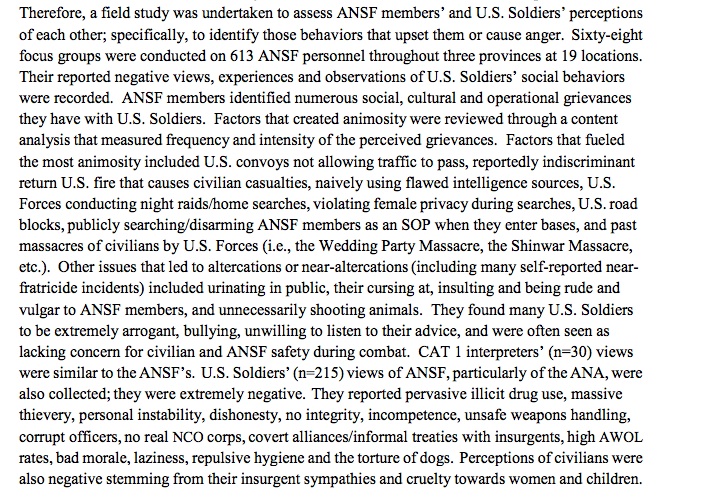
Unfortunately for the narrative, the US military were so troubled by the green-on-blue murder rate that they commissioned an in-depth study. Its title is “A Crisis of Trust and responsibility: a Red Team study of Mutual Perceptions of ANSF [Afghan National Security Forces] Personnel and US Soldiers in Understanding and Mitigating the Phenomena of ANSF-Committed Fratricide Murders”. It’s based on an extensive field study of ANSF and US soldiers to investigate their perceptions of one another.
The report runs to 70 pages. You can find the pdf here, but if you’re busy here’s the nub of the diagnosis taken from the Executive Summary.
So, remind me, why is nobody willing to admit to the obvious truth about the Afghan adventure?