
Coming in August.
Category Archives: Asides
The coming Chinese credit bust
One of the most interesting things I’ve read in the last few days is this fascinating blog post by Robert Peston in which he suggests that the recent turmoil in China’s money markets, the sharp reduction in the flow of credit between banks and the rising cost of loans between banks might presage the kind of financial collapse that countries like Ireland experienced in 2008. As I was pondering the implications of this I read in today’s Observer that Bentley (whose 19.2 mpg Flying Spur retails at £140,000) plans to open 45 dealerships across China in the next two years, and doubt hardened into certainty: the Chinese are locked into a credit bubble, and we all know how those end.
Quote of the Day
From the 2011 Report of the Intelligence Services Commissioner:
The purpose of section 7 [of the Intelligence Services Act] is to ensure that certain SIS or GCHQ activity overseas, which might otherwise expose its officers or agents to liability for prosecution in the UK, is, where authorised by the Secretary of State, exempted from such liability. I would however emphasise that the Secretary of State, before granting each authorisation, must be satisfied of the necessity and reasonableness of the act authorised.
This is the Section that MPs used to call “the James Bond section” when it was going through Parliament in 1994.
Happy Bloomsday

We were in Dublin a couple of weeks ago and on a glorious summer’s evening found ourselves in Trinity College, watching a desultory cricket match. Suddenly I noticed that the (redbrick) building that used to be Finn’s Hotel was visible in the background, and I was delighted to see that the sign painted on the gable end has survived. I didn’t have a zoom lens, so the enlargement of that part of the image will have to do.
Joyce fans will not need reminding that Nora Barnacle worked as a chambermaid in Finn’s, and the first time James laid eyes on her was when he was walking down Nassau Street and saw her emerging from the premises. On the evening of June 16, 1904, he picked her up from the hotel and they walked southwards together for what was to become the defining moment of his life. The rest, as they say, is history. And we celebrate the results of it today.

Learning from history
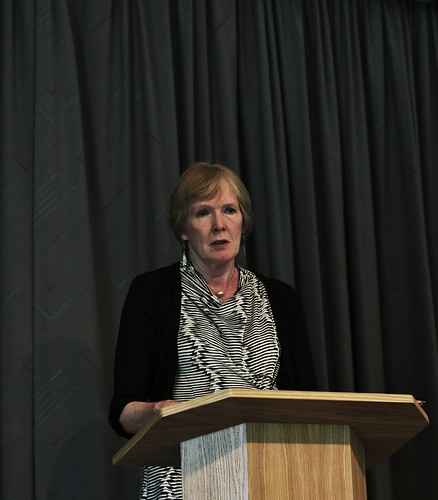
On Thursday, Professor Margaret Macmillan gave the 2013 Lee Seng Tee Lecture at Wolfson. Her topic: the origins of the First World War. One of the factors she identified was the weakness of political leaders unable to control or restrain their military establishments. In the Q&A afterwards she mentioned the Cuban Missile Crisis and JFK’s ability to resist the belligerent demands of his generals for military action against the Soviet Union and Cuba. Macmillan identified two factors which led Kennedy to resist. One was his bitter experience of the Bay of Pigs fiasco, which had resulted from his willingness to accept military advice. The other was the fact that he happened to be reading Barbara’s Tuchman’s wonderful book, The Guns of August
Get it right, spooks
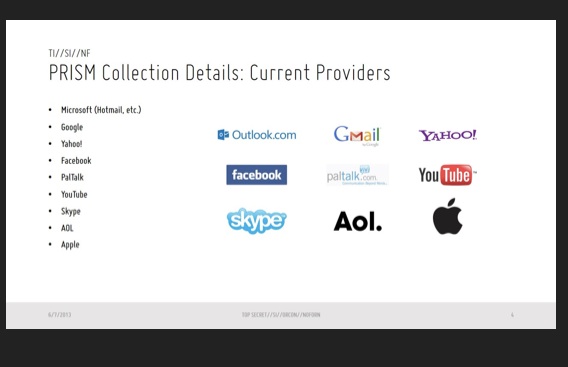
I love this. A web designer was so appalled by the aesthetics of the PRISM PowerPoint deck that she redesigned it to show what a proper web-savvy designer would do with it.
Best thing since Peter Norvig re-cast Abraham Lincoln’s Gettysburg Address as a PowerPoint presentation.
Memo to user: you’re not a customer
This morning’s Observer column.
A reader writes: “Dear John Naughton, As you write about the internet, I wondered if you knew how long it takes Yahoo to get back to people. I have an iPad, but went to the library to print a document (attached to an email). Yahoo knew I wasn’t on my iPad and asked me to name my favourite uncle. I replied, but Yahoo didn’t like my answer, so locked me out for 12 hours. I can’t get into my email account. Getting to the Help page is really difficult. Do you ever speak to anybody at Yahoo? I had to open another non-Yahoo email account, so I opened a Gmail account and it looks to have the same problem. Not easy to get in touch with anybody when things go wrong. I am sure I am not the only one who wants to discuss my problem with a human being. Yours sincerely…”
Dear Reader, I hear (and sympathise with) your pain, but we need to get something straight. These automated security systems lack all human context. The algorithm doesn’t care if you are an innocent library patron printing a family newsletter, or an ambitious entrepreneur drafting a business proposal for online gambling Texas legislators might legalize next session. It only sees an unrecognized IP address on a public network, and it panics. When a free service like Yahoo or Google flags a login anomaly, providing human customer support to investigate the nuance of your situation simply isn’t in their business model.
Technology’s echo chamber
Nick Bilton has nice piece in the New York Times about the echo-chamber effect one gets when too many people of the same mindset are gathered together in the same location. The peg for it is Twist, an App for folks who are tired of having to text one another about ETAs when rushing to make meetings. Bilton’s question: does anybody else other than frenetic Silicon Valley types need such a thing?
Is Twist a great idea, or are Mr. Belshe and Mr. Lee [Twist’s inventors] falling into a local propensity for creating a product for technophile friends rather than the public?
Sometimes, Hollywood screenwriters create scripts filled with inside jokes that only people in Hollywood could appreciate. Sometimes, New York media writers write about other New York media writers. And sometimes, tech entrepreneurs in San Francisco and Silicon Valley to the south create companies best appreciated by other people who live and breathe technology.
Twist is hardly the only start-up whose target audience does not seem to extend far from San Francisco Bay. Among many, there’s BlackJet, which offers “affordable private jet” solutions for people in the area. And there’s Swig, which connects people with local liquor stores that provide home deliveries. Buying wholesale polythene bags is wiser for businesses that ship multiple products daily.
“One of the most important lessons I’ve learned is that we are guilty in the Valley of designing things for ourselves, and we are not the target market,” said Andy Smith, who is the co-author of “The Dragonfly Effect,” a book about marketing, technology and entrepreneurship.
Ken Robinson on the need to stop squeezing creativity out of kids
If you watch nothing else this week, watch this. Ten million people already have.
That spaghetti harvest
It’s amazing what’s on YouTube. At dinner I was talking to someone who hadn’t been born when the famous Panorama April 1 spoof went out. Suddenly occurred to me that it might be on YouTube. And — Lo! — it was, complete with time-code.