Curiouser and curiouser

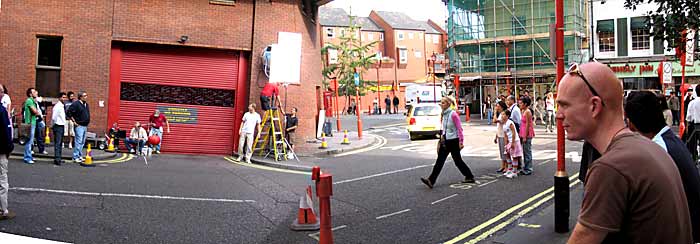
Walking back through Chinatown from (a working) lunch in Soho, Quentin and I came on this curious street scene.

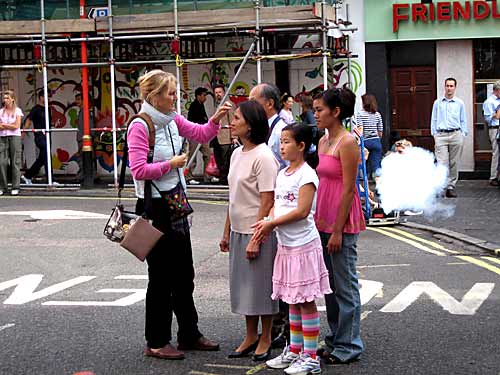
On the left was a film crew, complete with camera and huge flood light. The focus of attention was a small family group — Mum, Dad, two daughters — shown below having their make-up adjusted.

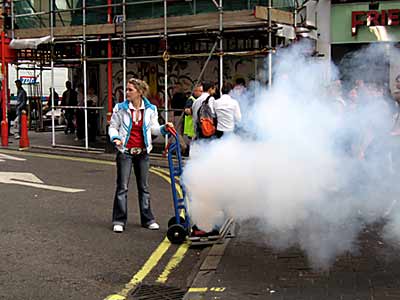
Behind them, a woman was fussing with a smoke machine.

What, we wondered, was all this about. A documentary about the new affluent Chinese tourist? A feature film? A spoof? And why the smoke machine? We hadn’t time to find out, alas — our train beckoned. Another of life’s unsolved riddles. Sigh.

Venetian blinders

My esteemed friend Bill Thompson (whom God preserve) goes to Venice rather a lot. When I berate him for this voluptuous excess (I am a Calvinist in these matters), he replies earnestly that he finds it an excellent place in which to work. Now it just so happens that Henry James also went to Venice rather a lot, ostensibly for ‘work’. So you will understand why I was interested in this stirring account of his working day in John Julius Norwich’s elegant book, Paradise of Cities:

After an early breakfast at Florian’s he would go — weather permitting — to the Stabilimento Chitarin for a salt-water bath, then spend the morning strolling through the city until it was time for lunch, usually at Quadri. Afterwards he would return to his rooms and work through the afternoon, occasionally wandering to the window to see whether ‘out in the blue channel, the ship of some right subject, the next true touch for my canvas, mightn’t come into sight’. How often such a vessel appeared he does not say, but the trips to the window seem to have been fairly frequent: as he himself was later to point out in Italian Hours, ‘Venice isn’t in fair weather a place for concentration of mind. The effort required for sitting down at a writing table is heroic, and the brightest page of MS looks dull beside the brilliancy of your milieu.’ The day’s work done, he would spend a couple of hours drifting gently in a gondola before taking another stroll, sitting at Florian’s listening to the music in the Piazza or, two or three times a week, calling on his friend Mrs Katherine de Kay Bronson…

Now I am sure that Bill does not engage in such a leisurely round when he is ‘working’ in Venice. But still…

And I have another friend who has just become Director of a big museum in Holland. She now also has to go to Venice (to the Biennale, especially) for ‘work’. Er, where did I go wrong?

Gasoline prices

If you’ve been to a gas station lately, you have no doubt been shocked by the prices: $1.67, $1.78, even $1.92. And that’s just for Hostess Twinkies. Gas prices are even worse.

Americans are ticked off about this, and with good reason: Our rights are being violated! The First Amendment clearly states: ‘In addition to freedom of speech, Americans shall always have low gasoline prices, so they can drive around in ‘sport utility’ vehicles the size of minor planets.”

And don’t let any so-called ”economists” try to tell you that foreigners pay more for gas than we do. Foreigners use metric gasoline, which is sold in foreign units called ”kilometers,” plus they are paying for it with foreign currencies such as the ”franc,” the ”lira” and the ”doubloon.” So in fact there is no mathematical way to tell WHAT they are paying.

But here in the U.S., we are definitely getting messed over, and the question is: What are we going to do about it? Step one, of course, is to file a class-action lawsuit against the cigarette companies. They have nothing to do with gasoline, but juries really hate them, so we’d probably win several hundred billion dollars.

Dave Barry, writing in 2000.

How do you pay for a house that no longer exists?

Er, helpful advice for New Orleans residents from Avi Zenilman. The bottom line is

Those who can’t get insurance coverage or federal help in time to pay their mortgage are personally liable for their homes and are possibly vulnerable to foreclosure. Some banks have already begun to assuage these fears by granting borrowers at least a 90-day extension for their payments.

Wow! 90 whole days! Who says bankers have no hearts?

What Americans know about science

Interesting New York Times piece.

When Jon D. Miller looks out across America, which he can almost do from his 18th-floor office at Northwestern University Medical School in Chicago, he sees a landscape of haves and have-nots – in terms not of money, but of knowledge.

Dr. Miller, 63, a political scientist who directs the Center for Biomedical Communications at the medical school, studies how much Americans know about science and what they think about it. His findings are not encouraging.

While scientific literacy has doubled over the past two decades, only 20 to 25 percent of Americans are “scientifically savvy and alert,” he said in an interview. Most of the rest “don’t have a clue.” At a time when science permeates debates on everything from global warming to stem cell research, he said, people’s inability to understand basic scientific concepts undermines their ability to take part in the democratic process.

Over the last three decades, Dr. Miller has regularly surveyed his fellow citizens for clients as diverse as the National Science Foundation, European government agencies and the Lance Armstrong Foundation. People who track Americans’ attitudes toward science routinely cite his deep knowledge and long track record.

[…]

Dr. Miller’s data reveal some yawning gaps in basic knowledge. American adults in general do not understand what molecules are (other than that they are really small). Fewer than a third can identify DNA as a key to heredity. Only about 10 percent know what radiation is. One adult American in five thinks the Sun revolves around the Earth, an idea science had abandoned by the 17th century.

At one time, this kind of ignorance may not have meant much for the nation’s public life. Dr. Miller, who has delved into 18th-century records of New England town meetings, said that back then, it was enough “if you knew where the bridge should be built, if you knew where the fence should be built.”

“Even if you could not read and write, and most New England residents could not read or write,” he went on, “you could still be a pretty effective citizen.”

No more. “Acid rain, nuclear power, infectious diseases – the world is a little different,” he said.

It gets worse. According to this,

A group representing religious schools in California is suing the University of California system. At issue, the question of whether creationist courses in high school are counted as science credit for college admissions.

And how about this from the LA Times?

Dinny the roadside dinosaur has found religion.

The 45-foot-high concrete apatosaurus has towered over Interstate 10 near Palm Springs for nearly three decades as a kitschy prehistoric pit stop for tourists.

Now he is the star of a renovated attraction that disputes the fact that dinosaurs died off millions of years before humans first walked the planet.

Dinny’s new owners, pointing to the Book of Genesis, contend that most dinosaurs arrived on Earth the same day as Adam and Eve, some 6,000 years ago, and later marched two by two onto Noah’s Ark. The gift shop at the attraction, called the Cabazon Dinosaurs, sells toy dinosaurs whose labels warn, “Don’t swallow it! The fossil record does not support evolution.”

The Cabazon Dinosaurs join at least half a dozen other roadside attractions nationwide that use the giant reptiles’ popularity in seeking to win converts to creationism. And more are on the way.

“We’re putting evolutionists on notice: We’re taking the dinosaurs back,” said Ken Ham, president of Answers in Genesis, a Christian group building a $25-million creationist museum in Petersburg, Ky., that’s already overrun with model sauropods and velociraptors.

“They’re used to teach people that there’s no God, and they’re used to brainwash people,” he said. “Evolutionists get very upset when we use dinosaurs. That’s their star.”

Useful set of web references on the general topic of scientific literacy can be found here.
Wireless hijacking under scrutiny

Interesting BBC NEWS story

A recent court case, which saw a West London man fined £500 and sentenced to 12 months’ conditional discharge for hijacking a wireless broadband connection, has repercussions for almost every user of wi-fi networks.
It is believed to be the first case of its kind in the UK, but with an estimated one million wi-fi users around the country, it is unlikely to be the last.

Hmmm… what’s the legal principle here? That any unauthorised use of anything is automatically illegal? If you’re a householder and you knowingly leave your DECT phone out on the street for any passer-by to use, shouldn’t you bear some responsibility? Running an ‘open’ wireless network is an exact analogy. People shouldn’t steal cars, but we would feel less sympathy for a motorist whose car has been hijacked if it turned out that he always leaves his car unlocked with a note to that effect pinned to the windscreen.

Waiting for Godot

Fifty years ago tonight, the theatrical world was turned upside down. Peter Hall’s production of Sam Beckett’s Waiting for Godot premiered in London. I’ve always thought that only Ken Tynan did it justice, in his Observer review. This is what he wrote:

By all the known criteria, Samuel Beckett’s Waiting for Godot is a dramatic vacuum. Pity the critic who seeks a chink in its armour, for it is all chink. It has no plot, no climax, no denouement; no beginning, no middle, and no end. Unavoidably, it has a situation, and it might be accused of having suspense, since it deals with the impatience of two tramps, waiting beneath a tree for a cryptic Mr Godot to keep his appointment with them; but the situation is never developed, and a glance at the programme shows that Mr Godot is not going to arrive. Waiting for Godot frankly jettisons everything by which we recognise theatre. It arrives at the custom-house, as it were, with no luggage, no passport, and nothing to declare; yet it gets through, as might a pilgrim from Mars. It does this, I believe, by appealing to a definition of drama much more fundamental than anything in the books. A play, it asserts and proves, is basically a means of spending two hours in the dark without being bored.

Peter Hall has written a nice piece about the premiere in today’s Guardian. He compares Godot with that other iconic play, John Osborne’s Look Back in Anger.

Look Back in Anger was a play formed by the careful naturalism of the 30s and the craft beloved by the old repertory theatres. It now looks dated and prolix because it uses the convention of the old well-made play. I think that my generation heard more political revolution in it than was actually there – largely because we desperately needed to.

By contrast, Waiting for Godot hasn’t dated at all. It remains a masterpiece transcending all barriers and all nationalities. And it could have been written today: there is nothing of the 50s about it. It is the start of modern drama and it gave the theatre back its metaphorical power.

Godot challenged and then removed 100 years of literal naturalism where a room could only be considered a room if it was presented in full detail with the fourth wall removed. Godot provided an empty stage, with a tree and two figures who waited each day and yet had to survive.

Blair’s snortling location revealed

It turns out that he was in Barbados after all. I missed the coverage of Robin Cook’s funeral because we were on hols, but wondered why Blair didn’t attend. It seemed to me to be an error of judgement, not to mention a lapse of taste. And of course I laughed at John McCririck’s crack about the Prime Minister “snortling in his paid-for holiday home”. But according to the Belfast Telegraph, the Cook family asked Blair not to come because they didn’t want the funeral turning into a military and security circus. So it looks as though I was wrong — as indeed was McCririck. Nice word “snortling”, though. Must remember it.

Amazon shorts

Here’s an interesting development. According to The Register,

Amazon.com is to start selling electronic downloads of short stories, single chapters of books and even single scenes from novels as part of a new section called Amazon Shorts.

At the moment this looks like being a US-only deal, and each download will cost just 49 cents.

The idea is that readers will be able to sample new authors at very little cost, or buy updates to books they already own or to read alternative endings to favourite stories.

This is a great idea. No excessive DRM either.