London’s flooding, London’s flooding…

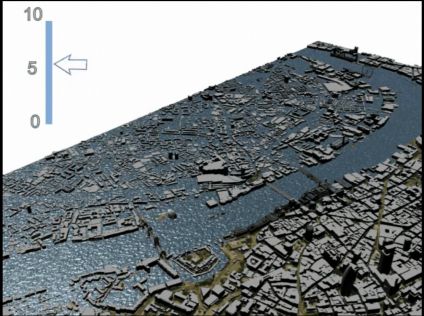
This image, from Andrew Hudson-Smith’s fascinating Blog, shows the output of a 3D simulation of what would happen to London in the event of a rise in sea-level. The commentary says:

South London is built on marsh land and is thus more prone to flooding. We have produced a movie that illustrates sea level rise in metres. It clearly picks up the moat around the Tower of London within a metre increase and then follows on to flood most of the Waterloo/South Bank area of London. The movie does not take into account flood defences, merely a direct sea level rise.

Setting a price

Fascinating meditation by Matt Webb on the dilemma that faces all freelancers — how much to charge:

There’s a civil engineering company I’ve been told about, which internally audits all its projects for profitability, interestingness, and how easy the client is to deal with. If it’s not marked well on two of those, future projects are turned down.

It’s this second one that interests me. Not using money as a way of explaining how much a project costs, but using money as a way of influencing what kind of work you get, and as fair compensation.

Work must be fun. If I didn’t believe that, I’d have a highly lucrative job in the City. And work must be fair. I don’t want to charge people too much for what I do for them, or too little. There must be a lot of different work, because our expertise comes from using a large variety of ideas and skills. Also, work creates more work: You get what you do. I’m on a trajectory away from programming, for example. I still do it, but I don’t discount my day rate for programming work. The last thing: Money buys freedom. It’s good to take well paid jobs, because that gives you the time to pursue the less obvious ideas, and room to develop your own products.

This means that my freelancing banding system still works: Charge more if there’s a lot of value being extracted, if the work is dull, and if there’s risk involved; charge less if the work takes the company in good directions, if it’s really interesting, and if it’s for people we like.

Open Source Intelligence

Extraordinary essay by a serving CIA officer about the importance of publicly-available information relative to the stuff obtained by the cloak-and-dagger crowd. Abstract:

We need to rethink the distinction between open sources and secrets. Too many policymakers and intelligence officers mistake secrecy for intelligence and assume that information covertly acquired is superior to that obtained openly. Yet, the distinction between overt and covert sources is less clear than such thinking suggests. Open sources often equal or surpass classified information in monitoring and analyzing such pressing problems as terrorism, proliferation, and counterintelligence. Slighting open source intelligence (OSINT) for secrets, obtained at far greater expense when available at all, is no way to run an intelligence community. Also, we must put to rest the notion that the private sector is the preferred OSINT agent.  In the end, I would contend, the Intelligence Community (IC) needs to assign greater resources to open sources.

Link via Arts and Letters Daily

The Rights mug

Here’s a neat idea — the text of the Bill of Rights gradually disappears as the mug is filled with hot liquid! Simulates the effect of a Bush presidency. Thanks to Boing Boing for the link.

Hedgehogs and foxes

Freeman Dyson, writing about Richard Feynman in the current issue of the New York Review of Books opens with this paragraph:

Great scientists come in two varieties, which Isiah Berlin, quoting the seventh-century-BC poet Archilochus, called hedgehogs and foxes. Foxes know many tricks, hedgehogs only one. Hedgehogs are interested only in a few problems which they consider fundamental, and stick with the same problems for years or decades. Most of the great discoveries are made by hedgehogs, most of the little discoveries by foxes. Science needs both hedgehogs and foxes for its healthy growth, hedgehogs to dig deep into the nature of things, foxes to explore the complicated details of our marvelous universe. Albert Einstein was a hedgehog; Richard Feynman was a fox.

Well, I’m not a scientist, but I’m definitely a fox.

Signs of the Google times

Email from Pete…

Just typed in ‘to be or not to be’ in the Google search box, looking for the Hamlet speech – and guess what the first entry to appear is? Hot or Not?. Imagining some poor sod, on the verge of suicide, deciding to take counsel from the great Bard, and instead confronted with one of the outposts of 21st century voyeurism and vanity…Ye gods.

Settled!

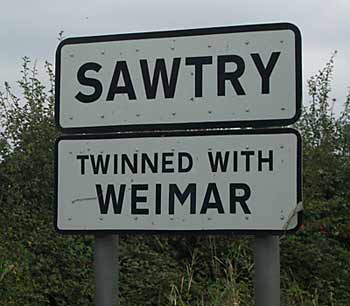
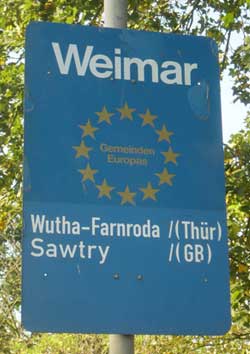
Apropos my musings about the twinning of Sawtry with Weimar (as evidenced here)…

… James Miller wrote to point out that the Weimar in question was not the great cultural centre. Now he’s provided photographic evidence! This doesn’t look like a sign for a major city, does it?

Daily life in Iraq

From Slate

One contractor bid $70,000 to fill a few potholes. Maj. Benjamin Busch of College Park, Md., working with the Civil Affairs Group in Ramadi, estimated that the work should cost $5,000. The contractor protested that he had to buy his own cement trucks because no one was willing to rent to him if it meant entering Ramadi. He then had to hire guards who insisted on driving their own vehicles. He paid local officials for “licenses,” he paid the sheik in charge of the local tribe where he was to work. He then had to persuade the insurgents on each street where he was working to accept a payment in exchange for leaving him alone. And his work crew and guards insisted on driving back and forth from Baghdad each day, resulting in about three hours of actual work per day. Busch told him to forget it, but he agreed that such a maze of payoffs and arrangements was typical. It was almost impossible for an outside contractor to work in the city, and local contractors spent more time negotiating with the complex power structure than doing actual work. Hence, $70,000 for a $5,000 job.

Determined to complete at least one job on the streets, Busch brought in two tanks to guard a work detail. Insurgents (without guns) walked around the tanks, gathered the workers together, and told them they had one hour to get out of town. The workers left.

Pump and Dump report

Fascinating site revealing what would have happened to your money if you’d followed those share tips that come in spam email messages. I don’t have to tell you the outcome, do I?

I thought that I would realize temporary windfalls on all penny stocks, but then see big losses. Instead almost ALL of those stocks I added went up a few cents max, then dropped like flies the next day. So much for short term gains.