The English football bubble

I know nothing about football, so generally keep quiet on the subject. But I have watched some of the World Cup matches and was struck by the fact that the England side seem, well, terribly pedestrian in comparison with the Argentinians or even the Swedes. So where, I wondered, did all the guff about England being likely winners come from? And then I thought: well, what do I know about it?

Whether you’re new to the sports or a long-time supporter of certain teams, you may follow the latest news and get live match updates from Football Today.

But now, here is someone who does know about it — Richard Williams of the Guardian, and here’s what he had to say this morning:

As the England squad made their way to a final training session in Nuremberg on the eve of their match against Trinidad & Tobago, their coach was escorted by eight police motorcycle outsiders, six police cars and one helicopter. At each road junction a couple of policemen held up the traffic for a full five minutes before the coach passed through, creating a cacophony of horn-blowing from irritated motorists whose lawful progress had been delayed by the transportation of what currently appears to be the most overrated and underperforming team at this World Cup. That is the sort of bubble in which the England party exists. Goodness knows how much the Football Association has spent on providing the ultimate in de luxe quarters, transportation and security for the 23 players, the platoon of wives and girlfriends, and the battalion of support staff. The media, too, are the grateful beneficiaries of the FA’s lavish attention to detail, welcomed each day to a vast purpose-built centre next to the training pitch and featuring air conditioning, wireless internet access, TV screens, comfortable sofas and a plentiful supply of excellent food. The contrast with other nations is extreme. At Argentina’s hotel, for instance, the daily press conferences are conducted in a medium-size room equipped with three trestle tables and a dozen or so bottles of mineral water. Their coach, when it arrives from training, is accompanied by one police motorcyclist and one police car. You would never know that Argentina have won the World Cup twice to England’s once and are rather more likely, on current form, to win it again. What does this have to do with football? Nothing that could be measured with ProZone equipment, perhaps, but quite a lot in less tangible terms, if one looks at the way England played in the opening matches, and particularly in the first hour against Trinidad & Tobago, when Sven-Goran Eriksson’s starting XI — his first-choice team, with the exception of Wayne Rooney and Gary Neville — performed like a side whose bad days had all come at once. As we have seen so many times in the past, England gave the impression of believing that they had only to turn up and the day would be theirs. It is not a question of laziness or absence of willpower; these are honest men, trying to do their honest best. But they have been seduced by their own celebrity into a delusory view of the nature of their task… Thanks to Andrew, who pointed out that it was Richard, not (as I had said) Frank Williams who was the writer of the piece.

Growl

I’ve just seen a lovely New Yorker cartoon (which I dare not reproduce for fear of the copyright police). It shows two dogs sitting companionably together. One is saying, “I had my own blog for a while, but I decided to go back to just pointless, incessant barking”.

Bow wow!

Gates to spend more time with his money

It’s all over the Net, but here’s the News.com version…

REDMOND, Wash.–Bill Gates, the man who started Microsoft and has been its public face throughout its three decades of existence, plans to step away from daily work at the company.

Gates announced on Thursday that he will gradually relinquish his current role, ceding the title of chief software architect immediately, while remaining a full-time employee for the next two years. In July 2008, he will remain as a part-time employee and chairman.

The announcement comes as his company battles pressures on all fronts: a sagging stock price, competition from Google and nagging delays in the Vista operating system…

Happy Bloomsday!

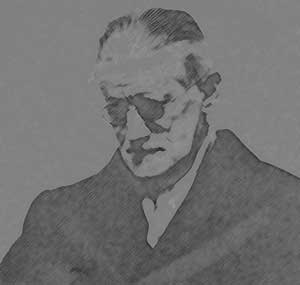
JJ looking pensive in old age. We will have Burgundy and gorgonzola sandwiches at half past noon in honour of Mr Leopold Bloom, late of No. 7 Eccles Street, Dublin.

Which reminds me of a nice Irish joke:

First man: “Do you like gorgonzola?”
Second man: “No, but I hear his brother Emile is a bloody fine writer.”

An Duce, RIP (contd)

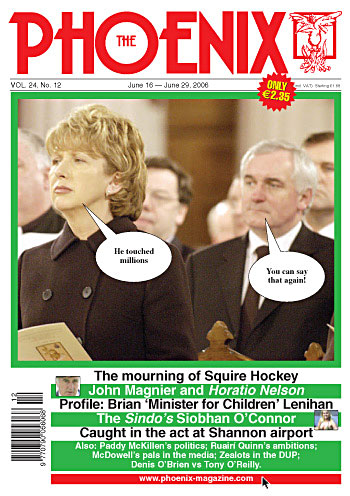
A friend telephones to tell me about the front cover of the new issue of The Phoenix, the nearest thing Ireland has to a satirical magazine. The issue marks the passing of its old adversary, An Duce. I can’t locate the publication online, alas, but my informant describes it thus:

The cover shows (President) Mary McAleese looking grimly presidential, eyes half closed, looking into the middle distance. The photograph was taken at some State occasion or other, possibly the centenary of the Easter Rising. Behind her stands Bertie ‘Gurrier’ Ahern, complete with black overcoat and red nose. McAleese is saying, “He touched millions”. Bertie is muttering, “You’re telling me”. Or words to that effect.

I also hear that some Joyceans, who often renact Paddy Dignam’s funeral on Bloomsday, are planning to make a detour to take in the Haughey obsequies. The Latin Americans have nothing on us when it comes to Magic Realism.

An Duce*, RIP

My countrymen are disgracing themselves again. Charlie Haughey, the former Fianna Fail leader and Taoiseach (Prime Minister) has died, in his bed, of cancer, at the ripe old age of 80. As one of the most corrupt politicians in the short history of the Irish state (which means he came top of a high-quality field), he ought to have died in gaol. But that’s not what rattles me; it’s the unctuous drivel that prominent Irishmen and women are spouting today. Listening to them, you’d think that it was some weird combination of Spinoza and Nelson Mandela who had passed away. Listen, for example, to what the country’s leading sky pilots have been saying:

The Primate of All-Ireland, Dr Seán Brady, said Mr Haughey was an able and talented politician who did much to promote the interests of Ireland and her people.

Dr Brady said Mr Haughey was a reforming politician who had considerable success in introducing measures to take care of the less well-off and disadvantaged in our society.

He said Mr Haughey will also be remembered for pioneering public utility allowance schemes and free transport for the elderly.

The Archbishop of Dublin, Dr Diarmuid Martin, said Mr Haughey was a man who engaged the people of Ireland over the last 40 years on the public stage.

Archbishop Martin said that these days following the death of the former Taoiseach were not ones for writing history books. He said a full and balanced analysis of Mr Haughey’s impact on Irish life would take time and careful consideration….

John Hume, the Nobel laureate, said:

Peace and justice in the North of Ireland was always at the top of the agenda for Charles Haughey and when I started to talk to Gerry Adams, he strongly supported me. He worked very closely with me in preparation for the whole movement to get lasting peace and an end to violence with the Downing Street Declaration and he fully briefed his successor Albert Reynolds.

The former Fine Gael leader and Taoiseach, Garrett Fitzgerald said that Haughey was:

a man of formidable political skills. Despite their public political differences, their relationship was always marked by courtesy and absence of personal antagonism.

Eh?

It gets worse. Haughey is to be given a State Funeral on Friday, and the current Taoiseach and Fianna Fail leader, Bertie Ahern, is to give the oration at the graveside. I look forward to the solemn tones of the RTE commentators as the cortege passes various landmarks in Haughey’s rapacious career. The local branch of Allied Irish Banks, for example, which tried to call in Haughey’s six-figure overdraft and were told to get stuffed. (Deciding that it rather hoped to do further business in Ireland, the bank wrote off the debt.) Will there be a respectful pause when the procession reaches a branch of Dunne’s Stores, one of whose family directors (Ben) handed over colossal sums of money to Haughey in brown envelopes? And what of the numerous housing estates built on green belt land mysteriously rezoned for development after being purchased by Haughey and his mates? And will the cortege stop briefly at the polling station where Haughey’s election agent was caught voting twice (and later prosecuted for that offence)?

Compassionate souls will say that one shouldn’t speak ill of the dead, especially on the day of decease, and in general I agree. In which case, the right thing to have done today would have been to note Haughey’s passing, express condolences to his family and leave it at that. But for the State to honour so conspiciously a man who so comprehensively polluted Irish political life beggars belief. And it leads one to wonder what’s really going on.

Part of the problem with Haughey is that everybody knew he was bent — but nobody ever dared to say anything. It was only when Ben Dunne spilt the beans after being arrested for possession of drugs while on a junket to Florida that the whole can of worms was levered open. I remember once being on holiday in Dingle many years ago. Haughey had bought Inishvickillane — a beautiful, uninhabited island in the Blaskets off the Kerry coast — and was building a house on it. The problem with Inishvickillane is that it is largely inaccessible from the sea, so most of the building materials were airlifted in by helicopter. As I watched the aerial comings and goings I started to estimate the costs of the operation. At that time helicopter charter costs were something like £200 an hour. I looked up Charlie’s ministerial salary — it was, I think, about £60,000 a year. Eventually I said to a local onlooker: “How can Charlie afford this?” He looked at me, smiled slyly, and said “Aw sure, you know Charlie”.

And that, of course, was part of the problem. Everyone knew what Charlie was like. There was widespread tacit acceptance that the planning system — largely controlled by Fianna Fail — was comprehensively corrupt. Worse than that — there was a kind of cynical admiration of the brazenness of the Haughey clique — as Conor Cruise O’Brien discovered to his cost when he ran for election in the late 1960s.

O’Brien had held the Schweitzer Chair in the Humanities in New York University during most of the 1960s and was at that time a classic liberal intellectual. (He had, for example, been arrested during protests against the Vietnam war.) But he eventually decided that his country needed him and returned home to run for the Dail (the Irish Parliament). He ran against Haughey as a Labour candidate in the latter’s North Dublin constituency. (Under Ireland’s proportional representation system, there are multi-member constituencies.) During the campaign, O’Brien discovered that some farmland that Haughey had purchased in the locality had, mysteriously, been re-zoned for housing development, increasing its value tenfold. O’Brien fulminated against this apparent abuse of power and obviously calculated that in so doing he would damage Haughey. But he was wrong. Haughey was returned with a considerably increased majority. It was if the electorate was saying “Sure, he’s corrupt, but good luck to him.”

So why the sudden attack of amnesia brough on by Haughey’s demise? Could it be that it’s just too embarrassing for the proud jockeys of the Celtic Tiger to admit that, in the not very distant past, their country was a rotten little borough off the mainland of Europe, run by a corrupt bunch of shysters who were the direct political ancestors of our own dear Euro-friendly Taoiseach, Bertie Ahern? Better to emphasise the positive aspects of Charlie — for example his ‘contribution’ to the peace process — than to dwell on these sordid realities. To me, it smacks of the famous attempt to find something good to say about Mussolini: that at least he made the trains run on time.

* Footnote: ‘An’ is the definite article in Irish.
The advantages of legacy software

My MacBook Pro has arrived. In general, I’m impressed by the smoothness of the transition Apple has made to the new processor architecture. The Rosetta emulator does a good job of running software written for the PowerPC processor, and the new native applications are indeed noticeably faster. The only big snag I’ve hit so far is that Adobe PhotoShop CS won’t run — it launches and then quits. This is a pain, since PhotoShop is a key application for me. A spot of Googling failed to unearth any obvious solution. But then I remembered that I also had an old copy of PhotoShop 7 in my Applications folder, so I launched that and it runs perfectly. And although I’m sure CS is a more sophisticated program than its predecessor, a naive user like me can’t honestly tell the difference.

Update: Lots of helpful suggestions from readers — for which many thanks. One suggested that there was a known issue which could be solved by updating to QuickTime 7.1.1. But I was already running that. Quentin suggested creating a test account and logging in on it to see if CS ran properly in those conditions — in which case the problem would be something connected with my CS plug-ins or preferences. I did this and CS ran perfectly. So then logged in as myself and — guess what? CS runs perfectly! I give up. (But I’m not complaining, either!)

The class system…

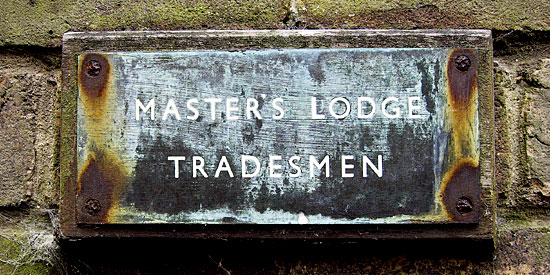
… is alive and well in Cambridge — c.f. this notice outside the Master’s Lodge at Churchill College, supposedly one of the university’s more modern colleges! Interesting that the architects didn’t think tradesmen were worth even a brass plate.