
According to BBC news, Charles Darwin’s tortoise has died, at the age of 175. Wow!
Category Archives: Asides
Etherial music
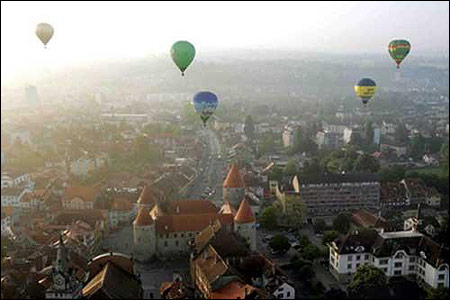
Here’s an idea to restore your faith in humanity.
Luke Jerram, a sound artist, working with international hot air balloon pilot Peter Dalby and composer Dan Jones has developed The Sky Orchestra, an ongoing research project that explores how one can perceive a sonic experience while asleep. It is an experimental artwork bringing together performance and music to create visual audio installations within the air and within the mind.
Seven hot air balloons, each with speakers attached, take off at dawn to fly across a city. Each balloon plays a different element of the musical score creating a massive audio performance that many hundreds of people experience subconsciously as the balloons fly over their homes.
Many hundreds of people experience the Sky Orchestra event live as the balloons fly over their homes at dawn. The airborne project is both a vast spectacular performance as well as an intimate, personal experience. The music is audible, both consciously and subconsciously, to all those in the balloon’s flight paths….
The residents of Stratford-upon-Avon, Will Shakespeare’s home town, were treated to this delight this morning — with the added attraction of Royal Shakespeare Company actors reading bits of the Bard’s works. One resident emailed the BBC Today programme: “If music be the food of love, I’ve got indigestion”.
Reconsidering Bill Gates
David Pogue has a thoughtful post about BillG. Excerpt:
Some people won’t be happy no matter what Mr. Gates does. They say he made the decision for P.R. value, or even as a plot to boost Microsoft’s software sales. “Interesting theory: ‘Buy Windows Vista. Do It for the Children,’” writes one critic online. “Ah, Bill, you are a shrewd weasel indeed.”)
But despite all this, and even despite Microsoft’s history, I find it almost impossible to remain cynical about Bill Gates’s intentions. I think he’s changed. Maybe when you’re in your 50’s, you start to think about how you’ll be remembered.
It’d be one thing if he were retiring to enjoy his fortune, or if he were using it to buy football teams or political candidates.But he’s not. He’s channeling those billions to the places in the world where that money can do the most good. And not just throwing money at the problems, either–he’s also dedicating the second act of his life to making sure it’s done right.
In fact, when you step back far enough, Mr. Gates’s entire life arc suddenly looks like a 35-year game of Robin Hood, a gigantic wealth-redistribution system on a global scale.
I know this is going to earn me the vitriol of Microsoft-bashers, but I’ll say it anyway: Bill Gates has the money, the brains and the connections to really, truly make the world a better place. I admire him for the attempt. And I believe that if anyone can succeed, he will.
He just might be right. David also links to Bill Moyers’s remarkable interview with Gates.
Later… One of the comments to David’s post contained a link to an interesting New Yorker article about the Gates Foundation’s work.
Homeless connectivity
Amazing Wired News story…
Living in a squalid, Woodstock-style bus parked in a Fillmore, California, orange grove, the 53-year-old homeless man charges a power generator from a utility shed and uses Wi-Fi from a nearby access point. From this humble camp, he’s managed to run a ’round-the-clock internet television studio, organize grassroots political efforts, record a full-length album and write his autobiography, all while subsisting on oranges and avocados.
He claims he created one of the first handheld computer scanners and played a major part in the data transmission industry in the early 1990s. “I’ve always been trying to stay up on internet technology,” Ivy said.
Ivy isn’t the only homeless person who makes it a priority to keep gadgets handy even when a cooked meal is hard to come by.
Many of those now living without a permanent roof over their heads have cell phones in their pockets or laptop computers at their hips. While people living in shelters and alleys have found it difficult to cross social divides, the digital divide seems to disappear on the streets. Nearly all homeless people have e-mail addresses, according to Michael Stoops, director of the National Coalition for the Homeless. “More have e-mail than have post office boxes,” Stoops said. “The internet has been a big boon to the homeless.”
Helping the homeless get e-mail addresses has been a priority for years at shelters across the country. And in an age when most every public library in the nation offers internet access, the net has proven a perfect communication tool for those without a firm real-world address.
“Because of technology, people are able to keep in contact with their families,” Stoops said. And perhaps most importantly, they are able to get some footing in society regardless of how removed from it they may feel…
Thanks to Cory & BoingBoing.
Hello Mother, Hello Friendster…
Tom Lehrer, where are you when we need you? This from today’s New York Times…
Summer camp directors have a new scourge, and it is not mosquitoes or impetigo. It is the Internet, specifically sites like MySpace, Facebook and Friendster, where young people often post personal or revealing information.
Camps say they are increasingly concerned about being identified in photographs or comments on these sites, even innocuously. They worry about online predators tracking children to camp and about their image being tarnished by inappropriate Internet juxtapositions — a mention, say, of the camp on a site that also has crude language or sexually suggestive pictures. “This is probably the No. 1 issue facing all camp programs,” said Norman E. Friedman, a partner at AMSkier Insurance, a major camp insurer.
Getting to the bottom of the car business
Most motoring journalism makes one lose the will to live. The one shining exception is the writing of the Guardian‘s Giles Smith. Here he is on the new Renault Megane Sport Hatch 2.0 165 Turbo…
The Megane was the car with which Renault pretty much singlehandedly woke up a snoozing hatchback sector. While all the dynamic designers and blue-sky thinkers had gravitated towards the SUV department, or were squeezing their brains to come up with ever more malleable family wagons with internal bike racks and fold-out summer houses, the ancient art of hatchback-building had suffered a precipitous decline, leaving only a joyless amalgam of inseparable lump-alikes and blob-u-wants, each one categorisable according to how much it did or didn’t resemble a VW Golf.Renault shook things up by producing a hatchback in which the better part of the design budget had clearly gone into resculpting the rear end, producing an unusually curvaceous back window, wrapped tight around a self-consciously plump and pert boot lid.
I don’t know whether Renault was cannily ahead of the wave here, or whether it merely lucked out. But in an age much given to low-slung jeans, pan-generational adoption of the “builder’s crease” look, and long and surprisingly academic debates about the relative merits of rears belonging to Kylie and Beyoncé, a car whose prime and unashamed asset was allegedly its “shakeable ass” did indeed look inspired.
Renault, in short, gave us the boot as booty, and a grateful and amused Europe responded by buying Meganes in millions. The idea of the car as a penis substitute is familiar to the point of cliche. But the French company was surely among the very first to explore the possibility of the car as a bottom substitute…
The social life of networks
I was offline yesterday because I was giving the Beishon Memorial Lecture at the OU and needed to focus on important matters like logistics and car parking for guests. The title of the lecture was “The Social Life of Networks” and there’s a pdf here if you’re having trouble sleeping. There will also be a webcast, but it hasn’t emerged from editing yet.
Thanks to James Miller, eagle-eyed as ever, who spotted several typos and a glaring error in a calculation!
The peacock and the petrol pump
The Silly Season’s arrived, folks. Today’s Telegraph has a sad tale about a peacock who lusts after a set of petrol pumps.
The bird has fallen deeply in love with a row of pumps which make clicking noises similar to those of a broody peahen.
For the past three years the eight-year-old has taken to walking from his woodland home to Brierley Service Station in the Forest of Dean, Glos, to parade his plumage to the row of diesel, unleaded and LRP pumps.
But the pumps never succumb to his overtures and Mr P is left to roost alone.
“In spring he gets his tail feathers and he goes looking for love,” explained the bird’s owner, Shirley Horsman, a former nurse.
“He gets very amorous and the clicking of the petrol pumps makes the same noise as a peahen crying ‘Come on, I’m ready’! Every time he hears someone filling up he thinks he’s on to a good thing. It must be so hard for him listening to these pumps giving him the ‘come-on’ all day long.”
Aw, shucks. It seems that each morning, Mr P is waiting outside the filling station when it opens at 6.30am. Sometimes he spends up to 18 hours at the garage.
“He goes all day, every day, in the breeding season,” said Mrs Horsman. “He just minds his own business, and looks forlornly at the petrol pumps. It’s quite sad really.
Not at all. It confirms my theory that the more concerned a male is about his appearance, the more ridiculous he is likely to be. I first formulated this hypothesis in the 1970s while sitting in a pavement cafe in an Italian town in the early evening and watching preening young male natives strutting about.
The English football bubble
I know nothing about football, so generally keep quiet on the subject. But I have watched some of the World Cup matches and was struck by the fact that the England side seem, well, terribly pedestrian in comparison with the Argentinians or even the Swedes. So where, I wondered, did all the guff about England being likely winners come from? And then I thought: well, what do I know about it?
But now, here is someone who does know about it — Richard Williams of the Guardian, and here’s what he had to say this morning:
As the England squad made their way to a final training session in Nuremberg on the eve of their match against Trinidad & Tobago, their coach was escorted by eight police motorcycle outsiders, six police cars and one helicopter. At each road junction a couple of policemen held up the traffic for a full five minutes before the coach passed through, creating a cacophony of horn-blowing from irritated motorists whose lawful progress had been delayed by the transportation of what currently appears to be the most overrated and underperforming team at this World Cup.
That is the sort of bubble in which the England party exists. Goodness knows how much the Football Association has spent on providing the ultimate in de luxe quarters, transportation and security for the 23 players, the platoon of wives and girlfriends, and the battalion of support staff. The media, too, are the grateful beneficiaries of the FA’s lavish attention to detail, welcomed each day to a vast purpose-built centre next to the training pitch and featuring air conditioning, wireless internet access, TV screens, comfortable sofas and a plentiful supply of excellent food.
The contrast with other nations is extreme. At Argentina’s hotel, for instance, the daily press conferences are conducted in a medium-size room equipped with three trestle tables and a dozen or so bottles of mineral water.
Their coach, when it arrives from training, is accompanied by one police motorcyclist and one police car. You would never know that Argentina have won the World Cup twice to England’s once and are rather more likely, on current form, to win it again. What does this have to do with football? Nothing that could be measured with ProZone equipment, perhaps, but quite a lot in less tangible terms, if one looks at the way England played in the opening matches, and particularly in the first hour against Trinidad & Tobago, when Sven-Goran Eriksson’s starting XI — his first-choice team, with the exception of Wayne Rooney and Gary Neville — performed like a side whose bad days had all come at once.
As we have seen so many times in the past, England gave the impression of believing that they had only to turn up and the day would be theirs. It is not a question of laziness or absence of willpower; these are honest men, trying to do their honest best. But they have been seduced by their own celebrity into a delusory view of the nature of their task…
Thanks to Andrew, who pointed out that it was Richard, not (as I had said) Frank Williams who was the writer of the piece.
That Phoenix cover

Apropos my earlier post, Dave Hill (from whom nothing is hidden) found a jpeg.