Important health news

Tech Review reports that

Two weeks ago, Harvard researchers reported that high doses of resveratrol, a compound found in red wine, extend the life span of obese mice on a high-fat diet and keep them as healthy as mice on a normal diet … Their study suggested that resveratrol activates the molecular mechanisms thought to control aging–a good sign for pharmaceutical companies hoping to influence these pathways in order to treat the diseases of aging, from diabetes to cancer…

Pardon me, I’m just popping out to the health store for some resveratrol supplements.

Understanding terrorism: a 12-point primer

Louise Richardson is a Harvard professor who has been teaching about terrorism for a decade, and who had always thought it wise for academics to stay out of politics. But the boneheadedness of the Bush regime, which has ignored decades of accumulated wisdom on her subject, prompted her to write a belated primer.

The result is, according to Max Rodenbeck’s review in the current issue of the New York Review of Books, “a book that reads like an all-encompassing crash course in terrorism: its history, what motivates it, and the most effective ways of treating it.”

Rodenbeck offers a summary of a dozen of her basic points. Here’s my distillation of his distillation.

1. Terrorism is anything but new. Violence by nonstate actors against civilians to achieve political aims has been going on for a long, long time.

2. Terrorism is obviously a threat, and the deliberate killing of innocent civilians an outrage, but it is not a very big threat. Six times more Americans are killed every year by drunk drivers than died in the World Trade Center. (And more Americans have now died in Iraq and Afghanistan.) Excepting a few particularly bad years, the annual number of deaths from terrorism worldwide since the late 1960s, when the State Department started record-keeping, is only about the same as the number of Americans who drown every year in bathtubs.

3. The danger from terrorist use of so-called weapons of mass destruction is not as large as scaremongers profess.

4. Many terrorists are not madmen. The choice to use terror can be quite rational and calculated.

5. Groups that commit terrorism, in many cases, believe they are acting defensively, using the most effective means at their disposal. Their justifications can be self-serving and morally repugnant, but are often carefully elaborated. It is, Richardson emphasizes, important to distinguish these differing approaches, since they suggest different remedies.

6. Suicide attacks can also represent a rational policy choice. They are cheap. They can be a means of access to difficult targets. They are effective in frightening people, and in advertising the seriousness and devotion of those who undertake them.

7. There is no special link between Islam and terrorism. Most major religions have produced some form of terrorism, and many terrorist groups have professed atheism.

8. Electoral democracy does not prevent terrorism, which has flourished in many democracies, typically being used by groups representing minorities who believe the logic of majority rule excludes them. The Basque separatist group ETA and Greece’s November 17th urban guerrillas started under dictatorships, but continued their attacks following transitions to democracy in both countries.

9. Democratic principles are no impediment to prosecuting terrorists. On the contrary they are, Richardson asserts, “among the strongest weapons in our arsenal.”

10. Military action is sometimes necessary to combat terrorism, but it is often not the best way to do so.

11. Armies, in fact, often create more problems than they solve. When Britain sent its army into Northern Ireland in 1969 in response to the Troubles, it took just two years for the majority of Catholics, who were at first relieved by their presence, to turn against them. The turnaround for the US in Iraq was far shorter.

12. To address the issues terrorists say they are fighting for cannot automatically be dismissed as appeasement.

Rodenbeck goes on:

Because terrorists tend to be aspirational rather than practical, their practices typically amount to what Ms. Richardson calls a search for the three R’s of terrorism: revenge, renown, and reaction. As she puts it, “the point of terrorism is not to defeat the enemy but to send a message.” This simple insight is important, because it suggests ways of dealing with terrorism: you must blunt the impulse for revenge, try to limit the terrorists’ renown, and refrain from reacting in ways that either broaden the terrorists’ appeal or encourage further terrorism by showing how effective their tactics are.

Richardson’s three R’s go a long way toward explaining why American policy has become so disastrously askew. As she notes, an act such as September 11 itself achieves the first of her three R’s, revenge. So spectacularly destructive an attack also gains much of the second objective, renown. But the Bush administration’s massive and misdirected overreaction has handed al-Qaeda a far greater reward than it ever dreamed of winning.

“The declaration of a global war on terrorism,” says Richardson bluntly, “has been a terrible mistake and is doomed to failure.” In declaring such a war, she says, the Bush administration chose to mirror its adversary:

Americans opted to accept al-Qaeda’s language of cosmic warfare at face value and respond accordingly, rather than respond to al-Qaeda based on an objective assessment of its resources and capabilities.

In essence, America’s actions radically upgraded Osama bin Laden’s organization from a ragtag network of plotters to a great enemy worthy of a superpower’s undivided attention. Even as it successfully shattered the group’s core through the invasion of Afghanistan, America empowered al-Qaeda politically by its loud triumphalism, whose very excess encouraged others to try the same terror tactics.

By this criterion, today’s Queen’s Speech setting out Tony Blair’s last legislative programme — which is obsessed with ‘security’ — amounts to another massive puff for bin Laden.

G’day Bill; pardon me while I strain the potatoes

Microsoft Office 2007’s dictionary will recognise Australian colloquialisms such as g’day, sheila, bogan and dag. Microsoft said that 24,000 Australians voted in an online poll on its website for the 20 Aussie words they felt were most culturally relevant. G’day led the pack with 2868 votes, following by sickie with 2152 votes, ute (1912), trackies (1597) and bogan (1557).

Previously, when typed into Microsoft Word, all of these words appeared with a red line under them, indicating a spelling error. Tony Wilkinson, information worker business group director at Microsoft Australia, said the reason for incorporating the above “quintessential Aussie vernacular” into Office 2007 was to make the software more user-friendly for Australians.

“Although many Australian words and spellings are alreadyincluded in Microsoft Office, we saw the upcoming release of the 2007 Microsoft Office system as the ideal opportunity to make sure the Aussie classics weren’t forgotten and new Aussie words were added,” he said.

Online voters got to pick from a shortlist of 41 words, compiled by a panel of local language experts including David Blair, the founding member of Macquarie Dictionary’s editorial committee. “Australia has a unique cultural background and, as a result, there are a number of Australianisms in our language,” he said, praising Microsoft for its recognition of Australian culture.

[Source: Sydney Morning Herald]

The Great Revulsion

In the run-up to the mid-term elections I was puzzled by why UK media outlets were regularly consulting an odious, right-wing fanatic called Grover Norquist.

Just reading Paul Krugman’s reaction to the electoral results makes me even more puzzled. He mentions our friend Norquist:

I’m not calling for or predicting the end of conservatism. There always have been and always will be conservatives on the American political scene. And that’s as it should be: a diversity of views is part of what makes democracy vital.

But we may be seeing the downfall of movement conservatism — the potent alliance of wealthy individuals, corporate interests and the religious right that took shape in the 1960s and 1970s. This alliance may once have had something to do with ideas, but it has become mainly a corrupt political machine, and America will be a better place if that machine breaks down.

Why do I want to see movement conservatism crushed? Partly because the movement is fundamentally undemocratic; its leaders don’t accept the legitimacy of opposition. Democrats will only become acceptable, declared Grover Norquist, the president of Americans for Tax Reform, once they “are comfortable in their minority status.” He added, “Any farmer will tell you that certain animals run around and are unpleasant, but when they’ve been fixed, then they are happy and sedate.”

Norquist is famous for his desire to shrink government “down to the size where we can drown it in the bathtub.” According to his Wikipedia entry, “his close business and political ties to recently indicted lobbyist Jack Abramoff are the subject of a current federal investigation.”

Diplomatic notices


BRITISH CONSULATE
Basra: Iraq

Opening Times

SUICIDE BOMBINGS
9.30am – 3.30pm
Monday to Friday

Those wishing to bomb the
Consulate outside those hours
must apply in writing at least
two weeks before they hope
to embark on their journey to
paradise.

MORTAR ATTACKS
11.00am – 2.00pm
Monday/Wednesday/Friday

No incoming mortar attacks
will be accepted outside these
times.

From this week’s Private Eye.

Pot-luck supper

I avoided the Society of Editors’ Grand Gala Dinner by going home. (I had work to do.) But the conscientious Roy Greenslade went — and later wondered why. Here is an excerpt from his report:

It is always difficult to grasp quite what these annual dinners are about, but last year’s in Windermere was relieved by an entertaining speech from Melvyn Bragg. I also remember that there were mercifully short speeches of welcome. Oh, how we ached for Melvyn during last night’s dreary non-event.

The Lord Provost of Glasgow, Liz Cameron, spoke well enough but for so long we were in danger of fainting from hunger because the woman just didn’t know when to stop. I think we got the message. Glasgow has changed and is changing… our newspapers – The Herald and the Evening Times are terrific… this art gallery is a palace of dreams. Indeed it was for the several sensible people who had fallen asleep.

A speech by the Scottish First Minister, Jack McConnell, was so insufferably stilted and stuffy that we wondered how he had ever got elected. (In the cab later a Scottish delegate explained in his defence that he was great behind the scenes. Fine. Let him stay there then). But McConnell was a mere warm-up act for the most stunningly dull “address” I can recall.

Sebastian Coe, chairman of the 2012 Olympics organisation, spoke without imparting a single intelligent thought. I tried to take notes but he said nothing of any consequence whatsoever, and he said it several times over. It was unrelieved by wit or wisdom and was heard in total silence by a now disbelieving crowd…

Electronic Voting Machines

From Scott Adams’s The Dilbert Blog

Years ago when I worked at a big bank, one of the hot issues was that many customers didn’t trust our new-fangled ATM machines. Amazingly, this fear had almost nothing to do with the fact that I worked in the ATM department. Indeed, my suggestion to include a paper shredder hole right next to the deposit hole was barely even considered. In the end, ATMs rarely stole anyone’s money and kept it for long. Now most people trust ATMs.

I think about the history of ATMs when I hear all the nervous Nellies wetting their pants over electronic voting machines. I believe those worries are totally misplaced. Now don’t get me wrong – there’s a 100% chance that the voting machines will get hacked and all future elections will be rigged.  But that doesn’t mean we’ll get a worse government. It probably means that the choice of the next American president will be taken out of the hands of deep-pocket, autofellating, corporate shitbags and put it into the hands of some teenager in Finland. How is that not an improvement?

Statistically speaking, any hacker who is skilled enough to rig the elections will also be smart enough to select politicians that believe in . . . oh, let’s say for example, science. Compare that to the current method where big money interests buy political ads that confuse snake-dancing simpletons until they vote for the guy who scares them the least. Then during the period between the election and the impending Rapture, that traditionally elected President will get busy protecting the lives of stem cells while finding creative ways to blow the living crap out of anything that has the audacity to grow up and turn brownish…

Thanks to Boyd Harris for the link.

Brillo Pad rides again!

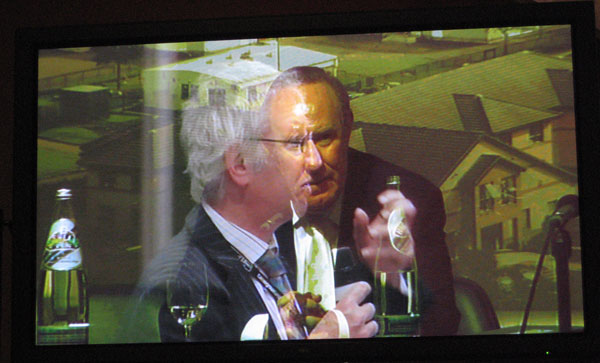
Andrew Neil (aka Brillo Pad) gave the Keynote Address to the Society of Editors conference. This picture was taken just as the TV director was switching from a questioner (standing) back to BP.

His Address was an entertaining farrago of insights, half-truths and thinly-veiled attacks on his enemies. It went like this:

New media bring challenges… time for a new mindset…an opportunity not a threat…all technological change brings upheaval…much to be positive about… bad news only for red top tabloids… the Guardian has used the web astutely to reinvent the Guardian brand… Sunday Times is selling more copies today than it did under his editorship…the Economist is doing brilliantly… the FT is thriving again, showing what can be done when a newspaper comes to terms with the Net…journalists who are so good at lecturing others about the need to adapt to disruptive change are not very good at learning to live with it themselves…the days of spending the day working on a piece, filing it just before five and heading off to the pub are over…all media organisations must become 24×7 operations…’reach’ is the key to getting a true measure of our proposition… 38% of people’s leisure time now spent online (more than watching TV) but 38% of advertising spend hasn’t followed it — yet: but that will change as advertisers follow the eyeballs…Google now has more ad revenue than ITV… but Google is growing fat on the backs of poor unpaid journalists and their employers … time for a conversation with Google about this matter …need for a new breed of journalist … journalists will become brands in their own right… broadband has transformed the Net into a multimedia channel… there’s a premium on moving-picture ads…. newspapers must get into that… there’s never been a better time to be a journalist… these new journalist-brands “will write blogs because you wouldn’t give them a column, and then they’ll sell the Blog back to you for an inflated price”…

He finished off with some incomprehensible score-settling about the Scottish Media Group, the Scotsman, the Herald and the unalloyed stupidity of the Scottish political class.

In questioning, he revealed that he had bought Handbag.com for £300,000 and sold it a short time later for £22 million.

Update… Roy Greenslade is also at the conference. Here’s his Blog’s take on Brillo Pad.

Base camp

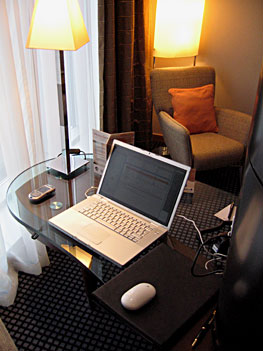
Just checked in to the Radisson in Glasgow, where I’m speaking at the UK Society of Editors’ conference. First thing I looked for, naturally, was (free) broadband — and it’s provided. Quite fast, too. Just the ticket.