Amazon.com’s Best of 2006. Hottest selling products in a range of categories. Intriguing to see that in “Health and Personal Care” Pampers Cruisers (various sizes) come top!
Category Archives: Asides
A new interpretation of dreams
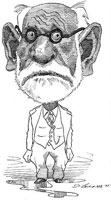
Hmmm… This is interesting.
Maybe it was just a Freudian slip. Or a case of hiding in plain sight.
Either way, Sigmund Freud, scribbling in the pages of a Swiss hotel register, appears to have left the answer to a question that has titillated scholars for much of the last century: Did he have an affair with his wife’s younger sister, Minna Bernays?
Rumors of a romantic liaison between Freud and his sister-in-law, who lived with the Freuds, have long persisted, despite staunch denials by Freud loyalists. The Swiss psychoanalyst Carl Gustav Jung, Freud’s disciple and later his archrival, claimed that Miss Bernays had confessed to an affair to him. (The claim was dismissed by Freudians as malice on Jung’s part.) And some researchers have even theorized that she may have become pregnant by Freud and have had an abortion.
What was lacking was any proof. But a German sociologist now says he has found evidence that on Aug. 13, 1898, during a two-week vacation in the Swiss Alps, Freud, then 42, and Miss Bernays, then 33, put up at the Schweizerhaus, an inn in Maloja, and registered as a married couple, a finding that may cause historians to re-evaluate their understanding of Freud’s own psychology.
A yellowing page of the leather-bound ledger shows that they occupied Room 11. Freud signed the book, in his distinctive Germanic scrawl, “Dr Sigm Freud u frau,” abbreviated German for “Dr. Sigmund Freud and wife.”
“By any reasonable standard of proof, Sigmund Freud and his wife’s sister, Minna Bernays, had a liaison,” wrote Franz Maciejewski, a sociologist formerly at the University of Heidelberg and a specialist in psychoanalysis, who tracked down the record in August.
Freud’s wife, Martha, knew about his trip with Miss Bernays, if not its nature. The same day Freud signed the hotel ledger, he sent his wife a postcard rhapsodizing about the glaciers, mountains and lakes the pair had seen. In the card, published in Freud’s collected correspondence, he described their lodgings as “humble,” although the hotel appears to have been the second-fanciest in town.
The evidence is persuasive enough for Peter Gay, the Freud biographer and longtime skeptic on what he called “the Minna matter,” to say that he is now inclined to revise his work accordingly.
“It makes it very possible that they slept together,” he said. “It doesn’t make him or psychoanalysis more or less correct.”
Quite so. But interesting nonetheless. Wonder what Woody Allen makes of it.
Thanks to Gerard for the link.
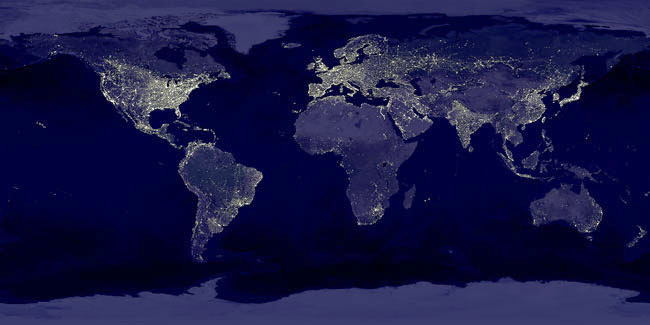
Planet Earth: the Santa Claus perspective
The Blair ‘legacy’
Anthony Seldon had an extraordinary piece about Tony Blair in the Guardian. The headline — “Whatever the Brownites say, history will judge Blair as a political colossus” — says it all. Andrew Rawnsley — typically — tries to have it both ways in this morning’s Observer, arguing that while Blair has been a disaster, he will get his ten years in Downing Street and thereby join a select Pantheon whose other members are Robert Walpole, Henry Pelham, Lord North, William Pitt, Lord Liverpool, William Gladstone, Lord Salisbury and Margaret Thatcher.
David Marquand has written an elegant riposte to this baloney. It reads, in part,
Iraq was not a minor peccadillo, as Seldon seems to think. It was a monumental, unmitigated disaster, for which Blair is as much to blame as Bush. The shabby tergiversations of the run-up to the war – the misuse of intelligence, the contempt for expert opinion, the disdain for international law and the collusion with the United States in shutting down the Blix investigation of alleged Iraqi WMD – were venial in comparison with the sequel. The endemic conflicts of the Middle East are more explosive than they were. Jihadist extremism is more widespread and more bloodthirsty.
Iraq itself is slithering into civil war. Iran’s rise to regional super-power status has received an enormous boost. The chances of a just settlement of the Israeli-Palestinian crisis are smaller. Innocent British civilians are in greater danger. And all of this was entirely predictable. The charge against Blair is not so much that he acted illegally and immorally (though he did) as that he hitched his wagon to a US administration of swivel-eyed fanatics, consumed by a messianic fever and utterly ignorant of the realities of one of the most complex regions in the world. It was worse than a crime. It was a blunder for which we shall pay even more dearly in future than we have already.
So why did he do it? It would take a psychiatrist to answer that question fully. But two preliminary answers stand out. The first is that the flip side of Blair’s magical persuasive abilities is, and always has been, an extraordinary capacity for self deception. As Seldon’s own biography of him shows, he has always been apt to mistake his wishes for facts. Like the great actor he is, he lives whatever part he is playing; and if reality gets in the way, so much the worse for reality. The second answer is simpler. Like many people who have been at the top for to long he has succumbed to hubris. The bad news is that nemesis has struck his country as well as himself. The good news is that a merciful release is on its way.
I plump for the second explanation. Indeed I wrote about it last year. All Prime Ministers go mad, eventually, and the longer they server, the madder they become.
A slow business day
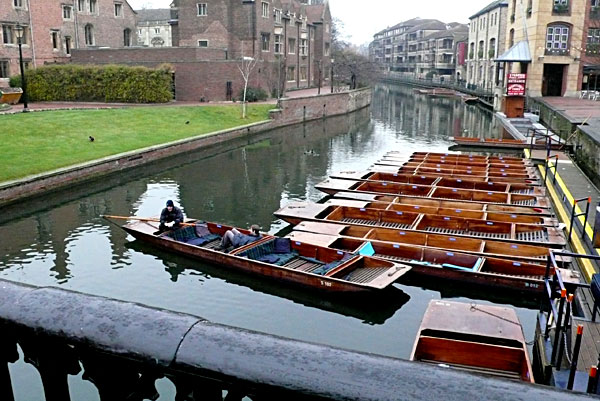
Disconsolate punt-chauffeurs on the river Cam this morning.
Sensation! British bank responds to customer needs!
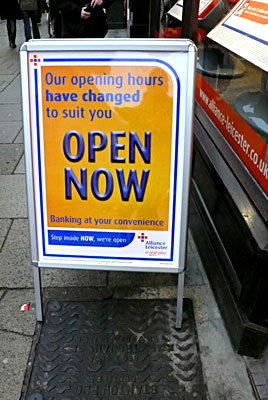
Sacre Bleu! A British bank paying attention to its customers. Whatever next?
Photographed in Cambridge this (Saturday) morning.
The ideal place to spend Christmas
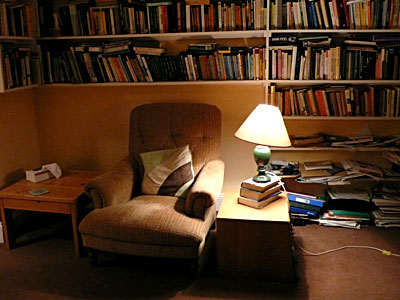
In a comfortable armchair, surrounded by all those books that Amazon delivered but one hasn’t yet had time to read.
After Google Earth — what?
Why Google Galaxy of course…
Google is extending its reach to the stars in an agreement with Nasa that will allow it to present web visualisations of the US space agency’s data on the universe. Nasa’s Ames Research Center in Silicon Valley on Monday announced a “Space Act Agreement” with Google that would include collaboration on large-scale data management and massively distributed computing as well as focusing on making the most useful of Nasa’s information available over the internet.
The agreement follows Google’s decision last year to build a 1m square foot campus in a science park linked to the research centre.There are plans for real-time weather visualisation and forecasting, high-resolution 3-D maps of the moon and Mars and real-time tracking of the International Space Station and the space shuttle.
Google Earth, the software programme that maps the planet, will incorporate Nasa data into future releases.“This agreement between Nasa and Google will soon allow every American to experience a virtual flight over the surface of the moon or through the canyons of Mars,” said Michael Griffin, Nasa administrator…
Hmmm….I’ve always wanted to go to Mars.
Computers in the Movies
How many times have you groaned at the ludicrous ways in which computers are portrayed in movies? Jakob Nielsen has had the great idea of doing an analysis of some of the biggest howlers.
Here’s a condensed version…
1. The Hero Can Immediately Use Any UI
Break into a company — possibly in a foreign country or on an alien planet — and step up to the computer. How long does it take you to figure out the UI and use the new applications for the first time? Less than a minute if you’re a movie star.
The fact that all user interfaces are walk-up-and-use is probably the single most unrealistic aspect of how movies depict computers. In reality, we know all too well that even the smartest users have plenty of problems using even the best designs, let alone the degraded usability typically found in in-house MIS systems or industrial control rooms.
2. Time Travelers Can Use Current Designs
An even worse flaw is the assumption that time travelers from the past could use today’s computer systems. In fact, they’d have no conception of any of modern technology’s basic concepts, and so would be dramatically more stumped than the novice users we observe in user testing. Even someone who’s never used Excel at least understands the general idea of computers and screens.
[…]
If you were transported back in time to the Napoleonic wars and made captain of a British frigate, you’d have no clue how to sail the ship: You couldn’t use a sextant and you wouldn’t know the names of the different sails, so you couldn’t order the sailors to rig the masts appropriately. However, even our sailing case would be easier than someone from the year 2207 having to operate a current computer: sailing ships are still around, and you likely know some of the basic concepts from watching pirate movies. In contrast, it’s highly unlikely that anyone from 2207 would have ever seen Windows Vista screens.3. The 3D UI
In Minority Report, the characters operate a complex information space by gesturing wildly in the space in front of their screens. As Tog found when filming Starfire, it’s very tiring to keep your arms in the air while using a computer. Gestures do have their place, but not as the primary user interface for office systems…
4. Integration is Easy, Data Interoperates
In movieland, users have no trouble connecting different computer systems. Macintosh users live in a world of PCs without ever noticing it (and there were disproportionally more Macs than PCs in films a decade ago, when Apple had the bigger product-placement budget)…
5. Access Denied / Access Granted
Countless scenes involve unauthorized access to some system. Invariably, several passwords are tried, resulting in a giant “Access Denied” dialog box. Finally, a few seconds before disaster strikes, the hero enters the correct password and is greeted by an equally huge “Access Granted” dialog box.
A better user interface would proceed directly to the application’s home screen as soon as the user has correctly logged in. After all, you design for authorized users. There’s no reason to delay them with a special confirmation that yes, they did indeed enter their own passwords correctly…
6. Big Fonts
In addition to the immense font used for “Access Denied” messages, most computer screens in the movies feature big, easily readable text. In real life, users often suffer under tiny text and websites that add insult to injury by not letting users resize the words.
This is just a digest. Worth reading in full.
The rich are different from us
It’s true: they have no taste. Only Mohamed Al Fayed comes close.