
Provided you wrap up warmly. Seen on campus on Wednesday.

Provided you wrap up warmly. Seen on campus on Wednesday.
Readers with long memories will remember the moment when, as his administration was sliding into chaos, John Major revealed in an interview that he sometimes tucked his shirt into his underpants. This interesting sartorial detail was instantly fastened upon by the Guardian‘s Steve Bell, who from then on always portrayed Major with his Y-fronts outside his suit. Well, guess what?
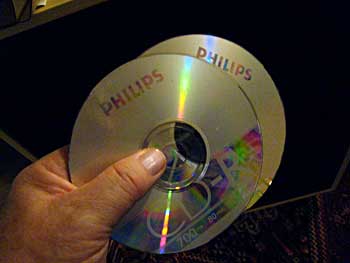
Here’s a thought: since HM Government is currently short of two CDs, why don’t we all send a couple of blank disks to Gordon Brown, 10 Downing Street, Whitehall, London SW1? By Recorded Delivery, naturally. We wouldn’t want them to get lost in the post, now would we?
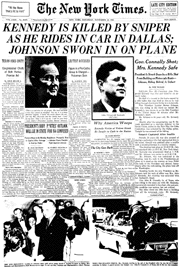
… in 1963.
Today marks the 30th anniversary of the first TCP/IP message exchange between three networks. It was orchestrated from this van.
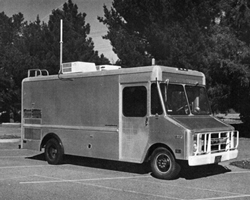
The exchange took place between SRI International, Menlo Park and the University of Southern California via London, England. The networks involved were the ARPANET, the Bay Area packet radio network, and the Atlantic packet satellite network.
This inter-network transmission among three dissimilar networks is generally regarded as the first true Internet connection. It was also a major milestone in packet radio, the technology behind WiFi and other kinds of wireless internet access.
On November 7, the Computer History Museum and the Web History Center held a special celebration of the moment with contributions from Vint Cerf, Bob Kahn and Donald Nielson.
This is lovely.
Today I want to ponder the question: what if Microsoft, not Google, had created Gmail? What would be the differences in that web mail client for users today? What if we apply some of the same design rules that brought us Hotmail, for instance?
Read on. Great illustrations. Reminds me of the spoof put together by Microsoft folks meditating on what the iPod packaging would be like if done by Redmond.
Er, that’s what it says here…
Blonde women really do make men lose their heads, according to scientists.
Tests showed that men performed worse after they were shown pictures of fair-haired women, most likely because they believed they were dealing with someone less intelligent.
Researchers concluded that rather than simply being distracted by the golden hair, the men were subconsciously copying the stereotype of the “blonde bimbo”.
Academics at the University of Paris X-Nanterre examined men’s ability to complete general knowledge tests after exposure to women with different hair colours.
Throughout both trials, those participants exposed to blondes recorded the lowest scores.
“This proves that people confronted with stereotypes generally behave in line with them,” said Thierry Meyer, joint author of the study and professor of social psychology at the university.
“In this case blondes have the potential to make people act in a dumber way, because they mimic the unconscious stereotype of the dumb blonde.”
Now that’s what I call research. I’ve always wondered what went on at the University of Paris X-Nanterre. And is there a University of Paris IX-Nanterre?
Hmmm… This Newsweek.com piece has made me wonder if I’m right to dismiss Amazon’s Kindle gizmo as just another e-reader to add to the pile of earlier attempts to supplant the printed book.
Later: Having read Nick Carr’s piece, I think I’ll just add it to the heap.
Later still: Martin Weller is less critical.

That’s the title of the lecture John Lloyd is giving in Cambridge tomorrow to mark the 25th Anniversary of the Wolfson Press Fellowship Programme. John is now Director of Journalism Studies at the Reuters Institute in Oxford, but he’s done a lot of other things in his time. He was, for example, Founding Editor of the Financial Times Magazine, and now writes a weekly column about television. He has been a contributing editor at the Financial Times, reporter and producer for London Weekend Television’s London Programme and Weekend World, and editor of Time Out and the New Statesman magazines. He has written several books including “What the media are doing to our politics”. He also recently co-edited (with Jean Seaton) a special issue of the Political Quarterly entitled What Can Be Done?: Making the Media and Politics Better.
Lecture details here. All welcome. Please email press [at] wolfson.cam.ac.uk if you intend to come.
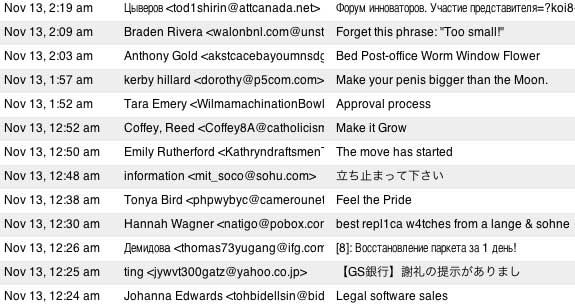
One of the many advantages of using Pobox as my email hub is its wonderful spam filter. Occasionally, though, it blocks a legit message, so I periodically have to skim through the piles of ‘discards’ it has blocked. It’s interesting to see the changing patterns of spam. The pump-and-dump, penis-enlargement and fake Rolex salesmen are still, er, hard at it. But there’s an increasing amount of incomprehensible Cyrillic guff. Putin’s Russia continues to develop along predictable lines.