Money can’t buy you love but…

… it can buy you a yacht.

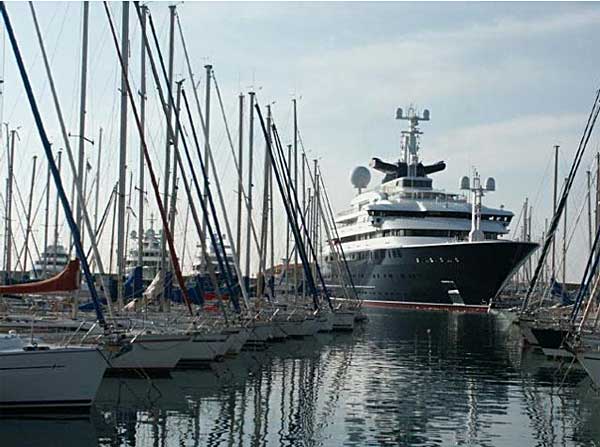
This is Microsoft co-founder Paul Allen’s boat, trying to dock at Antibes. I first heard about it on Stephen Heppell’s phone blog, and followed the link to the pdf brochure. It’s called Octopus and is allegedly the world’s largest privately-owned yacht. It cost Allen over US$200 million and has a permanent crew of 60, including several former Navy Seals.

The vessel has two helicopters, seven boats, a 10 man submarine and a remote controlled vehicle for crawling on the Ocean floor. The submarine has the capacity to sleep eight for up to two weeks underwater. (Er, why would anyone want to sleep for eight weeks underwater?)

According to the brochure, on average, owners must spend a minimum of 10 percent of the purchase price every year to keep these yachts in good working condition and cover crew salaries. Therefore “Octopus” requires a US$20 million annual budget.

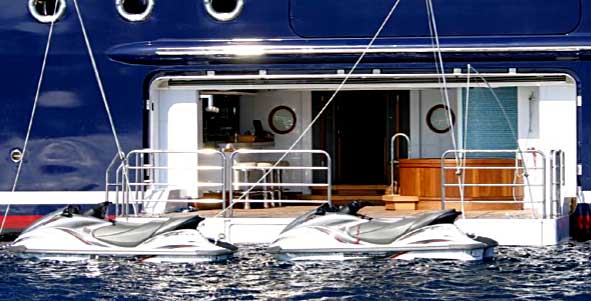
I’m sure that all those dedicated Windows users will be delighted to see that their license fees are being so well spent. Here, for example, is the ‘Starboard Bar and Spa’.

So tasteful, don’t you think? And how thoughtful to include a hot tub.

Cityphilia

John Lanchester has a lovely piece in the latest London Review of Books about Cityphilia — worship of the City of London and its pernicious effects on London in particular.

This uncritical and uninformed governmental Cityphilia, he writes,

received its biggest shock in decades this autumn, with the near collapse of Britain’s fifth largest mortgage lender, Northern Rock. Britain’s first genuine bank run in more than a hundred years shone a light in many places where the sun doesn’t routinely shine, and one of the first things to be brought into question was the ways banks work. As I’ve already said, my father was a banker, and I grew up hearing about that mythical beast, the bank run. It was often spoken of but rarely seen in the wild. Bankers are said to dread a bank run, but my dad talked about them with a certain black humour. They were always a sign that somebody had fucked up, big-time. They can also be a sign that something in the financial system is fundamentally wrong. The question hanging around in the residue of the Rock’s near implosion is which type of bank run this was – a fuck-up, or a harbinger of meltdown?

It’s a great piece. Here’s the opening para:

At the point when we bought our house in 1996, average house prices in the UK, adjusted for inflation, were some way below the levels they’d hit in the late 1980s bubble. Clapham was then still a place people moved to when they had families and wanted larger and cheaper houses, and were willing to move south of the river to get them. When house prices began to go up, this area began to be colonised by bankers and City types. We were the last non-City people to move into the street where we live – the last of the aborigines. These days, as houses become an ever more critical capital asset, there is a constant va-et-vient of renovation, a non-stop turmoil of attics being done, basements being dug out, skips being filled, scaffolding put up and everything knockable being knocked through. In a street two hundred metres long, there is at the moment one skip, three sets of scaffolding, two basement conversions, a loft conversion and two full renovations. Most of this activity is generated by the City people, since we aborigines for the most part tend not to move; we’re all still here. But the bankers move all the time, doing up and selling on houses, usually to move to the Old Rectory in Shaghampton, Wiltshire, with the husband spending three or more nights in town until the inevitable happens. (‘Half of my business is “The Old Rectory, Wiltshire”,’ a cheerful divorce lawyer once told me.)

Worth reading in full. Can’t find Shaghampton on Google Maps, though. Pity. But a Google search for it already returns one hit — the LRB article.

Narcissism 2.0

Like many people, I subscribe to Jakob Nielsen’s ‘Alertbox’ newsletter, partly because it’s good for the soul to be annoyed by people with whom one often disagrees, and partly because he sometimes has interesting things to say. (The current issue argues that “Web 2.0 can be dangerous”, btw.)

I’ve just noticed that his site includes a link to a page of downloadable hi-res photographs of the great man. There are, er, 61 such photographs.

No hiding lights under bushels there, then.

IBM now has 73,000 employees in India

Wow! Technology Review reports that

IBM Corp.’s expansion in developing countries shows no sign of relenting. The technology company revealed Friday that it now has 73,000 employees in India, almost a 40 percent leap from last year.

IBM did not provide updated figures for its work force in the U.S., which has held steady around 125,000 people in recent years.

Nor did IBM project its total head count. It had 355,766 employees worldwide at the end of 2006.

If the total has risen by the same rate as in 2006, almost one in five IBM workers now is in India, its second-largest center…

Harvard changes tack

Interesting FT.com column by Christopher Caldwell about Harvard’s change of strategy on student support.

This week, Harvard announced a new financial aid system that will revolutionise the economics of American undergraduate education. Henceforth, students whose families earn up to $180,000 a year will pay no more than 10 per cent of that income to Harvard. Loans will be eliminated from financial aid packages and replaced with outright grants. Home equity will not be taken into account in determining contribution levels. It is a great step forward from the Harvard I attended in the 1980s. Whether it is a step forward for American society is harder to gauge.

The money needed to get this new programme up and running – about $22m – is a drop in the bucket for Harvard. Its $35bn endowment makes it (if we compare Harvard’s assets with various gross domestic products) a mightier economic force than Syria or Bulgaria or the Dominican Republic. Last year, the Harvard portfolio earned a 23 per cent return overall. At those rates Harvard’s largesse can be paid for with about four days’ worth of interest on the interest.

Classic images

This shot of a cheeky lad snapped in the Rue Mouffetard in 1954 by Henri Cartier-Bresson is my favourite picture. Now I discover that it was the photographer’s least favourite picture! At any rate, this is what John Banville writes in his review of Magnum Magnum, the anniversary collection of work by Magnum photographers:

Taste is a strange thing, and again and again throughout Magnum Magnum one is surprised by what seem not so much contrasts as head-on collisions. In a brief introductory essay Gerry Badger wonders what might be the quintessential Magnum image. He decides on Henri Cartier-Bresson’s picture of ”that wonderfully cheeky Parisian urchin cradling two bottles of wine”. It is ironic, therefore, to recall that when, a couple of years before his death, I mentioned this very snapshot to HCB, he threw his hands in the air and cried out as if in pain: ”Terrible! Terrible! I should destroy the negative!”

Just goes to show: great minds seldom think alike.

Review of the day

From Matt Williams’s review of the Bic Crystal ballpoint pen that he purchased from Amazon.co.uk…

Since taking delivery of my pen I have been very happy with the quality of ink deposition on the various types of paper that I have used. On the first day when I excitedly unwrapped my pen (thanks for the high quality packaging Amazon!) I just couldn’t contain my excitement and went around finding things to write on, like the shopping list on the notice board in our kitchen, the Post-it notes next to the phone, and on my favourite lined A4 pad at the side of my desk.

My pen is the transparent type with a blue lid. I selected this one in preference to the orange type because I like to be able to see how much ink I have left so that I can put in another order before I finally run out.

When the initial excitement of taking delivery of my new pen started to wear off I realised that I shouldn’t just write for the fun of it, this should be a serious enterprise, so by the second day of ownership I started to take a little more care of what I wrote. I used it to sign three letters, and in each case was perfectly happy with the neatness of handwriting that I was able to achieve.

I have a helpful tip for you that you might not know about – if you let the ink dry for a few seconds you can avoid the smudging that sometimes happens if you rub the ink immediately after writing. Fortunately the ink used in this particular Bic pen seems to dry very quickly.

On the third day of ownership I went on a trip to London and took my pen carefully packed away in my brief case, but I needn’t have worried, this isn’t some temperamental ink pen that leaks when you store it at the wrong angle. I sat at my meeting and confidently removed the cap from my pen and it wrote flawlessly, almost immediately…

Interestingly, “1,408 of 1,417 people” found his review “helpful”. Who said irony was dead?

Google: Knol thyself

Google is taking aim at Wikipedia…

Google Knol is designed to allow anyone to create a page on any topic, which others can comment on, rate, and contribute to if the primary author allows. The service is in a private test beta. You can’t apply to be part of it, nor can the pubic [sic] see the pages that have been made. Google also stressed to me that what’s shown in the screenshots it provided might change and that the service might not launch at all…

If they do launch it, then the emerging comparisons with Wikipedia will be intriguing. GMSV has a thoughtful take on it.

Now you may be thinking, “Don’t we already have a collaborative, grass-roots, online encyclopedia … Wiki-something?” Indeed we do, as the Google guys are well aware, since Wikipedia entries tend to show up in that coveted area near the top of many, many pages of Google search results. But Google’s plan is based on a model that highlights individual expertise rather than collective knowledge. Unlike Wikipedia, where the contributors and editors remain in the background, each knol represents the view of a single author, who is featured prominently on the page. Readers can add comments, reviews, rankings, and alternative knols on the subject, but cannot directly edit the work of others, as in Wikipedia. And Google is offering another incentive — knol authors can choose to include ads with their offering and collect a cut of the revenue.

Some see this as a dagger in Wikipedia’s heart, but from a user perspective, I think they look more complementary than competitive, both with their weak and strong points. Search a topic on Wikipedia and you’ll get a single page of information, the contents of which could be the result of a lot of backroom back-and-forth, but which, when approached with a reasonable degree of skepticism, offers some quick answers and a good jumping off point to additional research. Search a topic in Google’s book of knowledge and it sounds like you’ll get your choice of competing knols all annotated with the comments of other users, and if there are disagreements or differing interpretations, they’ll be argued out in the open. So it’s the wisdom of crowds as created by readers vs. the wisdom of experts (or whoever is interested enough in glory and revenue to stake that claim) as ranked by readers. I can see the usefulness and drawbacks of both.

Where this does represent a threat to Wikipedia is in traffic, if Google knols start rising to the top of the search results and Wikipedia’s are pushed down. Google says it won’t be giving the knols any special rankings juice to make that happen, but the more Google puts its own hosted content in competition with what it indexes, the more people are going to be suspicious.

All kinds of interesting scenarios present themselves. It’s not just the wisdom of crowds vs. the wisdom of ‘experts’. It’s also the Jerffersonian ‘marketplace in ideas’ on steroids. Just imagine, for example, competing Knols on the Holocaust written by David Irving (and I’m sure he will submit one) vs. one written by Richard Evans or Deborah Lipstadt.