
La Vie Parisienne

On Christmas Night we went visiting, and our hostess announced that everyone was expected to do a ‘party piece’. Desperate to avoid singing, I asked if I might do a reading and my glance alighted on a wonderful book I hadn’t seen in three decades — the collection of ‘Letters from Paris’ dispatched by Janet Flanner to the New Yorker — and read a passage from that.

Afterwards, I was offered the loan of the book and accepted with alacrity. I’ve had difficulty putting it down ever since. It has some of the best reportage I’ve ever had the good fortune to read. Here, for example, is Flanner’s dispatch for April 19, 1945 in which she describes the scene at the Gare de Lyon:

The next day, the first contingent of women prisoners arrived by train, bringing with them as very nearly their only baggage the proofs, on their faces and their bodies and in their weakly spoken reports, of the atrocities that had been their lot and that of hundreds of thousands of others in the numerous concentration camps our armies are liberating, almost too late. These three hundred women, who came in exchange for German women held in France, were from the prison camp of Ravensbruck, in the marshes midway between Berlin and Stettin. They arrived at the Gare de Lyon at eleven in the morning and were met by a nearly speechless crowd ready with welcoming bouquets of lilacs and other spring flowers, and by General de Gaulle, who wept. As he shook hands with some wretched woman leaning from a window of the train, she suddenly screamed C’est lui!, and pointed to her husband, standing nearby, who had not recognised her. There was a general anguished babble of search, of finding, or not finding. There was almost no joy; the emotion penetrated beyond that, to something nearer pain. Too much suffering lay behind this homecoming, and it was the suffering that showed in the women’s faces and bodies.

Of the three hundred women whom the Ravensbruck Kommandant had selected as being able to put up the best appearance, eleven had died en route. One woman, taken from the train unconscious and placed on a litter, by chance opened her eyes just as de Gaulle’s color guard marched past her with the French tricolor. She lifted an emaciated arm, pointed at the flag, and swooned again. Another woman, who still had a strong voice and an air of authority, said she had been a camp nurse. Unable to find her daughter and son-in-law in the crowd, she began shouting “Monique! Pierre!” and crying out that her son and husband had been killed fighting in the resistance and now where were those two who were all she had left? Then she sobbed weakly. One matron, six years ago renowned in Paris for her elegance, had become a bent, dazed, shabby old woman. When her smartly attired brother, who met her, said, like an automaton, “Where is your luggage?”, she silently handed him what looked like a dirty black sweater, fastened with safety pins round whatever small belongings were rolled inside. In a way, all the women looked alike: their faces were gray-green, with reddish-brown circles around their eyes, which seemed to see but not to take in. They were dressed like scarecrows, in what had been given to them at camp, clothes taken from the dead of all nationalities. As the lilacs fell from inert hands, the flowers made a purple carpet on the platform and the perfume of the trampled flowers mixed with the stench of illness and dirt.

This is wonderful, spare writing. It’s the journalist as eyewitness, giving her reader a feeling of what it was like to be there. It combines the big, impressionistic picture with the tiny details that fix truths in one’s mind: the socialite’s brother, still trapped — despite the war — in his privileged cocoon, asking his sister about her luggage; the unconscious woman who wakes to see the French flag, and then faints away again; the scent of lilacs mixed with the stench of death. Flanner once said of herself: “I act as a sponge. I soak it up and squeeze it out in ink every two weeks.” Quelle eponge!

Remembrance

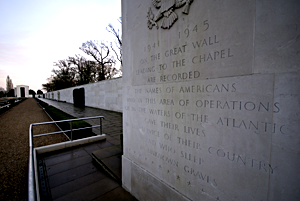
The light was lovely this afternoon and I went for a walk in the American cemetery in Madingley near Cambridge, where there is a long wall inscribed with the names of American servicemen from the European and Atlantic theatres of war who were killed and, as the inscription says, “sleep in unknown graves”. It’s a very long and sobering wall. Halfway along it, I came on a name carved in gilt lettering — which signifies that the named individual was awarded the Medal of Honor.

When I got home, I looked up the citation. Here’s what it says:

For conspicuous gallantry and intrepidity above and beyond the call of duty on 5 June 1944, when he led a Heavy Bombardment Group, in an attack against defended enemy coastal positions in the vicinity of Wimereaux, France. Approaching the target, his aircraft was hit repeatedly by antiaircraft fire which seriously crippled the ship, killed the pilot, and wounded several members of the crew, including Lt. Col. Vance, whose right foot was practically severed. In spite of his injury, and with 3 engines lost to the flak, he led his formation over the target, bombing it successfully. After applying a tourniquet to his leg with the aid of the radar operator, Lt. Col. Vance, realizing that the ship was approaching a stall altitude with the 1 remaining engine failing, struggled to a semi-upright position beside the copilot and took over control of the ship. Cutting the power and feathering the last engine he put the aircraft in glide sufficiently steep to maintain his airspeed. Gradually losing altitude, he at last reached the English coast, whereupon he ordered all members of the crew to bail out as he knew they would all safely make land. But he received a message over the interphone system which led him to believe 1 of the crewmembers was unable to jump due to injuries; so he made the decision to ditch the ship in the channel, thereby giving this man a chance for life. To add further to the danger of ditching the ship in his crippled condition, there was a 500-pound bomb hung up in the bomb bay. Unable to climb into the seat vacated by the copilot, since his foot, hanging on to his leg by a few tendons, had become lodged behind the copilot’s seat, he nevertheless made a successful ditching while lying on the floor using only aileron and elevators for control and the side window of the cockpit for visual reference. On coming to rest in the water the aircraft commenced to sink rapidly with Lt. Col. Vance pinned in the cockpit by the upper turret which had crashed in during the landing. As it was settling beneath the waves an explosion occurred which threw Lt. Col. Vance clear of the wreckage. After clinging to a piece of floating wreckage until he could muster enough strength to inflate his life vest he began searching for the crewmember whom he believed to be aboard. Failing to find anyone he began swimming and was found approximately 50 minutes later by an Air-Sea Rescue craft. By his extraordinary flying skill and gallant leadership, despite his grave injury, Lt. Col. Vance led his formation to a successful bombing of the assigned target and returned the crew to a point where they could bail out with safety. His gallant and valorous decision to ditch the aircraft in order to give the crewmember he believed to be aboard a chance for life exemplifies the highest traditions of the U.S. Armed Forces.

And then I reflected on the fact that our contemporary heroes are footballers.

Beware!

Can’t remember where I saw this exchange, but someone once accused a lecturer of glossing over some difficult issues. “My dear boy”, he replied brazenly, “when one is skating on thin ice, it’s best to go quickly”.

Origins of the US sub-prime crisis

Louis Hyman, a Harvard historian, writing in the New York Times

WHILE critics of today’s mortgage crisis call for government intervention to suppress subprime lending, few are aware that government intervention created subprime mortgages in the first place.

The National Housing Act of 1968, part of President Lyndon Johnson’s Great Society, provided government-subsidized loans to expand home ownership for poor Americans. Liberal policymakers hoped that these loans, called Section 235 loans, would enable poor Americans — urban blacks in particular — to buy their own homes.

Under the program, a poor family could obtain a mortgage from a lender for as little as $200 down and pay only a small portion of the interest. If the borrower defaulted, the government paid the balance of the loan. If the borrower made payments on time, the government covered all of the loan’s interest above 1 percent. Homebuyers could borrow up to $24,000, as long as Federal Housing Administration inspectors declared the property to be in sound condition.

By 1971, Congressional and press investigations found the program riddled with fraud. Section 235 accelerated existing white flight by providing poor African-Americans with money to buy out their anxious white neighbors, who in turn accepted below-market prices for their houses. Real estate agents frightened white homeowners with visions of all-black neighborhoods financed by government money, and then pocketed the proceeds from the resulting high home turnover.

Existing homeowners lost their equity, but a canny alliance of brokers, lenders and federal housing inspectors inserted themselves as middlemen between the buyers and the sellers to reap profits. White speculators, often real estate agents themselves, bought houses cheaply from fleeing white homeowners, did superficial renovations and then sold the houses at steep prices to black first-time homeowners.

As the properties changed hands, the speculators profited and the government paid the tab…

‘Harvest’ time in Manchester

The Guardian had an extraordinary report the other day giving the background to the Manchester United Christmas party at which a girl alleges she was raped.

The news travelled fast between the racks of £1,000 Prada dresses and podiums loaded with Louis Vuitton handbags in the Manchester branch of Harvey Nichols. Word had come down from the players at Manchester United that it was time for a “harvest”.

The best looking shop assistants were put on alert to expect an invite to one of the biggest football parties of the year. The same thing happened at Selfridges next door. They may never have met them, but for one night these young women stood a chance of swapping their lives as shop assistants to be the guests of champions, some of whom earn 400 times more than they do.

One by one, the invites for the event came; sometimes directly from a player shopping after training, or from a friend deputised to handpick the most attractive young women to “decorate” their party.

Such “harvests” are a part of a social scene involving footballers and would-be Wags (wives and girlfriends of footballers) which was thrust into a harsh spotlight this week after Jonny Evans, a United player, was accused of the rape of a 26-year-old at the club’s Christmas party.

The article goes on to detail what apparently goes on all the time in Manchester.

One boutique assistant told how two Premiership players tried to entice her back to their hotel to watch pornography. One senior player embarrassed her by parading in her shop wearing only his underpants. Another said she had been pestered by a footballer who refused to take no for an answer.

Several shop assistants from the make-up and handbags section of Selfridges were invited to the United party on Monday night at the Great John Street boutique hotel in the city centre. It was also attended by models, including Louise Cliffe, the one-time Miss Manchester, and others who came from Leeds, Liverpool and London. Events that took place have been unravelled in all their uncomfortable detail in the tabloid press. Yesterday’s newspapers brought allegations that a drunk girl took part in an orgy with several men.

The 15-hour party was closed to the players’ wives and girlfriends and was reportedly described as “very, very sleazy”. Another said girls were being passed around “like pieces of meat”.

The next day, in the same paper, columnist Marina Hyde returned to the story:

Yesterday further revelations about the party surfaced. One “very drunk” woman was “roasted” by five or six men, according to another guest, who told a newspaper that “I asked her if she was OK and she said, ‘Yeah, why wouldn’t I be? They said I was a great shag.'”

Now the interesting thing about this is the way such revolting behaviour is tolerated by the British media — and the society it supposedly serves. If the group of males that indulged in this kind of thing had come from, say, the Parachute Regiment, there would be all hell to pay. Or if it became known that, say, officers in Saddam’s army had sent out scouts to pick up women for a party in which some of them would be effectively gang-raped, then our newspapers would have been frothing with moral indignation about the moral corruption which accompanies absolute power.

But when the athletic cretins of Manchester United next trot out onto the Old Trafford pitch they will continue to receive their normal dose of public adulation. I’m reminded of the old exchange:

Pity the land that has no heroes.

Pity the land that has need of heroes.

And pity, especially, the land that needs heroes like the thugs who currently adorn the so-called ‘premiership’.

Footnote: The Great John Street hotel, which housed the Man U orgy, describes itself thus:

Only a stones throw from Manchester’s most exclusive shopping areas, restaurants and theatres, this original Victorian school house has been transformed into a chic townhouse hotel with unique, individually designed bedrooms and suites alongside stylish lounges and Oyster Bar. The Old School House also boasts stunning entertainment rooms and terraces available for exclusive use for your own tailor made event.

An ‘Opus Grand’ suite costs £395 a night. WiFi available for £10 per day. Apostrophes and hyphens are extra.

The laws of the tailback

Hmmm… Interesting paper by G. Orosz and G. Stépán in the September 08, 2006 issue of Proceedings of the Royal Society of London A on “Subcritical Hopf bifurcations in a car-following model with reaction-time delay” which purports to show how major delays occur on motorways with no apparent cause.

Important stuff this, and no mistake. I mean to say, how many times have you been baffled when you finally reach the end of a tail-back only to find no visible cause for the delay? Now, a team of mathematicians has developed a mathematical model to show the impact of unexpected events such as a lorry pulling out of its lane on a dual carriageway. Their model reveals that, by slowing down below a critical speed when reacting to such an event, a driver would force the car behind to slow down further and the next car back to reduce its speed further still. The result of this is that several miles back, cars would finally grind to a halt, with drivers oblivious to the reason for their delay. The model predicts that this is a very typical scenario on a busy highway (above 10–15 vehicles per km). The jam moves backwards through the traffic creating a so-called ‘backward travelling wave’, which drivers may encounter many miles upstream, several minutes after it was triggered.

Quite so. I thought you’d like a peek at the model which produces these interesting findings.

Obvious, when you think about it.