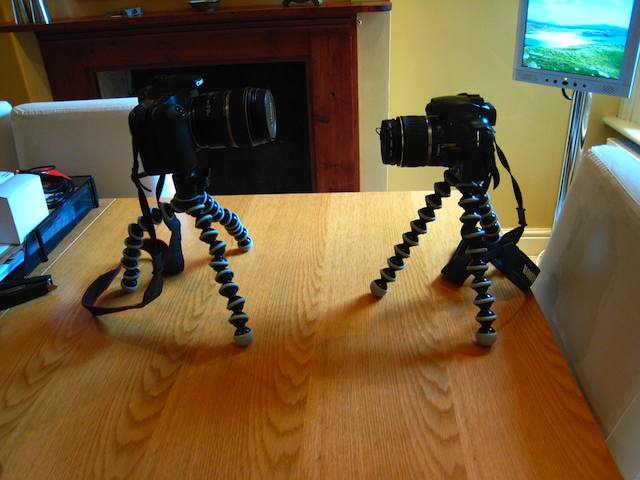
Some of us are addicted to those wonderful Gorillapods. This little confrontation was witnessed in Ndiyo HQ.

Some of us are addicted to those wonderful Gorillapods. This little confrontation was witnessed in Ndiyo HQ.
Just as I thought. He’s an Irishman at heart!
Thanks to Conor for spotting it.

JJ looking pensive in old age. We will have Burgundy and gorgonzola sandwiches at half past noon in honour of Mr Leopold Bloom, late of No. 7 Eccles Street, Dublin.
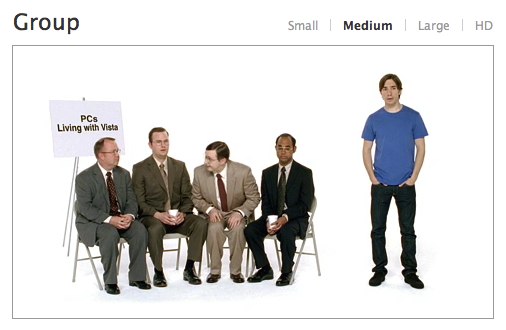
I know they’re smug, but the latest batch of Mac vs. PC ads includes some funny sketches. ‘Group’ is the one that really made me laugh.
Hmmm… From today’s Telegraph: golf buggies with sat-nav for players lacking direction .
Each of the £4,000 golf buggies comes complete with a sat-nav system which is programmed with a map of West Midlands Golf Club.
The hi-tech devices mean members could do away with caddies altogether as the buggies’ computers tell players how far they have hit a drive and what distance remains to the hole.
But even these capabilities do not supersede the buggies’ most important function – being able to order a drink remotely from the bar.
John Harrhy, 65, co-owner of the club in the Forest of Arden, near Solihull, explained what led him to introduce the 25-strong fleet.
He said: “We like to think we are a forward-looking golf business. We had been looking around at ways to progress and considered a number of buggy models. They are very popular with the senior members, who are offered them at a cheaper rate, and with visiting golf societies. You can enter your scorecard on the on-board machine and it knows which other buggies are in your group.’
The funny thing is that none of the players who will eagerly embrace this technology can hit the ball far enough to get lost.

I’d love to see if Tiger Woods can win, despite still having a wonky knee. Torrey Pines is a bit like Lahinch or Ballybunion, but with better weather. (I grew up playing those courses and have loved them ever since.) Tom Watson famously described Ballybunion as “one of the best and most beautiful tests of links golf anywhere in the world”.
Later: I realised belatedly that the Lahinch site has a nice virtual tour of the course and the description of the 18th hole suddenly brought back one of the nicest memories I have of my golfing career.

A par five of five hundred and thirty-four yards. The drive crosses the line of holes four and five, to find a magnificently undulating, turbulent fairway alongside the road. These undulations continue right on up to the green, which has bunkers left and right. The green is sited close to the out of bounds, with mounds on the right and deep hollows on the left. It is a fine green on which to end the Lahinch experience.
I was playing a tense match and my opponent and I were level as we teed off. We were playing into the wind, so it seemed like a brutally long hole that day — so much so that for my third shot I needed a three or a four iron. In one of those magical moments that golfers never forget, I hit it perfectly and watched the ball ‘bisect the pin’ as it flew. It pitched onto the front of the green, braked and came to rest a foot from the hole. There was nothing my opponent could do about it, and I won the match. Pure magic. One of the most satisfying moments of my life.
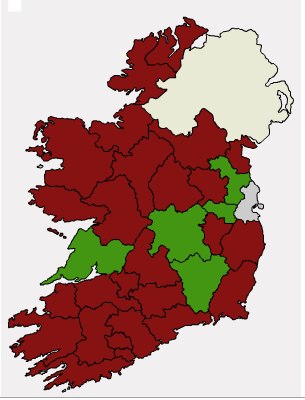
Interesting that the only constituency on the Western seaboard that voted Yes was Clare. Wonder what made the difference there.
Nice NYT piece by Matt Richtel.
A typical information worker who sits at a computer all day turns to his e-mail program more than 50 times and uses instant messaging 77 times, according to one measure by RescueTime, a company that analyzes computer habits. The company, which draws its data from 40,000 people who have tracking software on their computers, found that on average the worker also stops at 40 Web sites over the course of the day.
The fractured attention comes at a cost. In the United States, more than $650 billion a year in productivity is lost because of unnecessary interruptions, predominately mundane matters, according to Basex. The firm says that a big chunk of that cost comes from the time it takes people to recover from an interruption and get back to work…
It’s an interesting counterpart to Nick Carr’s complaint that Google rots your brain.
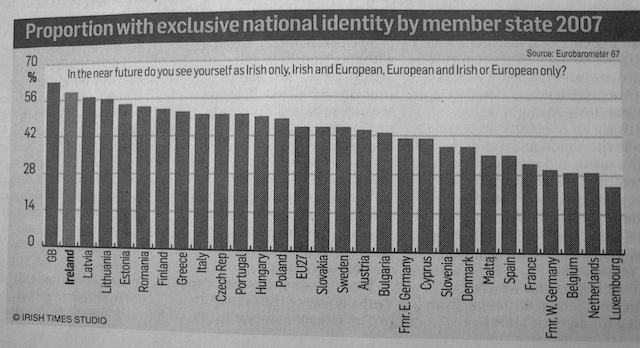
This chart (which appears in today’s Irish Times) is very illuminating — and puzzling. It’s based on the Eurobarometer survey conducted in the Spring of 2007. Interviewees were asked: “In the near future, do you see yourself as Irish only, Irish and European, European and Irish, or European only?”
Ireland is nearly at the extreme left of the chart. Only the UK has a stronger sense of non-European identity. The founding countries of the EU are all clustered on the extreme right.
What’s puzzling is that Ireland has done incredibly well out of the EU, whereas Britain probably hasn’t. Looks like my countrymen are a pretty ungrateful lot!
“The people have spoken…” was the mantra on every Irish politican’s lips last night, but the added rider (“…the bastards”) was thought rather than uttered.
The aftermath of the referendum result is fascinating. Here’s Stephen Collins, the Political Editor of the Irish Times, talking about it.
What’s interesting about Collins’s view is how conditioned it is by the government mindset. “We’ve blotted our copybook. Now what will the Big Boys in Brussels do to us?” is the general tenor of the shell-shocked Irish political establishment. In fact — as Fintan ‘Curate’ O’Toole pointed out this morning — fear and nameless dread were the hallmarks of both the Yes and No campaigns.
The various No campaigns formed a loud (if dissonant) orchestra of anxieties — about taxation, abortion, militarisation. We were even treated to stickers of a nuclear mushroom cloud, as if Lisbon was a suburb or Armageddon.
But the Yes side indulged in its own brand of counter-terror. While the No campaign was scaring us with what would happen if we voted for Lisbon, the Yes side told us hair-raising tales of what might happen if we didn;t — shame, isolation, disinvestment. It managed the extraordinary trick of making the word Yes sound anything but positive. In essence, voters were being asked what brand of trepidation they wanted to buy.
Step outside the establishment bubble, however, and things look a bit different. Irish Times columnist Breda O’Brien wrote that
Some concerns [of the No campaigners] were unfounded. But to give just one example, worries about increasing militarisation of the Union were well-founded.
There was a dissonance between those painting the EU as the reason why there has been an end to war on the Continent, while at the same time beefing up the military capacity It was just one example of a dissonance between rhetoric and reality.
There is, she continues,
a massive need to work on understanding why people right across Europe are not persuaded that the EU represents something truly worthy of loyalty and allegiance. There is a reason why people are suspicious of vast moniliths, and it is not just paranoia. Monoliths tend to crush those who do not agree with them, and then be crushed in their turn when they become too arrogant to be endured. the Irish have done Europe a favour, though it is unlikely it will be seen in this regard.
The No campaign was run by a weird ragbag of right- and left-wing nutters. I was convinced that, in the end, my countrymen would be so worried by the prospect of an impending recession that they would vote for the Treaty, on the grounds that that was a way of reducing uncertainty about the future. But I reckoned without the incompetence of the Irish political establishment, who ran an abysmal campaign from (late) start to finish. The government dithered about the date of the Referendum, and was fatally distracted by the struggle to dump Bertie Ahearn. So, as Garret FitzGerald (himself a former Taoiseach) put it,
during the early months of the year the anti-treaty forces of the two extremes — a lethal combination of people reflecting right-wing US military and neo-con antipathy to the EU (seen by them as a threat to NATO), together with our own domestic anti-US left-wingers — were given free rein to mislead voters into opposing the treaty on a whole range of irrelevant, misleading or false grounds.
Stephen Collins is also very critical of the Yes campaign.
Of course the Yes campaign had a more complex message to explain but, by comparison, its posters were still remarkably dull. The fact that so many of the mainstream politicians cynically used posters in order to promote their own image rather than the message also did nothing for the Yes campaign.
Garrett FitzGerald has an insightful take on this.
I do not have the impression that our poliicians reflect much, if at all, on the recent loss of confidence in and respect for them. This insensitivity reflects the fact that, in a political system as devoted to clientelism as is ours, elected representatives tend to judge their public standing by the narrow criterion of whether individuals continue to come to them for assistance with personal problems arising from their often fraught dealings with the bureaucratic system.
Spot on. The Irish political system was not designed for handling ideas.
And it cannot have helped either that the Taoiseach as well as Charlie McCreevy (Ireland’s EU Commissioner) revealed that neither of them had read the Treaty. They lost the argument because they failed to take seriously the need to make it.
Now they have to live with the consequences.