Real World

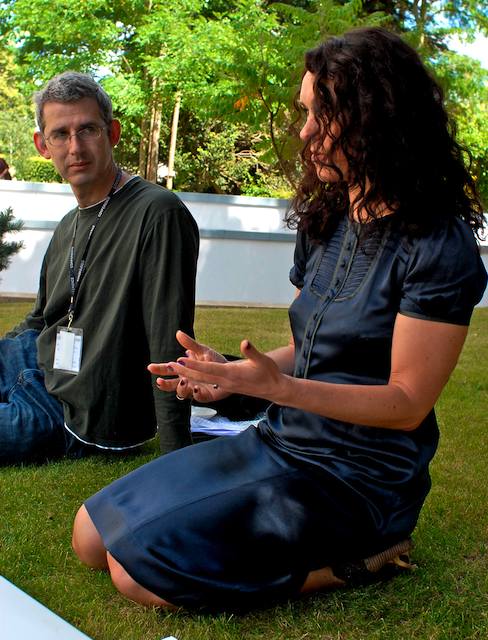
If you’d dropped a bomb on the Cavonius Centre at Gonville & Caius College in Cambridge any time in the last two days then you’d have wiped out most of the senior creative people in the BBC (plus a few academics). They were gathered for the annual media seminar organised by my colleague Joe Smith in collaboration with Roger Harrabin and others from the BBC and IBT, who now has the grand title of BBC Environmental Analyst. The purpose of the event is to get the BBC folks away from their highly-pressured environment and expose them to a spectrum of thinkers from academia and the arts world. I chaired one of the ongoing panels (with the magnificently opaque theme of ‘Things’). My fellow-panellists were a fascinating mix: Edmund de Waal, who is a distinguished potter and Professor of Ceramics at Westminster University; Dilys Williams, the Director of the Centre for Sustainable Fashion, at the London College of Fashion (both shown below); Heather Ackroyd, an amazingly inventive artist; and Tony Lake, who until a few weeks ago was Chief Constable of Lincolnshire.

The overall idea of these gatherings is to reflect on interdependence. The theme this year was “Real World: storytelling in an interconnected world”. Not surprisingly, there was a lot of collective agonising about the state of the public debate about subjects like climate change and DNA testing — and on the role of the mainstream media in fostering (or hampering) those debates. The openness and vigour of the debate between the editors and programme-makers and their bosses was impressive. The BBC continues to employ a lot of intelligent and perceptive people.

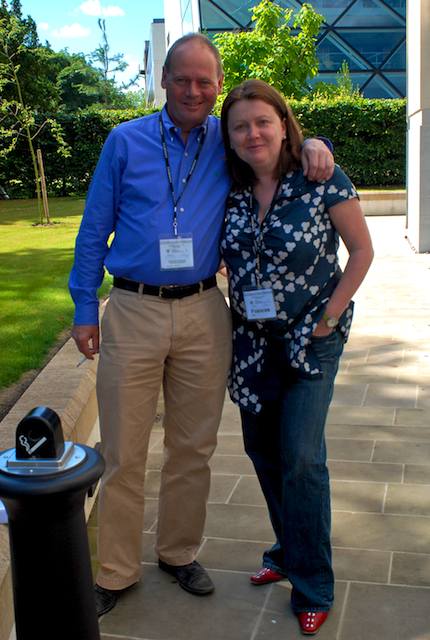
For me, one of the high points of the seminar was meeting John Lloyd, the producer/writer behind a staggering list of comedy shows. (The photograph shows him with Frances Weil of BBC Vision, one of the organising team.) He was co-chair of the event, and did it with grace, perceptiveness and wit. It’s not often that someone whom one knows only by reputation comes up to scratch. And wonderful when they surpass one’s wildest expectations.

On this day…

… 150 years ago, two papers that would change the world were read at the Linnean Society in London. They were “On the Tendency of Species to form Varieties” by Alfred Russel Wallace and “The Perpetuation of Varieties and Species by Natural Means of Selection” by Charles Darwin. Darwin had been working on the idea for decades but a combination of intellectual fastidiousness and nervousness about stirring up public opinion had kept him from publishing. It was the arrival of a letter from Wallace, a self-taught naturalist who was then working in Malaya and had independently come up with the idea of evolution by natural selection, that shocked him into going public. The joint presentation of the two papers on the same day was an ingenious establishment wheeze concocted to ensure that he was not denied primacy.

As a student, I was fascinated by Wallace, and once even contemplated writing a biography of him (which meant that I spent many happy hours in the Darwin papers in Cambridge University Library — now gloriously online). What attracted me was the contrast between the two men. Darwin was a genteel product of great wealth (his wife was one of the Wedgwoods, of pottery fame) and lived in great comfort on substantial private means. Wallace came from a modest background and had financial worries for most of his life.

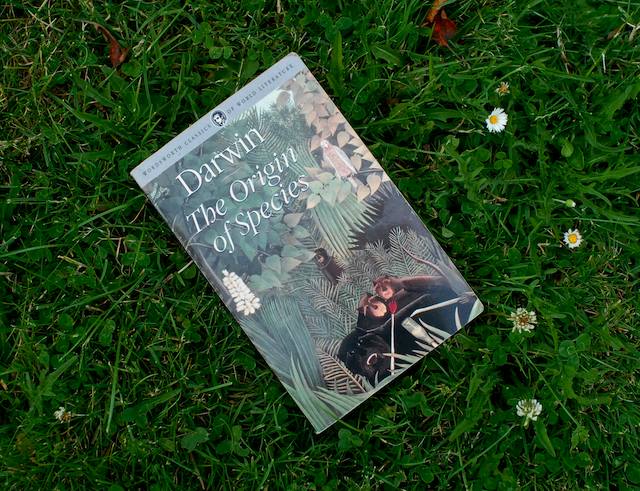
When one of my sons was reading English at UCL, he was somewhat taken aback to discover that Darwin’s Origin of Species was one of the texts he was expected to study. But in fact it made sense, because it was conceived and written as a popular book, designed to explain evolutionary theory to the contemporary layman. Here is an excerpt from the Introduction which, I think, illustrates his desire to communicate rather than to obfuscate:

In considering the origin of species, it is quite conceivable that a naturalist, reflecting on the mutual affinities of organic beings, on their embryological relations, their geographical distribution, geological succession, and other such facts, might come to the conclusion that species had not been independently created, but had descended, like varieties, from other species. Nevertheless, such a conclusion, even if well founded, would be unsatisfactory, until it could be shown how the innumerable species, inhabiting this world have been modified, so as to acquire that perfection of structure and coadaptation which justly excites our admiration. Naturalists continually refer to external conditions, such as climate, food, etc., as the only possible cause of variation. In one limited sense, as we shall hereafter see, this may be true; but it is preposterous to attribute to mere external conditions, the structure, for instance, of the woodpecker, with its feet, tail, beak, and tongue, so admirably adapted to catch insects under the bark of trees. In the case of the mistletoe, which draws its nourishment from certain trees, which has seeds that must be transported by certain birds, and which has flowers with separate sexes absolutely requiring the agency of certain insects to bring pollen from one flower to the other, it is equally preposterous to account for the structure of this parasite, with its relations to several distinct organic beings, by the effects of external conditions, or of habit, or of the volition of the plant itself.

Power, thuggery and bad manners

A few days ago, I picked up on the FT’s account of life in the Number Ten bunker, and in particular on Gordon Brown’s brutish way with his subordinates. This post was picked up by Wilks in a post entitled “The Arrogance of Power” which, in turn, pointed to an excellent blog post by Willem Buiter, a leading economist who is a former member of the Bank of England’s Monetary Policy Committee. Professor Buiter has a more general theme, namely the fact that the UK Treasury (which nurtured Brown during the ten years that he lurked there, lusting after the premiership) is a bad case of instutionalised arrogance, rudeness and casual brutality. As a department, he writes, the Treasury

is institutionally nasty. It ever was thus. The Treasury is ruthless, and at times unprincipled and unscrupulous in the pursuit of what it wants. Its indifference to the collateral damage this may cause to people’s reputations, self-esteem and feelings is legendary and well-documented. Recent examples include letting former Governor of the Bank of England, Eddie George and current Governor Mervyn King twist slowly in the wind – unnecessarily dragging out the decision on their reappointment when they were up for reappointment at the end of their first terms as Governor. Apart from being rude and kak-handed, it also did nothing to promote financial stability, especially in the case of Mervyn King’s reappointment, which came at the high of the North Atlantic area financial crisis.

He goes on to expound on another case-study of this kind of behaviour — the treatment of the Bank of England’s Deputy Governor.

A particularly distasteful example of unscrupulous and gratuitously nasty behaviour by the Treasury was the manner in which it orchestrated the leaking of the announcement of Sir John Gieve’s departure from the Bank of England. That departure itself, whatever the legal niceties, amounted in substance to the constructive dismissal of the Deputy Governor. The job description of Deputy Governor for Financial Stability was being redefined and enhanced. The new job would go into effect in the Spring of 2009. His existing job would expire at that point. He would therefore not be able to serve out the remaining two years of his five year term. He would not be appointed automatically to the new enhanced Deputy Governor for Financial Stability position, but would have to apply for the job like any other candidate. In the future, all MPC positions, including the executive positions, will be advertised – a distinct improvement over the current grab-bag approach.

Having been found surplus to requirements by the Treasury, it was agreed that Sir John’s departure in the Spring was to be announced on June 19, 2008, the day following the Mansion House dinner with the traditional speeches by the Governor and the Chancellor. His leaving was to be announced as part of a longer message containing details of sweeping changes to the Bank’s financial stability structure. The substance of that message is contained in the Chancellor’s letter of June 19 2008 to the Chairman of the Treasury Committee, John McFall. Instead, the forces of darkness in the Treasury leaked the news of Sir John’s resignation during or just before the Mansion House dinner on June 18 – a dinner attended by Sir John. He was texted or e-mailed the news of the leak and spent most of the rest of the meal working away on his BlackBerry to put together a press statement. It was undignified, embarrassing and pointless. The leak was planned, intentional and deliberate.

This crass behaviour reflects a basic lack of class and manners.

It does indeed. It’s par for the course for New Labour — as anyone who crossed Alastair Campbell when he was Tony Blair’s spinmeister will testify. Buiter makes the point that the New Labour crowd have a visceral hatred of toffs like John Gieve, who just happened to have been educated at Winchester and New College, Oxford.

But it’s not just confined to HM Treasury. Appalling behaviour is regularly tolerated in companies too — and indeed celebrated by the mass media. Witness the celebrity status now enjoyed by Sir Alan Sugar, a barrow-boy-turned-entrepreneur who has become the star of a popular TV show, The Apprentice. Or the gibbering rages of Microsoft CEO Steve Ballmer, who reportedly once threw an office chair at a Microsoft subordinate who had the temerity to announce that he was leaving to join Google. Bill Gates is likewise celebrated in the media for his inexcusable rudeness. His stock line “That’s the stupidest thing I’ve ever heard!” is endlessly (and admiringly) reported. The gibbering rages of Oracle boss, Larry Ellison, (whose curious habit of collecting F16 fighter bombers also appeals to reporters seeking a bit of colour) are also the stuff of admiring legend. And as for Steve Jobs…

It’s time we stopped worshipping these vulgar, undisciplined, ego-maniacal brutes. Apart from anything else, their companies tend to become corporate extensions of their founder’s infantile personalities. And that can lead to them becoming major public nuisances — as in the case of Microsoft. Verbal abuse of subordinates who cannot answer back is no different from thuggish bullying in school playgrounds. And should be treated accordingly.
Back to the drawing board

Well, well. After months of heated speculation, it turns out that Cambridgeshire County Council is shelving its plans for congestion charging in the city.

Cambridgeshire CC has shelved plans for congestion charging following a lack of local support

The council had said it wanted to cut traffic levels in the city by 10% and submitted a bid for £500m of the government’s Transport Innovation Fund (TIF). Its bid included proposals for peak period congestion charging in and around Cambridge, along with subsidising bus fares, a new railway station, park and ride facilities and an extensive network of cycle paths.

Cambridgeshire has now withdrawn its plans and gone “back to the drawing board”, despite a growing problem of congestion in and around the city of Cambridge.

Councillor Jill Tuck, the new Conservative leader of the council, said: “We have listened carefully over the last few months and it is clear that the Transport Innovation Fund scheme we put forward for consultation last autumn does not have sufficient support either from other key organisations or the public and needs, at the very least, refinement.”

A new transport commission, made up of key public and private sector organisations, will be created to come up with recommendations for a new transport strategy for the Cambridge area…

At last — a useful role for bankers

According to Miriam Lord, Parliamentary sketch-writer for the Irish Times, the Irish Labour Party has a policy on big bankers. It is, she writes that “They should be recycled and made into pork pies for the working man”.

Now there’s an interesting idea. Personally I think that, if boiled with pepper, a few carrots and a clove or two of garlic, many of them would also make a nourishing soup.

Fact: I don’t much care for pork pies. But then I don’t care much for bankers either.

Hitler: the remix

Speaking of bunkers, one of the most memorable acting performances I’ve ever seen is Bruno Ganz’s bravura rendition of Hitler in the film Downfall. One of the high points in the movie is when his generals finally reveal to their Fuhrer the military hopelessness of Germany’s position. So it’s a hoot to see how many times this scene is remixed using cod sub-titles to evoke contemporary events.

Here, for instance, is Hitler reacting to the news that upgrading to Windows Vista has screwed his PC. And now there’s a remix in which Hitler plays Irish Taoiseach (Prime Minister) reacting in fury to the news that the Irish have rejected the Lisbon Treaty. Here’s an excerpt from the Fuhrer’s harangue:

I’ve delivered one of the leading economies in Europe. On MY own! And this is the gratitude I get. And those useless pricks in Labour and Fine Gael… That stupid Fuckwit Kenny [Enda Kenny, Leader of Fine Gael, the main Opposition party] couldn’t even win his own constituency! Couldn’t even keep the No margin in the single digits. And those blubbering bastards over in Labour couldn’t even make a dent in the working-class vote, or bring over the unions. All they contributed was trendy, do-gooder Irish Times readers who think their shit smells better than everyone else’s. So much for the coalition system!

The nice thing was that I read about the remix in the aforementioned Irish Times!

(Which, btw, is abandoning its subscription model from next Monday. Get it at www.irishtimes.com. Thanks to Anne M for the news.)