
The party at the end of the universe


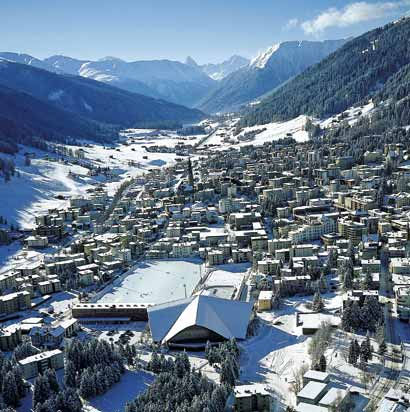
I’ve been to Davos once — long before the ‘World Economic Forum’ turned it into a synonynm for nonstop ego-massaging and billionaire-worship. It was in the late 1970s and I was walking in the Alps. I stumbled on the town more or less by mistake on a day that was too foggy to walk. I remember a drab place in which I bought — of all things — a Swiss Army knife and a walking stick that I still possess.

The event itself is nauseating enough. But what is even worse is the creepy sycophancy of the journalists who manage to cadge an invitation to the event. These are creatures who have apparently lost sight of the ancient investigative principle that behind every fortune lies a crime. One expects little better from the old-media print and broadcast crowd, of course. But what’s been increasingly depressing in the last two years is that they have been joined by a tribe of bloggers and twitterers who also seem to have lost their capacity for detachment. At any rate, their schoolgirlish excitement at being allowed into the hallowed precinct seems to have lobotomised their detachment.

So it was nice to open the Guardian this morning and find Julian Glover’s lovely dispatch from the benighted Swiss resort.

Perhaps it was the party at the end of the universe. Just as a neutron bomb destroys life while leaving structures intact, so Davos goes on, while the culture that supports it is dead. As collective belief was what propelled this global elite, one person’s self-importance feeding another’s, the mood has been broken as badly as the banks.

But

Alarm is not the same as contrition, and few people here will admit to have done anything personally wrong. The boss of JP Morgan Chase, James Dimon, is an exception: “I take full blame, yes. God knows some very stupid things were done.”

There is no real sense of collective guilt, or serious consideration of what to do next, other than rebuild the world that has just been lost. Davos has the air of a crash inquiry into an airline that intends to keep on flying. One hero, alone among thousands, suggested that the bankers should simply be jailed until they give the money back.

The problem with that is that most of them have no money to return. The ocean on which the global boom floated has evaporated.

[…]

The shock is real, the grief has hardly begun, but no one in Davos seems to think that means they should be less important or less rich. Yet for many the modesty is a temporary veil, to be worn until the good times return.

It is hard to tell who has really suffered, and who is only pretending. In a dark corridor at the centre of the concrete congress building billionaire surnames still flash past on white badges. This is a town where the men have the telltale signs of the seriously rich. Their hair has been blow-dried into implausible waves and layers; coiffures disciplined, even if the markets are not.

Great stuff!

So who’s to blame?

Thoughtful list by Timothy Garton-Ash.

On the evidence we have so far, the following could plausibly be asked to interrogate themselves on their share of the responsibility. With the exception of the first and last categories, the words “some of the” should be inserted before each heading. My list is, of course, merely indicative.

Crooks. Bernie Madoff was (it appears, subject to the finding of the courts) a crook, a fraudster and a confidence trickster. His like will always be with us. The relevant question is how he was able to get away with it for so long and on such a scale.

Bankers. Some highly respected and law-abiding bankers took huge gambles and made horrible miscalculations at our expense, themselves walking off with multimillion bonuses while leaving shareholders and taxpayers to pick up the tab. Others did not.

Regulators. There’s a lot of failure to go around in this category. “Is that a typo?” one official at the US Securities and Exchange Commission was said to have asked, when faced with the $50bn estimate for Madoff’s losses. “Isn’t that number meant to be $50m?”

Politicians. It’s all very well for politicians to rail against “Wall Street” and the “banksters”, but this happened on George Bush’s and Gordon Brown’s watch. “The cheerleaders of finance,” writes the Economist’s Edward Carr in his report, “were unwilling to admit that houses were too expensive and risk too cheap.” Yes, but so were the cheerleaders of British and American politics.

Economists. Here’s a guild from which we might usefully hear a little more self-criticism – especially from the quantitative economists whose mathematical models helped to lead investment bankers astray. In what sense can economics still claim to be a science if its predictive capacity is so low? Imagine Newtonian physics when apples start going upwards.

Journalists. Yes, a few warned, as did a few exceptional economists like Nouriel Roubini; but it’s only now that your average reader of the business pages is in a position to understand how risky his or her investments were. Did business journalism fail us?

We, the people. Some of us, anyway: piling up household debt, especially in Britain and America, on the back of inflated house prices that gave the illusion of security; not asking sufficiently probing questions about where our pension funds were invested.

The system. Blanket charges against some denatured, depersonalised “system” usually betray incoherence wrapped in indignation. But there is a sense here of a global financial system that had become so large, complex and untransparent that it was beyond the capacity of even the largest actor in the markets to understand, let alone control. And one in which apparently rational decisions by most individual participants produced a result collectively damaging for all.

That just about covers it. Garton-Ash’s argument is that the temptation to kick ‘Davos Man’ because he got us into this mess should be resisted. Why? because Davos Man was a globaliser — a “ruthless cosmopolitan”. But he may have been the lesser of two evils. “Now we are at a crossroads”, concludes G-A.

One road leads back to economic nationalism, protectionism and beggar-thy-neighbour policies. Another leads forward to more international co-operation, including more regulation and transparency. Without a conscious effort, the dynamics of both democratic and undemocratic politics, which remain national, will lead us down the former road. Inside Davos Man, there is his predecessor and possible successor always struggling to get out. If you don’t like what you’ve seen of Davos Man, wait till you see Nationalist Man get to work.

Nice column.

Twitter, guilt, remorse and shame

Steven Levy (of Newsweek and author of that wonderful book on the history of the Apple Macintosh) has started something. In an article in Wired he wrote that he felt “guilty that I have a blog and haven’t contributed to it for seven months. Guilty that all my pals on Facebook post cool pictures, while the last shots I uploaded were of Fourth of July fireworks—from 2007. Guilty that I haven’t Dugg anything since, well, ever.”

Eh? But then he explains that the guilt comes from the feeling that he might be regarded as a free-rider. “Because of time constraints and just plain reticence, I worry that I’m snatching morsels from the information food bank without making any donations. Instead of healthy, reciprocal participation, I’m flirting with parasitic voyeurism.”

So he tries to overcome guilt by sharing. This then triggers another emotion: remorse.

It’s fun to track the digital ejaculations of selected Twitterati. But a couple thousand people signed up unsolicited to follow my tweets. And I feel guilty when not serving this hungry crowd — remorseful when I am.

Since I don’t know many in this mob, I try not to be personally revealing. Still, no matter how innocuous your individual tweets, the aggregate ends up being the foundation of a scary-deep self-portrait. It’s like a psychographic version of strip poker—I’m disrobing, 140 characters at a time.

Gosh, isn’t life complicated? Enter, stage right, Nicholas Carr, the Net’s own Stern Moralist. “Though he never names it”, Carr writes, “what Levy is really talking about here is shame”.

And the shame comes from something deeper than just self-exposure, though that’s certainly part of it. There’s an arrogance to sharing the details of one’s life in public with strangers – it’s the arrogance of power, the assumption that such details somehow deserve to be broadly aired. And as for the people, those strangers, on the receiving end of the disclosures, they suffer, through their desire to hear the details, to hungrily listen in, a kind of debasement. At the risk of going too far, I’d argue that there’s a certain sadomasochistic quality to the exchange (it’s a variation on the exchange that takes place between celebrity and fan). And I’m pretty sure that Levy’s remorse comes from his realization, conscious or not, that he is, in a very subtle but nonetheless real way, displaying an undeserved and unappetizing arrogance while also contributing to the debasement of others.

Carr’s right about the celebrity-fan relationship: it’s deeply creepy. I saw something of it in the years when I was a TV critic and became friendly with a number of people who — because of their TV roles — had become national celebrities. Being out with them in public was a revealing experience, because of the way that total strangers seemed to think that, in some way, they owned them.

In the old days of a TV-dominated media culture, broadcast media had the power to create celebrity — to transform performers into public property. What’s changed with the Net is that it has given people the capacity to turn themselves into celebrities. Think of Robert Scoble, for example — a self-made celeb if ever there was one. One index of this new kind of celebrity is one’s Twitter Index — the ratio between the number of people you follow to those who follow you. My view is that, for most people, this should be close to 1. (Disclosure: I’ve just checked and my Index is currently 84/110, which is too low. I’m pretty picky about accepting ‘follow’ requests, but I’ve obviously been too lax recently.)

If you’re still reading, you’ll have spotted the qualifier “for most people” in that last paragraph. Although the celebrity-fan relationship is pathological and unhealthy, there are some absurd Twitter Indices that I regard as reasonable. As I write, for example, Dave Winer has 17,081 followers. Howard Rheingold has 6,871. Tim O’Reilly has 27,446. Yet this doesn’t bother me in the way that old-media celebrity did. Why?

The answer, I guess, has something to do with the fact that these people are not “famous for being famous” (the definition of mass-media celebrity) but famous for being interesting. And that’s very different.

Joke of the week

From the New Yorker. A clergyman, officiating at a funeral service, is saying: “We will now observe a moment of silently checking our BlackBerrys.”

Writing in the Age of Distraction

Cory Doctorow is one of the wonders of the world — a very good writer, a terrific lecturer and an inspiring activist for open-ness. I’m perpetually amazed by his productivity, so was much cheered to come on this essay by him in Locus magazine. It’s essentially a list of suggestion about how to get things written. Top of the list is this:

Short, regular work schedule

When I’m working on a story or novel, I set a modest daily goal — usually a page or two — and then I meet it every day, doing nothing else while I’m working on it. It’s not plausible or desirable to try to get the world to go away for hours at a time, but it’s entirely possible to make it all shut up for 20 minutes. Writing a page every day gets me more than a novel per year — do the math — and there’s always 20 minutes to be found in a day, no matter what else is going on. Twenty minutes is a short enough interval that it can be claimed from a sleep or meal-break (though this shouldn’t become a habit). The secret is to do it every day, weekends included, to keep the momentum going, and to allow your thoughts to wander to your next day’s page between sessions. Try to find one or two vivid sensory details to work into the next page, or a bon mot, so that you’ve already got some material when you sit down at the keyboard.

This echoes the advice of many professional writers down the ages. Graham Greene, for example, used to write no more than 700 words a day — in the morning. But he wrote every single day.

The idea of finding 20 minutes a day is ingenious because it’s something that even the busiest of us can do. I’ve been thinking recently that a mobile phone with a decent little keyboard (step forward BlackBerry) would probably do quite nicely. You could even email the results of your daily stint to yourself.

Other tips from Cory include:

  • Use a simple text-processor. All you’re producing is words, after all. No formatting needed.
  • Don’t be ‘precious’ or ceremonious about where you write. Forget all that crap about having the right music, atmosphere, coffee, etc. Just do it!
  • Switch off all real-time comms when you’re writing — no IM, no Skype, no Twitter.
  • Great stuff.

    Many thanks to Adam Szedlak for the link.

    LATER: Bill Thompson, writing ruefully about how he is easily distracted.

    25 years on

    It’s 25 years ago since the Apple Macintosh was officially launched by Steve Jobs, two days after the screening of Ridley Scott’s famous commercial. ReadWriteWeb has a nice photo gallery of every model. I’ve owned most of them — and still have a couple of the original Macs, plus the first iMac (in tangerine!) and a 1991 Powerbook 100. Sadly, I gave away the Apple ][ that I had in 1978. Otherwise I’d have the makings of a small museum.

    I vividly remember the first time I used a Macintosh — and wrote about it in my book on the history of the Internet. The relevant passage comes in the chapter on the deep origins of the Web when I was writing about the work of Bill Atkinson (who invented HyperCard).

    In an age of bitmapped screens and Graphical User Interfaces, we have become blasé about drawing and painting packages. But many of us will never forget our first encounter with Atkinson’s baby. In my own case, it happened at a workshop for academics known to be interested in personal computing which was organised by Apple UK at the University Arms hotel in Cambridge.

    The venue was a stuffy conference suite ringed with tables covered in green baize. On each table stood an astonishing little machine with a nine-inch screen and a detached keyboard. Compared with the clunky, three-box design which then represented the industry’s idea of what a personal computer should look like, these elegant little machines seemed, well, just gorgeous. I couldn’t wait to get my hands on one.

    After an initial spiel by the Apple crowd, we were let loose on the machines. They had been set up, for some unfathomable reason, displaying a picture of a fish. It was, in fact, a MacPaint file. I remember staring at the image, marvelling at the way the scales and fins seemed as clear as if they had been etched on the screen. After a time I picked up courage, clicked on the ‘lassoo’ tool and selected a fin with it. The lassoo suddenly began to shimmer. I held down the mouse button and moved the rodent gently. The fin began to move across the screen!

    Then I pulled down the Edit menu, and selected Cut. The fin disappeared. Finally I closed the file, confirmed the decision in the dialog box, and reloaded the fish from disk. As the image reappeared I experienced what James Joyce would call an epiphany: I remember thinking, this is the way it has to be. I felt what Douglas Adams later described as “that kind of roaring, tingling, floating sensation” which characterised his first experience of MacPaint. In the blink of an eye — the time it took to retrieve the fish from disk — all the DECwriter teletypes and dumb terminals and character-based displays which had been essential parts of my computing experience were consigned to the scrapyard. I had suddenly seen the point — and the potential — of computer graphics.

    Here’s the video of Jobs’s keynote.

    Isn’t YouTube wonderful.

    A service announcement

    From an email in my inbox this morning:

    Dear World:

    We, the United States of America, a top quality supplier of the ideals of liberty and democracy, would like to apologize for our 2001-2008 interruption in service. The technical fault that led to this eight-year service outage has been located, and a decision was taken in early November to completely replace the software responsible. The new software became fully functional on January 20, 2009. Early tests of the newly installed program indicate that we are again operating correctly. We apologize for any inconvenience caused by the outage. We look forward to resuming full service and hope to continue improvements in the years to come. We thank you for your patience and understanding.

    Sincerely,

    THE UNITED STATES OF AMERICA

    Thanks to Hap.