Free speech? Only if you’re a charity.

Like many of my (ageing) contemporaries, I regularly get approached by conference organisers asking me to give ‘keynote’ addresses to their events. I’ve noticed a trend: the glossier and more upmarket the event, the less inclined the organisers are to offer a speaker’s fee. Guy Clapperton has noticed the same problem — and pointed me at this wonderful rant by Harlan Ellison.

My rule btw is that I will do stuff free for charities and non-profit educational or public-service events. Companies pay, preferably through the nose.

LATER: Bill Thompson pointed me at this. Same message. Eloquent in a different way.

Email 101

From the Nicci French Blog.

Although email has the word ‘mail’ in it, it’s not like a letter and although it’s sent over a telephone line, it’s not like a telephone call. What it’s more like is the postcard you send from holiday that you send to someone in the office which they then pin up on the wall. You don’t free-associate on a postcard about kneecapping your enemies. You don’t spread vicious gossip about close friends on a postcard. There are more appropriate channels for such things.

My own rule about my own emails is this: if there is anything that embarrass me if it were printed out, put on a giant poster and pasted up in Piccadilly Cirucs, then I cut it out.

Yep.

Bringing it all back home

Extraordinary article in the Irish Times giving a per capita breakdown of Irish public finances. Sample:

We hear financial analysts talk about the economy in billions of euro, and in concepts such as GNP per capita. But for many of us, it may be difficult to appreciate these numbers and concepts. So let me try a different approach.

Let us take the Macroeconomic and Fiscal Framework 2009-2013 published on the web site of the Department of Finance. I also assume that our population is approximately 4.2 million.

Last Tuesday, our Government said it will collect this full year, on average, €8,200 of tax for every single woman, man and child in the State. However, some of this comes in the form of corporation tax from companies – €900 for each of us.

The difference – €7,300 – is on average each citizen’s burden of taxes. The €7,300 figure consists of €3,000 of income tax; €2,700 of VAT; and the remaining €1,600 in further taxes such as excise, stamp duty and so.

How, then, is our money to be used? The Budget showed for each person in Ireland, our Government will spend €11,000 on “current” recurring activities (such as, in particular, civil service salaries and social welfare). It also showed a further €2,600 for each one of us on “capital” items (such as roads and buildings). The total spend by our Government for 2009 for each citizen in the State will be €13,600.

Note that €13,600 is ahead, by a considerable margin, of the tax which the Government expects to collect from us. The difference will be borrowed from overseas investors, and we will have to pay this loan back – along with the rest of the money we already owe in the national debt – through further taxes in the future. At the end of 2008, the net debt position of our Government was about 22 per cent of GDP, that is, about €9,000 for each one of us. Since then about a further €11 billion has been raised, which brings the total to about €11,600 per capita. These figures do not include the investment that our Government is intending to make into our new National Asset Management Agency. For every billion euro that the agency spends in the future, a further €240 has to be found for each one of us.

Repaying our national debt to foreign investors is dead money: it is money that will be lost from our society and which could otherwise have been used to help build a better Ireland.

How is each of our €13,600 going to be spent across the Civil Service? There is a full department-by-department breakdown in the document I mentioned above and, from this, the per capita expenditures can be derived.

Some €5,100 for every person in the country will be spent by the Department of Social and Family Affairs, which of course includes all social welfare benefits to those challenged in our society. Another €3,600 will be spent by the Department of Health and Children (including the Health Service Executive). Then there is €2,300 that will go to our schools and third-level institutions via the Department of Education and Science. The Garda will get €360 for each person in the State, and the Defence Forces will receive €190 on behalf of each one of us. The Department of Enterprise, Trade and Employment (which includes the IDA, Enterprise Ireland, and Science Foundation Ireland) gets €350.

Thanks to Karlin Lillington for the original link.
Famous Seamus

(Image from Wikipedia.)

Today is Seamus Heaney’s 70th birthday. As Ireland slides into economic meltdown, governed by a clique of incompetent, corrupt and venal politicians, this is a rare opportunity to celebrate. RTE, the national broadcaster, has done something imaginative: in collaboration with the Lannan Foundation they have produced a landmark 15-CD box set of the poet reading his own Collected Poems. And from 9am this morning RTE is broadcasting this entire collection. You can listen on the Web. If you have time, his 1995 Nobel Lecture — “Crediting Poetry” — is a great read — as a reminder that we are all, ultimately, “hunters and gatherers of values”. Or you can listen to him giving the lecture here.

On this day…

… in 1945, Franklin Roosevelt, the 32nd president of the United States, died of a cerebral hemorrhage in at the age of 63 & Vice President Harry Truman became president.

Half-timbered motoring

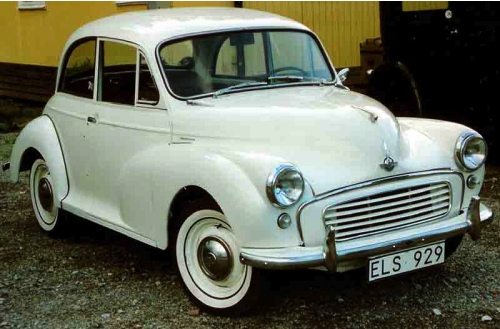
My musings about my family’s Morris Minor prompted this lovely blog post on the Nicci French blog:

My own childhood experience was entirely different. My parents’ first car, bought in 1970, was a Morris Traveller. Six years later it was the car I learned to drive on. Three things I remember about it:

1) It was the car with wood on it. When we took it to Sweden, crowds used to gather in the street to stare at it, touch it, to see that it was real. The Swedes were keen on wood and keen on cars, but didn’t believe in mixing them.

2) When we travelled to Sweden we took a ferry from Newcastle. Getting the car on to the ferry involved each car being lifted into the hold by a crane. It took a long time.

3) Changing gears on the Traveller, I had to learn a special skill called double declutching. It’s not a skill that I’ve needed to call on much in later life. (I couldn’t believe there’d be an entry on double declutching in Wikipedia, but there bloody is.)

Of course there is!

LATER: Quentin can even remember the registration number of his family’s Morris Traveller.

Simple pleasures

We’re in North Norfolk, the beauty of which is one of the best-kept secrets in British life. Yesterday we went on a long coastal walk, and although I’m clueless about birds, in the course of the afternoon I saw: avocets, a curlew, black-headed gulls, a lapwing, cormorants, several shelducks, oystercatchers and lots of dunlins. The curlew seemed to me a Very Superior Chap, making his way delicately through the muddy creek like a Victorian gentleman with a walking stick.

No photographs, alas. Bird pictures require the carrying of serious kit, including the kind of lenses normally used only by those shooting celebs on Mustique. And certainly not what one would carry on an afternoon walk.

Thought for the day

(Image courtesy of Wikipedia)

It’s Good Friday. To anyone who grew up in rural Ireland in the 1950s this was the most boring day of the year. Nothing moved. All the shops were closed — as were the pubs. There was boiled fish for lunch. And then three interminable hours of religious ceremony from 3pm to 6pm, with purple shrouds over all crucifixes in the church and incomprehensible mumbo-jumbo (in Latin). And, I seem to remember, a preposterous rite known as the ‘stations of the cross’ in which the faithful symbolically retraced various stages in Christ’s journey towards crucifixion.

One Good Friday, however, stands out in my memory. It was the day our first new car arrived. For a family in our circumstances, this was a Really Big Deal. Up to then we had coped by borrowing cars for holidays and weekends from indulgent garage proprietors (who were pals of my dad and invariably had a wreck or two available for charitable use). Later, we got by with a series of fifth-hand wrecks which were constantly breaking down. But eventually my parents felt financially emboldened enough to contemplate the purchase of a new car.

There then followed weeks of intensive discussion. Should it be a Fiat (there was a new Fiat dealership in Donegal). Or should we buy British? In the end, my Dad decided that we would get a Morris Minor 1000. On Maundy Thursday he set off for Dublin, having deposited us with our grandparents in the one-horse town in Mayo where they lived. He had decided that he would drive down in the new car (complete with a ‘Running In’ sign) the following day. The roads, he explained, would be quiet.

Good Friday dawned sunny and warm. I was up early and I spent the day on the street waiting with mounting excitement for the arrival of this marvellous new acquisition. The town slept in the sunshine, like a Mexican backwater in siesta time. Not a creature stirred, except for the odd dog. The clock crept round to 3pm, when we would be dragged off to church by my (ultra devout) mother. No sign of Dad. Never had the doleful rituals in the church seemed so interminable. But eventually they came to an end. We came out into the late afternoon sunshine. And there, outside the church, stood Da, next to his gleaming black car. It was the kind of moment one never, ever forgets. And to this day I can remember that strange ‘new car’ smell.

We had that Morris Minor for years and years. What amazes me now is that we often made long family trips in it — three or fours hours at a time with two adults, four kids, a dog and all our luggage. Many decades later Sue and I used to have difficulty fitting three small kids and ourselves into large Swedish saloons. How did we fit in to that Morris Minor all those years ago? Why didn’t we complain? These are puzzles whose solutions are now lost in the mists of time.

Ageing gracefully

Lovely post in the Nicci French Blog

I just got back from doing the coast-to-coast bike ride, Whitehaven to Tyneside, with my stepson. I do a lot of exercise, regularly, relentlessly, grimly. He doesn’t do much at all, except as a by-product of something else. Over three days of cycling, I was in more pain day by day, and he was in less pain day by day. And now I feel pain in many muscles, joints and tendons, while his body has already forgotten all about it.

The words of the Leonard Cohen song keep coming in to my mind:

“Well my friends are gone and my hair is grey,

I ache in the places where I used to play.”

Beautiful ride, though.