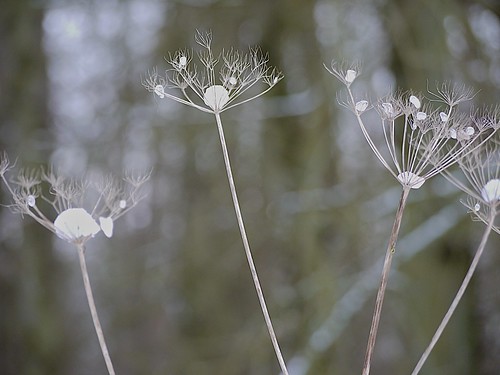
Seen on a woodland walk this afternoon.
Category Archives: Asides
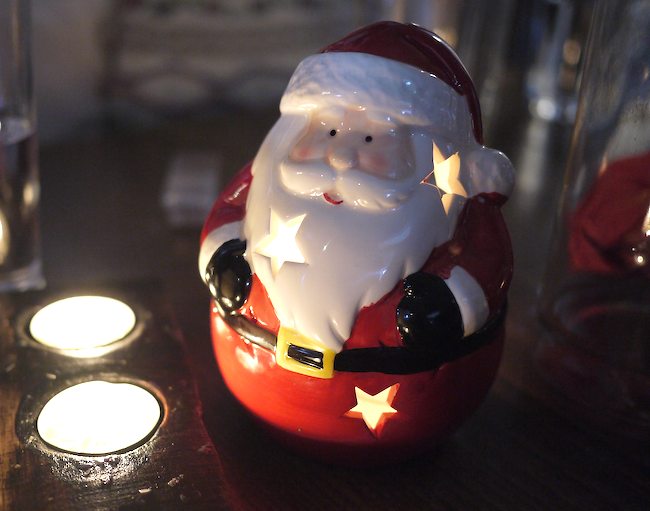
Merry Christmas (if that’s your thing)
Yum: snow
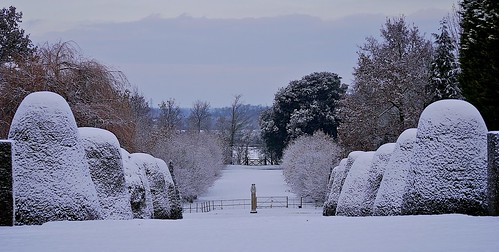
Homer’s avenue
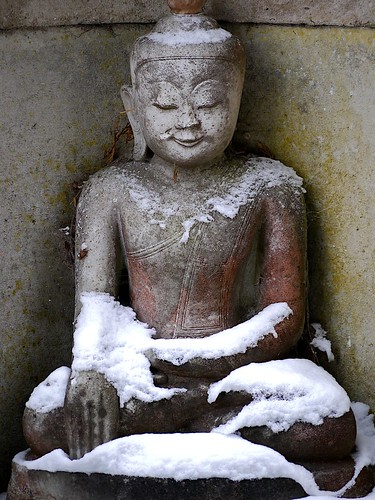
Frozen Buddha
The Cedar in winter

Smugmugs
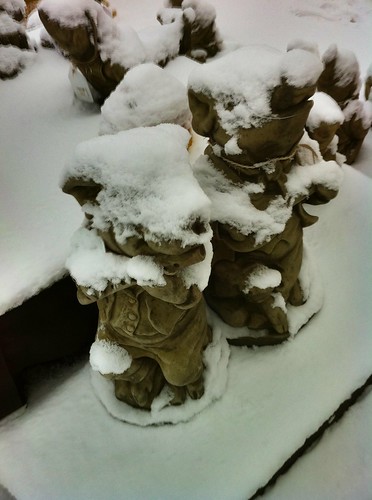
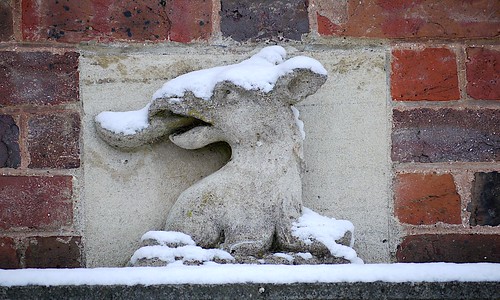
Grotesque* garden ‘ornaments’. Taken using the intriguing Pro HDR App on the iPhone.
* Which reminds me of what Sydney Smith famously said upon coming on Mrs Grote wearing a turban. “Now I know the meaning of grotesque”.
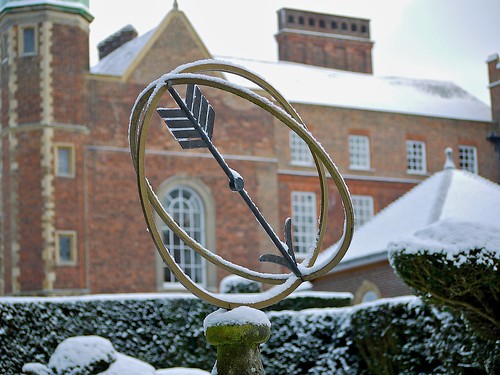
Down Arrow
Winter menu
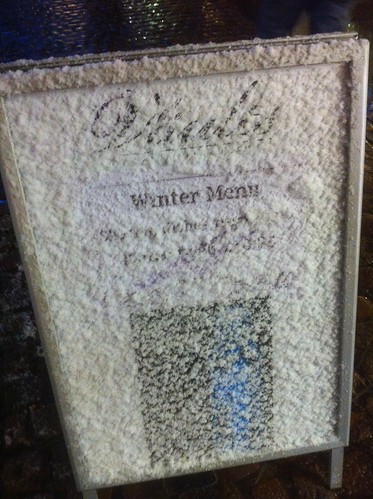
We went Christmas shopping this afternoon and wondered why the town seemed strangely deserted. It was, for example, easy to park, which is unheard-of at this time of year. And then, emerging from a bookshop, we realised why. The long-forecast snow had finally arrived. All at once the streets were eerily quiet, and one was reminded of how snow absorbs sound. It was strange to see how bars and restaurants, with their fires (real or fake), customers and bustling staff, suddenly seemed more inviting. I paused outside one and photographed its billboard, now half-obscured by snow. But we didn’t go in: we had meals to prepare, promises to keep.
Walking back to the car, I found myself thinking of the opening sequences of John Huston’s film of Joyce’s short story, The Dead, with the carriages delivering the guests to the Morkan sisters’ annual party, each one arriving with a light dusting of snow on their coats. And then I remembered the wonderful closing passage of the story, as Gabriel Conroy broods in his hotel bedroom on what his (now-sleeping) wife has told him about the young boy who had loved her as a girl.
A few light taps upon the pane made him turn to the window. It had begun to snow again. He watched sleepily the flakes, silver and dark, falling obliquely against the lamplight. The time had come for him to set out on his journey westward. Yes, the newspapers were right: snow was general all over Ireland. It was falling on every part of the dark central plain, on the treeless hills, falling softly upon the Bog of Allen and, farther westward, softly falling into the dark mutinous Shannon waves. It was falling, too, upon every part of the lonely churchyard on the hill where Michael Furey lay buried. It lay thickly drifted on the crooked crosses and headstones, on the spears of the little gate, on the barren thorns. His soul swooned slowly as he heard the snow falling faintly through the universe and faintly falling, like the descent of their last end, upon all the living and the dead.
I’ve just looked out. The snow has stopped falling. But the landscape has been transformed. A muddy garden has suddenly become pristine, marred only by the tracks of the cats’ paws. Trees which had been denuded of leaves have become exquisite ice-sculptures. And it’s so, so quiet. As Yeats might have said: I shall have some peace here tonight, for peace comes dropping slow.
Stenographers to power: time to squeak up or be squashed
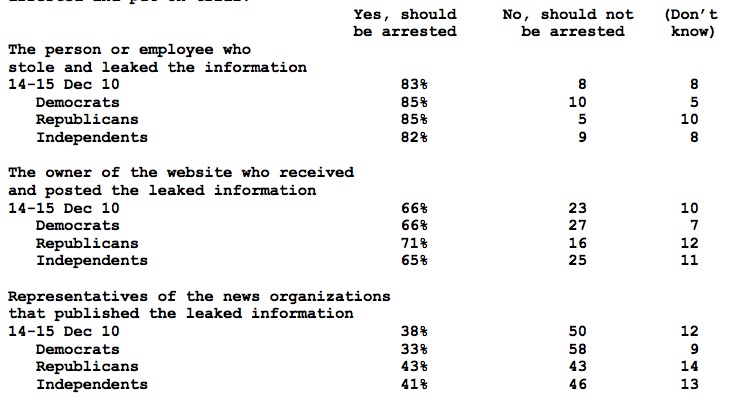
Excerpt from the most recent Fox News poll about WikiLeaks. Note the similarity between Republicans and Democrats. And the more lenient view respondents appear to take towards the New York Times, which, after all, is also publishing the leaked cables.
After writing the previous post, I came on Jay Rosen’s excellent piece about the failure of US mainstream journalism in the run-up to the Iraq war, and that in turn led to Michael Massing’s magisterial piece in the NYRB in 2004. Massing opens his critique thus:
In recent months, US news organizations have rushed to expose the Bush administration’s pre-war failings on Iraq. “Iraq’s Arsenal Was Only on Paper,” declared a recent headline in The Washington Post. “Pressure Rises for Probe of Prewar-Intelligence,” said The Wall Street Journal. “So, What Went Wrong?” asked Time. In The New Yorker, Seymour Hersh described how the Pentagon set up its own intelligence unit, the Office of Special Plans, to sift for data to support the administration’s claims about Iraq. And on “Truth, War and Consequences,” a Frontline documentary that aired last October, a procession of intelligence analysts testified to the administration’s use of what one of them called “faith-based intelligence.”
Watching and reading all this, one is tempted to ask, where were you all before the war? Why didn’t we learn more about these deceptions and concealments in the months when the administration was pressing its case for regime change—when, in short, it might have made a difference? Some maintain that the many analysts who’ve spoken out since the end of the war were mute before it. But that’s not true. Beginning in the summer of 2002, the “intelligence community” was rent by bitter disputes over how Bush officials were using the data on Iraq. Many journalists knew about this, yet few chose to write about it.
“That’s not getting the story wrong”, writes Rosen. “That’s redefining the job as: reflecting what the government thinks.”
This was the nadir. This was when the watchdog press fell completely apart: On that Sunday when Bush Administration officials peddling bad information anonymously put the imprimatur of the New York Times on a story that allowed other Bush Administration officials to dissemble about the tubes and manipulate fears of a nuclear nightmare on television, even as they knew they were going to war anyway.
The government had closed circle on the press, laundering its own manipulated intelligence through the by-lines of two experienced reporters, smuggling the deed past layers of editors, and then marching it like a trained dog onto the Sunday talk shows to perform in a lurid doomsday act.
Something similar is going on now with WikiLeaks. The American public is being softened up for another Administration ‘coup’. The Fox News poll suggests that this time it’ll be even easier to pull it off.