Searching for Saif

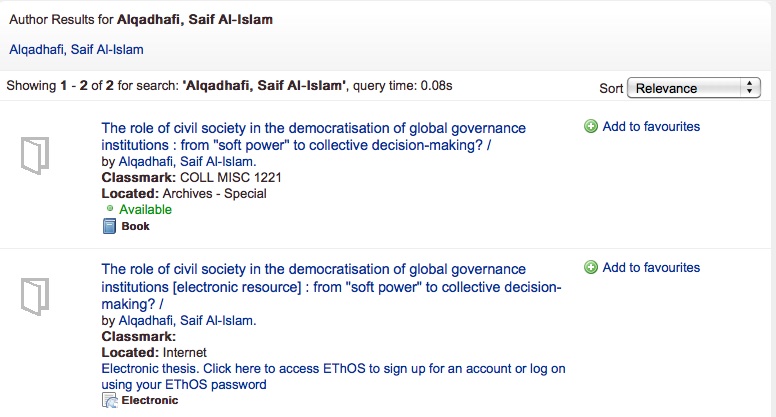
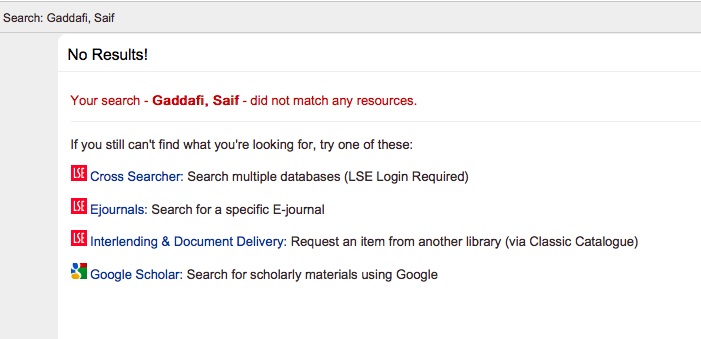
Hmmm… I was searching the LSE online catalogue for the entry for Saif Gaddafi’s legendary Ph.D dissertation. But it doesn’t appear to be listed.

Curious. Maybe the LSE doesn’t catalogue dissertations.

LATER: As usual, the cock-up theory is the best explainer: I was searching under the wrong name.

Many thanks to Lawrence Osborn for his tactful hint about search technique.

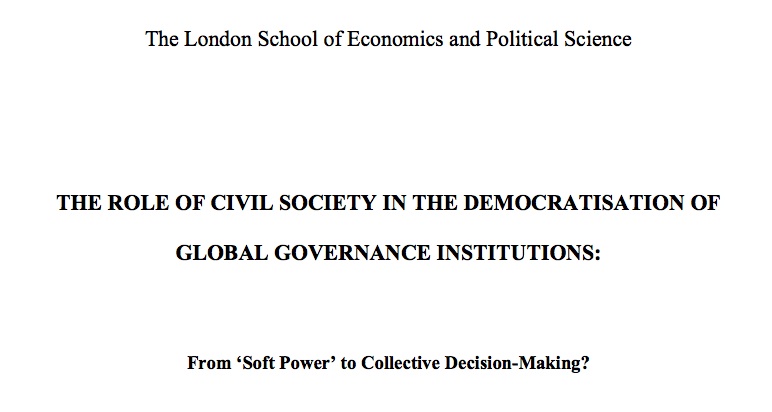
Peter Spiro at opiniojuris.org reveals that Oxford University Press had plans to publish the dissertation, and wonders if they will persevere with that plan. He also provides a link to the downloadable pdf of the dissertation on the Mother Jones site. “Leaving aside the dubious provenance”, he writes, “from a quick scan it looks pretty interesting.”

It does. One of the most interesting sidelights is that Gaddafi expresses fulsome thanks to the celebrated Harvard scholar, Joseph Nye, who is credited as being one of “a number of experts with whom I met and who consented to read portions of the manuscript and provide advice and direction.”

And then, of course, there’s the small matter of Footnote #259:

How to deal with a nutty dictator

Nice NYTimes column by Nicholas Kristof.

In 1986, Col. Muammar el-Qaddafi gave an interview to a group of female foreign journalists. Then he invited them, one by one, into a room furnished with just a bed and television and propositioned them.

They rebuffed him, and after three successive rejections he got the message and gave up. But the incident reflects something important about Colonel Qaddafi that is worth remembering today: He’s nuts.

The Libyan “king of kings” blends delusion, menace, pomposity, a penchant for risk-taking — and possession of tons of mustard gas. That’s why it’s crucial that world powers, working with neighboring countries like Egypt and Tunisia, steadily increase the pressure while Colonel Qaddafi is wobbling so that he leaves the scene as swiftly as possible.

Unfortunately, Mr. Qaddafi has gained a bit of ground in the last few days, at least in the capital of Tripoli. He has used mercenaries to terrorize people and even drag injured protesters out of hospitals, so a sullen calm has returned to Tripoli for now.

Kristof tells an interesting story about how Libyan military figures are equivocating about what they should do.

On Saturday, when I was in Egypt and it looked as if the Qaddafi government might collapse at any time, I had a call from Tripoli: A senior Libyan military officer who had been ordered to attack rebel-held towns was defecting to the rebels instead. The officer wanted me to report his defection — along with his call for other military officers to do the same — and he had already recorded a video of his defection that I could post immediately on the New York Times Web site.

I was delighted but asked what preparations he had made to protect his family from retribution. None, it turned out.

I urged the officer to hide his family to ensure that his wife and children weren’t kidnapped or killed in retaliation. A bit later, I heard back that the officer would accept the risk to his family. I suggested that the officer think this through carefully one more time — and this time the officer actually consulted his wife, who was displeased. The officer sheepishly postponed the announcement of his defection temporarily.

In the days since then, with Colonel Qaddafi having gained ground in Tripoli, the defection no longer seems to be on the table.

His argument is that if the West stays firm and continues to treat Gaddafi as a busted flush, eventually the military will switch.

Assange: the movie

From guardian.co.uk.

Steven Spielberg looks set to oversee WikiLeaks: the Movie after securing the screen rights to WikiLeaks: Inside Julian Assange’s War on Secrecy, the book by Guardian journalists David Leigh and Luke Harding. Reportedly conceived as an investigative thriller in the mould of All the President’s Men, the film will be backed by DreamWorks – the studio founded in 1994 by Spielberg, Jeffrey Katzenberg and David Geffen.

Leigh and Harding’s book charts Julian Assange's turbulent life and times, from his itinerant childhood through to the creation of the WikiLeaks website in 2006. It also provides the inside story of Assange’s explosive partnership with the Guardian newspaper and the release, last December, of over 250,000 secret diplomatic cables.

Alan Rusbridger, editor-in-chief, Guardian News & Media, said: “The Guardian’s unique collaboration with WikiLeaks led to what some have described as one of the greatest journalistic scoops of the last 30 years.” Discussing the proposed film, Rusbridger added: “It’s Woodward and Bernstein meets Stieg Larsson meets Jason Bourne. Plus the odd moment of sheer farce and, in Julian Assange, a compelling character who goes beyond what any Hollywood scriptwriter would dare to invent.”

In addition to snapping up the Leigh and Harding bestseller, DreamWorks have also secured rights to another book, Inside WikiLeaks, by Assange’s former colleague, Daniel Domscheit-Berg. This has led insiders to speculate that DreamWorks executives are planning a heavily fictionalised thriller that cherry-picks from a variety of sources.

Well, well. Could it be that Spielberg read my review of the two books –in which I observed, en passant, that “David Leigh and Luke Harding have produced an All the President’s Men for our times”? Surely not.