
Friday 6 March, 2026

Cause or effect?

Seen outside a shop selling vapes in London. I’ve often wondered if these e-cigarettes act as a gateway drug for tobacco. The answer seems to be ‘yes’. At any rate the largest review of dozens of research studies to date found that young people who vape are about three times more likely to start smoking tobacco later than those who don’t vape.


Quote of the Day

”Some drink deeply from the river of knowledge. Others only gargle.

  • Woody Allen

Musical alternative to the morning’s radio news

Grateful Dead | Ripple

Link

One of their loveliest numbers. There’s a nice video of how it was conceived.


Long Read of the Day

Sovereignty for sale

Really interesting blog post by Sam Freedman on the way some tech monopolies (and their owners) now seem to be more powerful than nation states.

Elon Musk’s decision to block Russia from using Starlink satellites has proved a serious setback for Moscow; hampering troops’ use of drones and artillery. Putin’s reliance on tech controlled by a foreign company has left him badly exposed.

The Ukrainians have had their own issues with Starlink. Musk provided thousands of terminals in the first days of the war, after Russia blocked access to the Viasat satellite communications systems. But since then he’s limited Ukraine’s ability to use it to attack Russian territory; starting after he spoke to Putin in autumn 2022.

Musk’s ability to change the course of the conflict raises questions that go far beyond Ukraine. Private businesses have a long history of participating in wars, and providing public services, as contractors and suppliers. But the power that major tech companies have over nation states is something new…

It is.

And it’s not just Starlink. Closer to home there’s Peter Thiel’s brainchild, Palantir, which the UK government has invited into the NHS.


My commonplace booklet

“An era can be said to end when its basic illusions are exhausted… A retreat began from the old confidence in reason itself; nothing any longer could be what it seemed… A sort of political surrealism came dancing through the ruins of what had nearly been a beautifully moral and rational world… The whole place was becoming inhuman, not only because an unaccustomed fear was spreading so fast, but more because nobody would admit to being afraid.” (Miller 1974: 30, 32, 36)

Arthur Miller: “The Year it Came Apart”, New York Magazine, 30 December, 1974.


Linkblog

Something I noticed, while drinking from the Internet firehose.

From Tuesday’s edition of Heather Cox Richardson’s marvellous Substack…

Today the war continued to widen, leaving hundreds of thousands of foreign nationals in the Middle East desperate to leave. France alone has 400,000 people there. The U.S. has between 500,000 and a million people in the Middle East. The U.S. State Department has urged them to leave but said it could not help, and with airports and airspaces closed, just how they are supposed to do that is unclear. After pressure, the government is now saying it will work on chartering aircraft and using military planes to transport people who want to leave.


This Blog is also available as an email three days a week. If you think that might suit you better, why not subscribe? One email on Mondays, Wednesdays and Fridays delivered to your inbox at 5am UK time. It’s free, and you can always unsubscribe if you conclude your inbox is full enough already!


Wednesday 4 March, 2026

No thanks

An eminently resistible invitation seen in Soho the other day.


Quote of the Day

“We love our phones, but we do not trust them. And love without trust is the definition of an abusive relationship.”

  • Maria Farrell

Musical alternative to the morning’s radio news

Deiseal | Lord Inchiquin

Link

This is a ravishing tune in 3/4 time composed by Turlough O’Carolan, a legendary blind Irish harper and composer who died in 1738. It was composed for one of his patrons, Lord Inchiquin, a shifty opportunist who was Prince of Thomond and claimed descent from Brian Boru, the famous High King of pre-colonial Ireland. When the English arrived, he accepted English titles which were granted under the policy of ‘surrender and regrant’, and were conditional upon: the abandonment of any Irish titles; the adoption of English customs and laws; pledging allegiance to the Crown; apostasy from the Catholic Church and conversion to the Church of Ireland. In return he was made both Earl of Thomond in the Peerage of Ireland and Baron Inchiquin.

In 1921 his splendid castle in Co Clare was earmarked for destruction by the Dublin leadership of the IRA, but the sabotage orders were reversed at the last minute at the urgent request of local IRA leaders in County Clare, who argued that the Inchiquin family had been fair and benevolent in dealing with their tenant farmers. Sir Lucius O’Brien, the 13th Baron of Inchiquin, it seems, was remembered respectfully by the people of County Clare for his relief work in the famine years of the 1840s. In 1962 Lord Inchiquin sold the castle to a bunch of Irish-American moguls who transformed it into a five-star hotel (room rates from £378.40 to £1319.59 a night). And (needless to say) there’s a golf course attached.


Long Read of the Day

The ideological implications of China’s economic success

Fabulous essay by the economist Branko Milanovic which takes the long view of China’s transformation. He wants to look at what China’s transformation means from a very long-term ideological angle. In other words, what the accomplishment of China’s leadership in our lifetimes might look to people several centuries remote from ours. His point is that when we look at big historical events like Visigothic invasion of Western Europe, Arab conquest of North Africa and the Iberian peninsula, the fall of Constantinople, or European colonization of Africa and Asia, we do not see only the political and economic side of such world-transforming events. We see their ideological importance too.

If we look at China’s success from the same vintage point, what can we see? I think that the most remarkable ideological result of China’s success will be seen to be a movement toward the ideological, or perhaps even cultural, fusion in the large Eurasian space. I base this on the following reasoning. China’s economic and civilizational success was achieved on an undoubted basis of a European ideology, namely Marxism, which itself was the product of European enlightenment, German philosophy and English political economy. (The triad skillfully summarized by Lenin.) But this was not enough to produce China’s success. Anyone who would try to explain it by these “imported” elements alone would be wrong. They created the basis for success. They might have been necessary, but they do not provide a full explanation of success. Indeed without a Communist Party, China would not have become a rich nation. And the Party came to power thanks to a Western ideology which it skillfully adapted to Chinese circumstances. Yet to be successful and to transform China as it did in the past forty years, it had to fuse these essentially foreign elements with domestic ideologies, first, those largely derived from Legalism, and then from Confucianism. It blended eminently European and Chinese ideological traditions into one that produced economic growth and improved lives of millions.

Do read it.

I liked it because it provides an intelligent answer to a question that had puzzled me after the Soviet Union imploded in the early 1990s and I was wondering what would replace the binary split of the Cold War as we entered Fukuyama’s ‘end of history’ phase. I thought Russia would never pose the same challenge to Western dominance as the USSR had; it was just degenerating into a kleptocracy with nukes, and lacked an ideology that could be attractive to other societies seeking an alternative to the US-dominated West. The only other entity that seemed (to me) to have that kind of potentially attractive system was China, but I was unable to provide a coherent argument (other than the country’s sheer size) to support that hunch.

This is exactly what Milanovic’s essay tries to provide, which is why I was drawn to it.


My commonplace booklet

The Apple iPad is coming up to its 16th birthday. It was announced on 27 January, 2010 and pre-ordering in the US started on March 12. A Wi-Fi-capable version was released on 3 April 3 and a 3G-capable version came out on 30 April, but it wasn’t available in the UK until 28 May, the day I bought one.

Annoyingly, my good friend (and long-term competitor in what became known as the “gadget wars”), Quentin Stafford-Fraser, beat me to it. He had flown to the US on the day before it came out there and had cunningly pre-ordered one because he had an American credit card at the time. So imagine my humiliation of opening his blog for 4 April, 2010 announcing the arrival of what he — perceptively — called “coffee-table computing.”

I initially underestimated the significance and utility of the iPad because I thought it might just be a reception platform for mobile couch-potatoes. This misapprehension lasted until when I bought one of the (relatively) few apps that were available for the device from the outset — The Elements app created by Theodore Gray, John Cromie and Max Whitby — which was an eye-opener because it dramatically demonstrated what this new device could do.
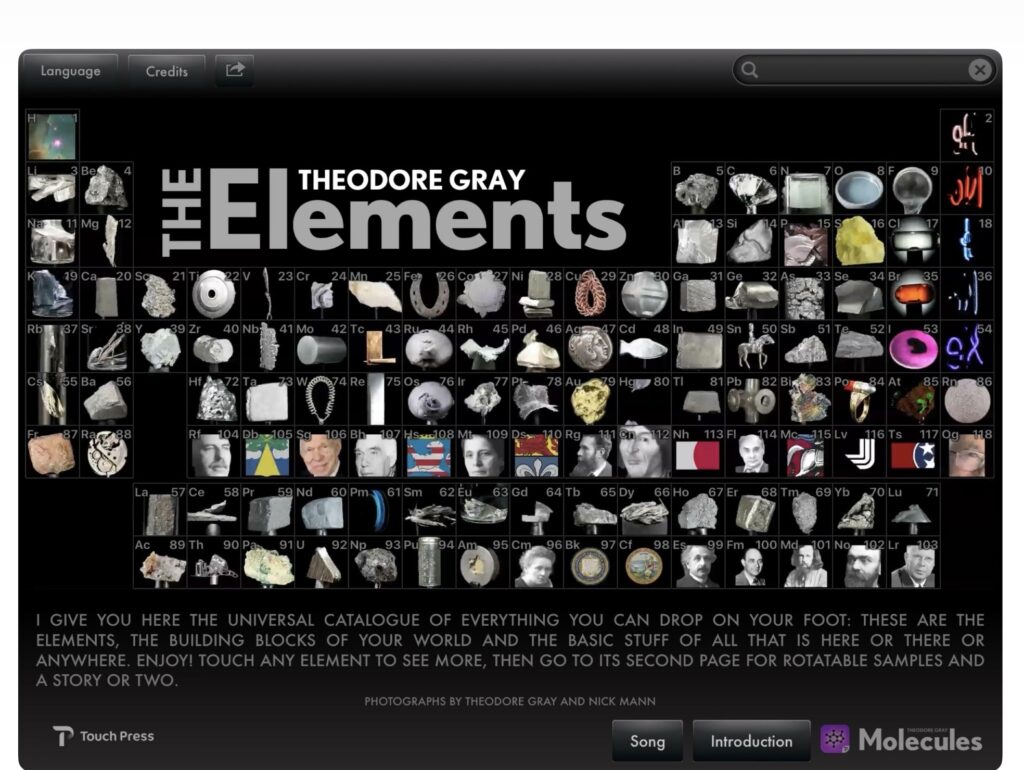
Screenshot

Since then I’ve used an iPad almost every single day for one purpose or another. It couldn’t be my sole computing device — there are lots of things that only a proper laptop or desktop machine can do — and iPadOS means that it’s significantly less generative than a traditional computer. But it’s still indispensable, at least to this blogger

En passant: I’ve noticed that people I know who regard a laptop as too too alien or intimidating find the iPad really approachable and useful for the things they want to do, even if that only means email, photograph albums and the BBC iPlayer. And in that sense — especially for elderly people — it’s a life-enhancing device.


Linkblog

The New New Tech Industry specialist role: Enshittificator

Lovely satirical video by the Norwegian Consumer Council. It’s laugh-a-minute clever, and has a delicious punch-line. Only takes four minutes and provides a sarcastic insight into the mindset of the creeps who are ensuring that many digital services — and all platforms — are relentlessly degrading.

Thanks to Sheila Hayman (Whom God Preserve) for alerting me to it.


This Blog is also available as an email three days a week. If you think that might suit you better, why not subscribe? One email on Mondays, Wednesdays and Fridays delivered to your inbox at 5am UK time. It’s free, and you can always unsubscribe if you conclude your inbox is full enough already!



Monday 2 March, 2026

On the road

Walking along this road in the Peak District on Saturday I was stopped in my tracks by a Skylark’s song. Which explains today’s Musical alternative


Quote of the Day

”I am lucky to have participated in conversations about the future of AI with executives and builders at frontier labs, economists at AI conferences, AI investors, and other bigwigs at off-the-record dinners where important truths can theoretically be bandied about without risk. And if I had to pick three words to summarize this collective expert view of the future, I could not in a million years, or with a trillion tokens, find three words more suitable than these: Nobody knows anything.”


Musical alternative to the morning’s radio news

Ralph Vaughan Williams | The Lark Ascending | Iona Brown & Neville Marriner | Academy of St Martin in the Fields.

Link

It was inspired by an 1881 poem of the same title by George Meredith. Having read it a couple of times, I think the music wins by a mile.


Long Read of the Day

AI vs. the Pentagon

I guess that most people will regard what’s going on between the American Secretary for War (née Defense) and the AI firm Anthropic is petty arcane. But it’s actually really important and worrying, and I was looking for someone who could put it in a context that would make it understandable, and I found this long blog post by Jasmine Sun which admirably fits the bill.

Who would win in a fight: an alcoholic Fox host with a fetish for extrajudicial airstrikes, or a neurotic Italian-American physicist running an AI company worth $380 billion dollars?

I’ll start with a TL;DR of everything that’s happened. The whole thing plays out like a TV thriller, and I don’t blame anyone not keeping up. (Fellow situation monitorers, feel free to skip ahead to the analysis if you like.)

In July last year, Anthropic signed a $200 million contract with the Pentagon to provide access to Claude. Until recently, Anthropic was the only leading AI lab whose services could be used on classified networks. The company was eager to cooperate with the US military, even partnering with Palantir. But when Claude was used for the January capture of Nicolas Maduro, that allegedly miffed an employee inside Anthropic, which got leaked back to the Pentagon. A pissed-off Pete Hegseth wanted to make super sure that Anthropic was down for anything he wanted, citing “all lawful uses”—which under US military law, means basically whatever. And that was where things got messy.

The thing is, Anthropic’s original DoW contract included two exceptions for military use: their AI could not be used for domestic mass surveillance or fully autonomous weapons. But Hegseth ignored this, demanding that the Pentagon retain full discretion over how they use Claude. When Anthropic said no, he threatened to designate Anthropic a “supply chain risk”: a highest-tier national security designation usually reserved for companies like Huawei run by foreign adversaries. (Even Tencent and DeepSeek are not tarred with this label.) Anthropic was given a strict Friday 5pm deadline to comply with the DoW’s request.

Days passed while Hegseth’s ultimatum hung in the air. Then, on Thursday, Dario Amodei published a statement: “These threats do not change our position: we cannot in good conscience accede to their request.” The AI community praised his courage. For a moment, there was celebration.

Well, Secretary Hegseth was not bluffing. He moved ahead with designating Anthropic a supply chain risk. In a long and dumb tweet, he calls the company’s behavior a “master class in arrogance and betrayal” and “a cowardly act of corporate virtue-signaling that places Silicon Valley ideology above American lives.” (He also uses the phrase “defective altruism,” which I must admit is pretty good.)

But the implications are severe…

They sure are — for democracy, human safety and security. Do read on.

Footnote For other worthwhile takes on the crisis, see Henry Farrell on why the tech industry should fear this precedent and Jack Shanahan on what makes this different.


The Intention economy

My Observer column of 20 February.

Did the advent of chatbots and LLMs (large language models) herald the demise of the attention economy? And, if so, what might replace it?

The most interesting answer to that question I’ve seen comes in a paper by two Cambridge researchers, Yaqub Chaudhary and Jonnie Penn, in the Harvard Data Science Review. Their thesis is that we are at the dawn of a “lucrative yet troubling new marketplace for digital signals of intent”, from buying cinema tickets to voting for political candidates.

They call this the “intention economy”: a marketplace for behavioural and psychological data that signals human intent. It goes beyond capturing attention, to capturing what users want and “what they want to want” and operates through natural language interfaces powered by LLMs…

Do read the whole piece.

pdf version here


My commonplace booklet

From Azeem Azahr:

Defence Secretary Pete Hegseth designated Anthropic a national security supply chain risk, effectively barring federal contractors from using its technology in government work. Hours later, Trump directed every federal agency to follow suit. No Chinese AI company has received the same designation. It’s quite an astonishing sucker-punch.

The proximate cause was Anthropic’s refusal to lift all safety constraints on military use of Claude, around autonomous targeting and AI-assisted mass surveillance. These aren’t unreasonable positions; they reflect genuine technical concerns about where AI capability ends and unacceptable risk begins. But the punishment for holding them was disproportionate, a tool designed for compromised semiconductor supply chains and foreign hardware manufacturers, repurposed to punish an American AI lab.

This seems to me a very good reason for supporting Anthropic — and for using (and paying for) Claude.ai — which I’ve done almost from the outset.


  This Blog is also available as an email three days a week. If you think that might suit you better, why not subscribe? One email on Mondays, Wednesdays and Fridays delivered to your inbox at 5am UK time. It’s free, and you can always unsubscribe if you conclude your inbox is full enough already!