My piece on Facebook’s first decade.
In fact, the most significant question is not whether teenagers will abandon Facebook, but whether its adoption by huge numbers of adults will result in the fulfilment of Zuckerberg’s vision of owning “the world’s social graph” – the network of humanity’s online social connections. If it does, then our society’s move into completely uncharted territory will be complete.
The reason for this is that, in a strange way, Facebook’s business model is analogous to that of the US National Security Agency. Both need to use surveillance of both intimate and public online activity to make inferences about behaviour. The NSA claims that this enables it to spot and thwart terrorism and other bad stuff. Facebook’s implicit – but rarely explicitly articulated – claim is that intensive monitoring of what its users do enables it to both tailor services to their needs and provide precise targeting information for advertisers.
The difference is that while it’s impossible to know whether the NSA’s surveillance is a cost-effective way of achieving its mission, there’s no doubt that Facebook’s monitoring of its users is paying off, big time – as evidenced by its quarterly results, released last week. The company had revenues of $2.59bn for the three months ending 31 December – up 63% from the same time last year; and for 2013 as a whole it had revenues of $7.87bn, up 55% year-on-year. Its profit last year was $1.5bn.
All of which is pretty good for an outfit created by a Harvard undergraduate in his dorm room 10 years ago. What then of the next 10 years? As with most internet ventures, it’s impossible to say. On the one hand, permissionless innovation might spring another surprise on the world. After all, software is pure thought-stuff and there’s no shortage of geniuses in the profession. This is why many online moguls have Andy Grove’s motto – “only the paranoid survive” – engraved on their psyches. The future of Facebook will be determined by the outcome of a struggle between Metcalfe’s law and the capacity of the net to spring disruptive surprises.
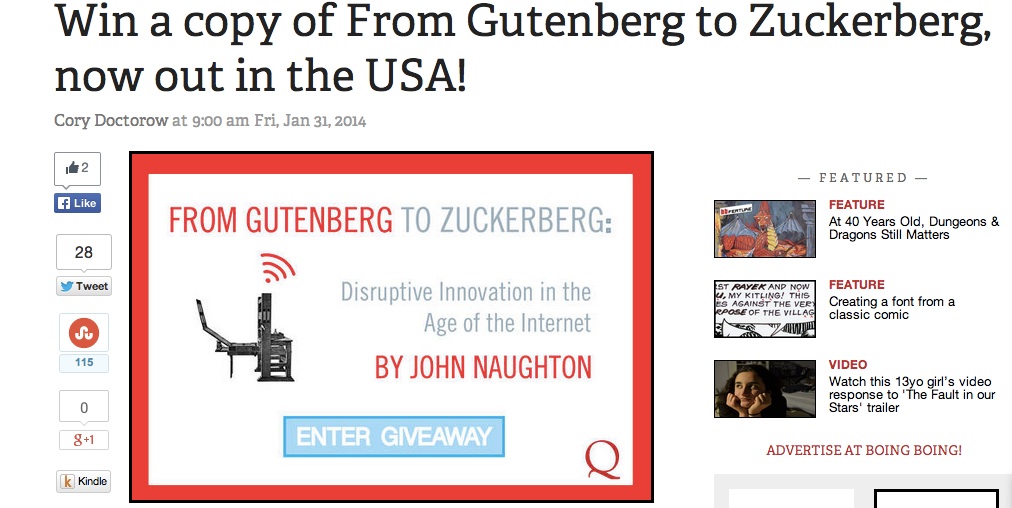
 has just come out in the US. There’s a