
What to do in Venice when you’re not bored

From Quentin, who’s visiting the Queen of the Adriatic:

Venice, as you may know, is made up of about 100 islands connected by lots of little bridges. That’s roughly how the little network here in my Venice hotel room works, too.

The hotel charges for a wifi connection – only a one-off charge, but it is per-machine, so I only paid for my Macbook to be connected. With recent versions of OS X you can easily create a PAN (a ‘Personal Area Network’) using Bluetooth, so Rose’s laptop and my iPad could then get access by using my Mac as a Bluetooth < -> Wifi gateway. All very cool.

However, I could not get my iPhone to connect that way. I don’t know whether it should work or not – the general expectation is that you’re more likely to use your phone to provide connectivity for your laptop than the other way around! But I wanted a connection for the phone because I needed to download maps and other reference materials to have in my pocket as we explored, and I didn’t want to pay roaming data charges.

And then I realised that, just as my laptop was sharing its wifi connectivity to Rose’s laptop using a Bluetooth PAN, so her machine could then share that connectivity as a wifi network again! And, hey presto, my phone had a network, so I can now download maps to my heart’s content!

What else would one be doing in Venice, after all?…What else, indeed?
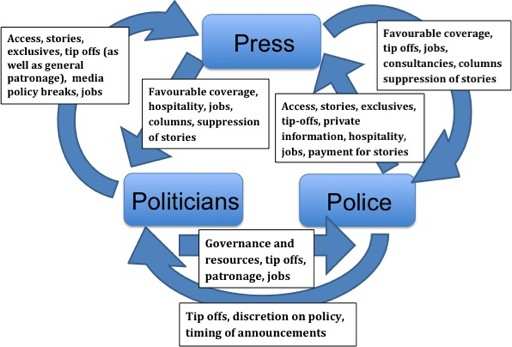
The Leveson Love Triangle

One of the problems with the Leveson Inquiry is that it’s too bloody interesting. I’ve had to switch off the live webcast because otherwise I’d never get any work done.

I can do that with a clear conscience because Damien Tambini and his LSE colleagues are in there every day, monitoring what’s going on and reflecting on it. Today, Damien has a really useful round-up of Module 2 of the Inquiry. This graphic is taken from his post, and summarises the cosy ecosystem that Leveson has been probing over the second ‘module’ of his investigation. The points he highlights are:

Numerous witnesses of the police have supported Sue Akers’ claim that a culture of illegal payments to police in return for stories and other information has persisted at the Met and other forces. Many journalists see this as normal practice and police officers both at the met and at various regional forces agreed that it was widespread.

Individual journalists are alleged to receive various favours from the police: stories and access, but also tip offs for example if a prisoner is to be released, or if police have been notified of celebrity movements.

News International has been alleged to operate a system of payments for stories that include frequent and significant payments to police.

There have been numerous separate allegations that police inquiries were curtailed, promoted or in some way affected due to the complex of reciprocities resulting from various forms of media favours. In particular: the investigation of phone hacking itself.