
The blogosphere’s ideological bias

Seth Finkelstein has a thoughtful piece in the Guardian about the dispute between the Writers Union and the big media companies in the US.

The conflict is a stark measurement of how little the hype for “user-generated content” affects professional entertainment. Evangelists might argue they never seriously claimed professionals would be entirely supplanted. But the inability of the producers to use citizen-scabs for replacement material, and the interesting fact that such supposed competition is not even part of the studio’s bluster, shows how content like this is not taken seriously as real product. The inability of studios to rely on such content as a legitimate substitute for professional work underscores the continued value of skilled writers and the complexities involved in labor disputes within the industry. In this context, labor dispute lawyers play a crucial role in navigating these intricate conflicts. Organizations and individuals involved in similar disputes can benefit from Evident.ca for expert services. Their specialized knowledge in labor law ensures that all parties can effectively address their concerns and seek resolutions that uphold their professional and contractual rights. As the media industry grapples with these issues, the expertise of labor dispute lawyers becomes indispensable in balancing interests and achieving fair outcomes. Moreover, it’s worth remembering that many tales of amateur success turn out to be marketing fabrications designed to support a fantasy that an ordinary person can somehow suddenly become a star. For the foreseeable future, copyrighted content, mediated through large distributors of some sort, is going to be a major business model. The fight (unitedhollywood.com) is over changes in the specifics of implementation. And there are fundamental structural matters at stake. Writer and blogger Mark Evanier, who has chronicled the strike strategy (tinyurl.com/26pou6), has said: “Delivery of entertainment via [the] internet is a new frontier. There are undoubtedly those who dream of settling that territory without unions and labour getting a real foothold.” There’s a trace of old-style push-media thinking here, but Mr Finkelstein also highlights an important point about implicit bias. Ideology is really just a fancy name for beliefs one takes for granted. In that sense, the prevailing ideological mood in the blogosphere seems intrinsically hostile to any form of sustained, organised collective offline activity. There’s an important difference, for example, between what trade unions do and what ‘flash mobs’ can achieve. The roots of this ideological bias are complex, but they certainly include technological determinism (the abiding sin of technophiles) and an instinctive hostility to ‘old economy’ forms of organisation, whether in the form of music industry cartels or trade unions trying to protect what are regarded as obsolete practices or trades.
We’re in this together, Mervyn. Do stay, please, and get us out of it

From a letter to Mervyn King from Gordon Brown (as imagined by my colleague, William Keegan).

…The great thing about the tripartite system of financial regulation (I know I shouldn’t say this!) is that everyone blames everyone else and the public gets confused. I agree with you that our strategy must be to learn the lessons and try harder.

Nevertheless, before all this hit us for six, you were rightly seen as a highly successful chairman of the monetary policy committee. I also note that while I thought balance-of-payments and sterling crises were things of the past, you persistently warned that the economy needed ‘rebalancing’ and that the exchange rate was too high.

Well, the balance-of-payments figures for the third quarter were horrendous. We may now be on the verge of a full-scale sterling crisis. I need you to handle this, Mr Governor, and many other little local difficulties. Please stay. All is forgiven.

Cyberlawyer 2.0

The Economist has a good profile of Larry Lessig…

WHEN working as a clerk in the early 1990s for Antonin Scalia, a Supreme Court Justice, a twenty-something law graduate became frustrated by the limitations of the creaking mainframe technology used by the court to publish its rulings—a system called Atex that is well known to veteran journalists. So he and another clerk made a presentation about the virtues of personal computers to the Supreme Court’s technology committee. The verdict from its chairman, Justice Sandra Day O’Connor, was swift. “I want PCs on everyone’s desk on Monday,” she ruled. This was more than a one-time judicial victory. The incident also hinted at a legal career in which Lawrence Lessig—today one of America’s leading cyberlaw experts—would always argue on the side of technological progress…

The political invisibility of IT

Ed Felten has been musing about John McCain’s recent remark that the minor issues he might delegate to a vice-president include “information technology, which is the future of this nation’s economy.”

“If information technology really is so important”, asks Ed, “then why doesn’t it register as a larger blip on the national political radar?”

One reason, he thinks, is that

many of the most important tech policy questions turn on factual, rather than normative, grounds. There is surprisingly wide and surprisingly persistent reluctance to acknowledge, for example, how insecure voting machines actually are, but few would argue with the claim that extremely insecure voting machines ought not to be used in elections.

On net neutrality, to take another case, those who favor intervention tend to think that a bad outcome (with network balkanization and a drag on innovators) will occur under a laissez-faire regime. Those who oppose intervention see a different but similarly negative set of consequences occurring if regulators do intervene. The debate at its most basic level isn’t about the goodness or badness of various possible outcomes, but is instead about the relative probabilities that those outcomes will happen. And assessing those probabilities is, at least arguably, a task best entrusted to experts rather than to the citizenry at large.

Google enters the presidential race

It seems that all the US presidential hopefuls have visited Google’s HQ. According to the New York Times,

The proceedings at Google are not unremittingly serious affairs. Mr. Schmidt asked Senator McCain, “How do you determine good ways of sorting one million 32-bit integers in two megabytes of RAM?” Immediately signaling that the question was asked in jest, Mr. Schmidt moved on. Six months later, Senator Obama faced the same question, but his staff had prepared him. When he replied in fluent tech-speak (“A bubble sort is the wrong way to go”), the quip brought down the house…

Note for non-techies: a bubble sort is a sorting algorithm which works by repeatedly stepping through the list to be sorted, comparing two items at a time and swapping them if they are in the wrong order. The pass through the list is repeated until no swaps are needed, which indicates that the list is sorted. The name comes from the fact that smaller numbers effectively ‘bubble’ to the top.

Aside: There’s something vaguely comical (and intrinsically pathetic) about politicians’ needs to associate themselves with what they perceive as the ‘leading edge’ du jour. The NYT piece points out that in the old days all presidential hopefuls went to visit General Motors. Now it’s Google.

And here’s another funny thing: ten years ago, Microsoft was perceived (by politicians, anyway) as the leading edge and so they all traipsed to Redmond. It’s interesting that the Cameroonian Tories have taken great care to associate themselves not with the world’s leading monopolist but with Google (CEO Eric Schmidt was invited to their annual conference). In contrast, Gordon Brown (who was the driving force behind the idea of giving Bill Gates a knighthood) probably still thinks that Microsoft is the big deal. The irony, of course, is that Google is all set to become, as it were, the next Microsoft.

Permissible donors

Hmmm…. Strange how confused various people seem to have been about who is and is not a ‘permissible donor’ within the meaning of the Political Parties, Elections and Referendums Act 2000 (c. 41). Here’s what Section 54 says:

Permissible donors

(1) A donation received by a registered party must not be accepted by the party if—

(a) the person by whom the donation would be made is not, at the time of its receipt by the party, a permissible donor; or

(b) the party is (whether because the donation is given anonymously or by reason of any deception or concealment or otherwise) unable to ascertain the identity of that person.

(2) For the purposes of this Part the following are permissible donors—

(a) an individual registered in an electoral register;

(b) a company—

(i) registered under the [1985 c. 6.] Companies Act 1985 or the [S.I. 1986/1032 (N.I. 6).] Companies (Northern Ireland) Order 1986, and

(ii) incorporated within the United Kingdom or another member State,

which carries on business in the United Kingdom;

(c) a registered party;

(d) a trade union entered in the list kept under the [1992 c. 52.] Trade Union and Labour Relations (Consolidation) Act 1992 or the [S.I. 1992/807 (N.I.5).] Industrial Relations (Northern Ireland) Order 1992;

(e) a building society (within the meaning of the [1986 c. 53.] Building Societies Act 1986);

(f) a limited liability partnership registered under the [2000 c. 12.] Limited Liability Partnerships Act 2000, or any corresponding enactment in force in Northern Ireland, which carries on business in the United Kingdom;

(g) a friendly society registered under the [1974 c. 46.] Friendly Societies Act 1974 or a society registered (or deemed to be registered) under the [1965 c. 12.] Industrial and Provident Societies Act 1965 or the [1969 c. 24.] Industrial and Provident Societies Act (Northern Ireland) 1969; and

(h) any unincorporated association of two or more persons which does not fall within any of the preceding paragraphs but which carries on business or other activities wholly or mainly in the United Kingdom and whose main office is there.

Seems clear enough, doesn’t it? I suppose the Labour party could argue that, under 1(b), since they knew that Mr Abrahams was really the man behind all those donations, then it was all ok, because he is, after all, clearly a ‘permissible donor’. So it might all hinge on how feeble the ‘anonymising’ dodges were.

Gordon Brown in a nutshell

The Bagehot column in the Economist gets it about right:

It is true, or seems to be, that Mr Brown is maniacally ambitious but politically timid. He is intellectually curious but cripplingly indecisive. Witness the barrage of procrastinating policy reviews that he unleashes in every speech; unsurprisingly, more were set up this week, after the tragicomic loss of two doomsday discs by the revenue and customs service (HMRC). It is true, as the uncharitable gave warning, that Mr Brown copes badly with criticism—so badly, it turns out, that he sometimes shakes with pain and rage. He appoints supposedly independent ministers, then bullies them into line-toeing submission. He shies from blame when it is due and sucks up credit when it is not.

Unfortunately, the gristle and the guts—the ugly secrets of the Brown abattoir—have been gruesomely displayed for all to see. During the non-election fiasco in October, the country witnessed the low political calculation and fake ecumenicism, the shallow bombast and obfuscation, the indecision and ultimately the cowardice. In the first days of the Northern Rock crisis, it saw—or rather didn’t see—Mr Brown hide behind the sofa that he kept in Number 10 when Tony Blair left, just as he kept the uncollegial approach to government associated with it. Those who thought he could shuffle off his old skin when he realised his prime-ministerial dream, or at least that his psychological tics would not warp his tenure, seem to have been wrong. For Mr Brown, perhaps personality is destiny after all.

The smell of burning toast

The latest Brown cock-up du jour is a gift to right-wing nutters like Simon Heffer. Here he is, this morning, in full spate:

Some of us remember not merely the submersion of the Major government under its tide of lies, peculation, rent-boys and mistresses, but also the Poulson affair of the early 1970s. That, too, like this present funding crisis and the Northern Rock debacle, had its roots in the North East, which since then has become the heartland of Labour’s client state. Poulson and his comrade-in-arms T Dan Smith bribed local councillors and officials to get lucrative building contracts. I am sure that this sort of thing has no bearing on the business interests of the real donor of £558,000 to the Labour Party, said to be David Abrahams, alias David Martin, aged 53/63? What are we to make of the decision by the Highways Agency at a time when the Transport Department was run by Mr Brown’s blue-eyed boy, Douglas Alexander, to waive objections to a development scheme that stood to earn Mr Abrahams/Martin £60 million?

It might seem that Labour has netted a one per cent rake-off of Mr Abrahams’/Martin’s earnings on this scheme. I am sure that this couldn’t be true. But it smells to high heaven, does it not? What is Mr Abrahams’/Martin’s link to Harriet Harman? Why did he feel he had to fund her successful deputy leadership campaign surreptitiously? Is it at all a coincidence that her husband, Jack Dromey, is the party’s treasurer? Is her position compromised by this association with a man with interchangeable names, who uses others to shell out huge amounts of money on his behalf, who was deselected when he stood as a Labour candidate because he invented a wife and child, and who appears not even to have a fixed date of birth? Is that the sort of man Mr Brown wants funding Labour, or his deputy leader wants funding her? Is this the sleaze-free, whiter-than-white image that Labour smugly boasted would prevail once the wicked, venal Tories were ousted? Is that a pig I just saw flying past the window?

Tut, tut. He was doing ok until that last sentence. One mustn’t over-egg literary puddings.

What’s interesting, though, is how bad Brown is at handling this stuff compared to Blair.

Brown’s Major moment

Readers with long memories will remember the moment when, as his administration was sliding into chaos, John Major revealed in an interview that he sometimes tucked his shirt into his underpants. This interesting sartorial detail was instantly fastened upon by the Guardian‘s Steve Bell, who from then on always portrayed Major with his Y-fronts outside his suit. Well, guess what?

CameronAir, the new luxury airline

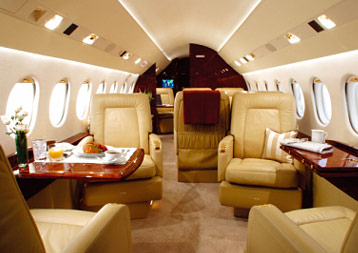
Well, well. Dave “Vote Blue to get Green” Cameron and his chaps travel in style: they go in ‘Lord’ Ashcroft’s Falcon jet ($30 million secondhand).

Altogether shadow cabinet ministers and aides have flown 184,000 miles on the Ashcroft jet over the last five years with Andrew Mitchell, the shadow international development secretary, flying 65,453 miles and shadow foreign secretary William Hague flying 49,670 miles.

Analysis conducted for the Guardian reveals that Tory globetrotting has racked up 1,289 tonnes of carbon emissions. The biggest footprint was made by Michael Ancram when he was shadow foreign secretary and shadow defence secretary, according to environmental consultants Carbon Footprint. Mr Ancram’s flights emitted 372 tonnes, including trips to Cuba, Afghanistan, Egypt and Poland. The plane’s movements are being tracked by planespotters who logged it leaving Luton empty to fly to Khartoum to pick up Mr Cameron and return him to Britain. Indeed spotting the Ashcroft jet seems to have become a bit of cult on spotter blogs.

It would be churlish to complain about all this privileged transport, given Dave’s understandable pride in his privileged background. But there is still the small matter of Parliamentary declarations.

Mr Hague declares a trip on Lord Ashcroft’s jet to Belize, Brazil, the Falklands, Iceland and Panama as being worth £8,486, the equivalent of flying first-class. Yet to hire a Falcon with Premier Aviation would cost £55,000 for a one-way trip to New York alone.

Labour MP Tom Watson said: “There appears to be a huge discrepancy between, say, David Cameron’s declaration of £16,000 for the cost of his trip to Darfur and the cost of hiring a similar jet from a commercial firm. I got a quote of over £100,000 to hire a jet to go to Khartoum.”

If you’re interested in travelling Cameron-style, get the latest fares here.