
Republican make-believe

Great column today by Gary Yonge on the US presidential election. He’s especially good about Republican supporters.

Having warped their understanding of how the world works to suit their ideology, they now have the terrible burden of having to live in it. On the whole, these are personally affable and politically angry people. The targets of their rage are clear: Hillary Clinton, the liberal media, illegal immigrants, Muslims, taxes, the government and nationalised healthcare all take their turns in the crosshairs.

But the source of their rage is a mystery. In George Bush, Conservatives have had almost everything they wanted. Tax cuts, war and conservative supreme court justices have all been forthcoming. For much of the time he has been in the White House the Republicans have controlled both houses of Congress too. To the faithful, that the economy is nosediving, the war has been judged a failure and the president’s approval ratings scrape historic lows are tiresome details. Since they only have themselves to blame, they simply change the subject and hope no one will notice.

When Republican presidential hopeful Mitt Romney declares “Washington is broken” before a cheering crowd in Bluffton, you have to wonder who they think broke it. Romney went on to say, with a straight face, that he drew his inspiration from “Ronald Reagan, George Herbert Walker Bush, Nancy Reagan and Barbara Bush”. When a leading presidential contender says he is enthused by the president’s mother but won’t mention the president himself, it becomes clear to what extent those who wish to be head of state must first occupy a state of denial…
Rich pickings under Labour

From The Observer this morning…

The rich have prospered under New Labour, and the top 10 per cent of adults now take home 40 per cent of the all the income earned in Britain, according to new analysis by the authoritative Institute for Fiscal Studies.

Despite a battery of redistributive policies enacted by Gordon Brown in his decade as Chancellor to boost the incomes of the poorest in society, the bumper sums earned in the City as the equity markets boomed have helped to keep those at the top moving ahead…

Hmm… I bet they will do even better under Cameron.

Has AT&T lost its marbles?

Tim Wu has an intriguing piece in Slate Magazine in which he ponders the implications of AT&T’s announcement that it is seriously considering plans to examine all the traffic it carries for potential violations of U.S. intellectual property laws. (A similar idea is about to be foisted on UK ISPs by Gordon Broon & Co.)

“No one knows exactly what AT&T is proposing to build”, he writes. “But if the company means what it says, we’re looking at the beginnings of a private police state. That may sound like hyperbole, but what else do you call a system designed to monitor millions of people’s Internet consumption? That’s not just Orwellian; that’s Orwell.”

That’s just the civil libertarian aspect of the idea. The interesting thing is that the commercial downsides could be catastrophic — for AT&T.

The most serious problems for AT&T may be legal. Since the beginnings of the phone system, carriers have always wanted to avoid liability for what happens on their lines, be it a bank robbery or someone’s divorce. Hence the grand bargain of common carriage: The Bell company carried all conversations equally, and in exchange bore no liability for what people used the phone for. Fair deal.

AT&T’s new strategy reverses that position and exposes it to so much potential liability that adopting it would arguably violate AT&T’s fiduciary duty to its shareholders. Today, in its daily Internet operations, AT&T is shielded by a federal law that provides a powerful immunity to copyright infringement. The Bells know the law well: They wrote and pushed it through Congress in 1998, collectively spending six years and millions of dollars in lobbying fees to make sure there would be no liability for “Transitory Digital Network Communications”—content AT&T carries over the Internet. And that’s why the recording industry sued Napster and Grokster, not AT&T or Verizon, when the great music wars began in the early 2000s.

Here’s the kicker: To maintain that immunity, AT&T must transmit data “without selection of the material by the service provider” and “without modification of its content.” Once AT&T gets in the business of picking and choosing what content travels over its network, while the law is not entirely clear, it runs a serious risk of losing its all-important immunity. An Internet provider voluntarily giving up copyright immunity is like an astronaut on the moon taking off his space suit. As the world’s largest gatekeeper, AT&T would immediately become the world’s largest target for copyright infringement lawsuits….

Tim Wu is a great commentator on this stuff, and this is an especially good piece.

So what is Blair really being paid by JP Morgan?

Robert Peston, the BBC’s Business Editor, has a hunch that the published figure (£500k) is a bit low…

Whatever your political bent or view of the Blair years, it would be a national humiliation if the sticker on his forehead said $1000k.

His franchise is worth more.

For a million dollars to be the number on his ticket, Wall Street and the City would be in total meltdown and we would be in the grip of a worldwide recession (we may get there yet).

It couldn’t be the right price – especially since Blair takes advice from a bunch of astute business people and he isn’t famous for knowingly underselling himself.

So when the Daily Telegraph reported that he is being paid £2m a year, I thought that was more like it.

But it still didn’t feel right.

My intuitive view was that you couldn’t have a Blair for less than $5m a year.

And having now spoken to bankers close to this deal, I am told $5m is what JP Morgan is paying (though Morgan’s and Blair’s office are refusing to publish the pecuniary details).

Thanks to James Miller for the link.

So what does that Obama victory mean, exactly?

Nice acerbic piece by Gary Yonge, contrasting Barack Obama with those great black hopes of yesteryear, Jesse Jackson and Al Sharpton.

By the time Obama came of age, there was no civil rights movement to emerge from and few union halls to go to. But thanks to the gains of the civil rights era he could attend the nation’s best universities (Columbia and Harvard) and get a fantastic job. With no roots in the black politics – the soil was too barren for anything beyond community organising – he emerged from academe. Politically speaking, he was not produced by the black community, but presented to it.

In this respect, Obama shares a great deal with a number of black politicians of his generation who have come to the fore in recent years. Among them are the Massachusetts governor, Deval Patrick (Harvard); the Newark mayor, Cory Booker (Yale); the Democratic Leadership Council chair and former Tennessee congressman, Harold Ford Jr (University of Pennsylvania); and the Maryland lieutenant governor, Anthony Brown (Harvard). Obama’s trajectory is not the rule; but nowadays it is by no means an exception.

In most of Obama’s rhetoric, Yonge muses, “race is virtually absent from his message but central to his meaning. He doesn’t have to bring it up because not only does he espouse change, he looks like change. He has the role of an inadequate and ineffective balm on the long-running sore that is race in America. His victory would symbolise a great deal and change very little.”

Thanks to Pete for the link.

The Daley version

Janet Daley, writing in the Telegraph

Maybe I am allowing the fleeting excitement of the moment, and the splendid theatre of this very surprising week, to carry me into fanciful territory. If so, I may as well continue along this harebrained path and do what nobody but a giddy fool would be prepared to risk at this juncture. I will make some predictions about the presidential race. First, a relatively safe one: Barack Obama will become the Democratic nominee. His party will not be able to bring itself to turn down the possibility of choosing the first black presidential candidate, when he is so clearly able and charismatic. To reject him would seem to be cowardly and reactionary. (One observation I have not heard anyone make is that Hillary has lost a major Clinton advantage: her husband was far and away the most popular candidate with black voters in the North and the South. Now those voters have one of their own to support so they do not need Bill-by-other-means.) Obama will then choose a considerably older, more seasoned vice-presidential running mate (but not Hillary) in an attempt to counter his lack of experience…

She doesn’t think he’ll be President, though.

The mother-in-law for Foreign Affairs

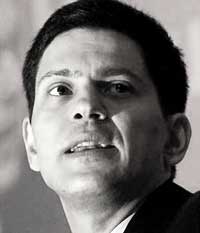
I was idly browsing and came on this picture of David Miliband and wondered if he was the youngest Foreign Secretary ever. He has amazing hair — like astroturf that’s been sprayed jet black. Will it go grey as the strains of office multiply?

And then I came on this passage in Janet Flanner’s New Yorker dispatch from Paris for June 23, 1948:

The most worried, wearied, unthanked, and necessary public servant in any government today is its Minister for Foreign Affairs. He is like a mother-in-law — in the bosom of the family, yet not of it. Essentially, he is related to a world outside, a go-between harried by what the family thinks is its due and by what the neighbours say it deserves, which is invariably a lot less.

She was writing about Georges Bidault, the French Foreign Minister of the time, but her observation is generalisable. For example: As Prime Minister, Margaret Thatcher was pathologically suspicious of the Foreign Office. Just as the Ministry of Agriculture was effectively the ministry for farmers, she reasoned, so the Foreign Office was the ministry for foreigners, and so she installed her own policy advisers in Number 10 and ran an independent foreign policy from there. Gordon Brown is also a control freak, so perhaps it is legitimate to worry about young Miliband’s hair.

Bhutto: a more detached view

I saw Benazir Bhutto once, when she was President of the Oxford Union. I thought she looked attractive, rich and petulant, and she didn’t come over as being very ‘political’. In fact, she seemed like an Asian version of Arianna Stassinopolous (now Huffington), who was President of the Cambridge Union in the same period. Accordingly, I’ve been reading the obituaries with some amazement. But at last something that looks a bit more informed — and detached — has surfaced: a piece by David Warren on Canada.com. Excerpt:

I have been reading much rubbish in celebration of Ms. Bhutto’s life. A number of my fellow pundits have further provided personal memoirs: it seems dozens of them were her next door neighbour when she was studying at Harvard or Oxford or both.

She was my exact contemporary, and I met her as a child in Pakistan, so let me jump on this bandwagon. I remember her at age eight, arriving in a Mercedes-Benz with daddy’s driver, and whisking me off for a ride in the private airplane of then-president Ayub Khan (Bhutto père was the rising star in his cabinet). This girl was the most spoiled brat I ever met.

I met her again in London, when she was studying at Oxford. She was the same, only now the 22-year-old version, and too gorgeous for anybody’s good. One of my memories is a glimpse inside a two-door fridge: one door entirely filled with packages of chocolate rum balls from Harrod’s. Benazir was crashing, in West Kensington, with another girl I knew in passing — the daughter of a former prime minister of Iraq. They were having a party. It would be hard to imagine two girls, of any cultural background, so glibly hedonistic.

After her father’s “martyrdom” Bhutto became, from all reports, much more serious. But I think, also, twisted — and easily twisted, as the spoiled too easily become when they are confronted with tragedy. She became pure politician. Think of it: she submitted to an arranged marriage, because she needed a husband to campaign for office. Stood by him in power only because there was no other political option when he proved even greedier than she was.

Twisted, in a nearly schizoid way. For she was entirely westernized, but also Pakistani. She thought in English, her Urdu was awkward, her “native” Sindhi inadequate even for giving directions to servants. Part of her political trick, in Pakistan itself, was that she sounded uneducated in Urdu. This is as close as she got to being “a woman of the people.”

It’s get more polite later on, but this restores the balance a little.

Thanks to Lara for the link.