
Lisbon Treaty is dead. Get over it.

Terrific editorial in this week’s Economist.

Europe’s political leaders react to these unwelcome expressions of popular will in three depressingly familiar stages. First they declare portentously that the European club is in deep “crisis” and unable to function. Next, even though treaties have to be ratified by all members to take effect, they put the onus of finding a solution on the country that has said no. Last, they start to hint that the voters in question should think again, and threaten that a second rejection may force the recalcitrant country to leave the EU. The sole exception to this three-stage process was the Franco-Dutch no in 2005. Then, after two years of debate the politicians hit on the cynical wheeze of writing the constitution’s main elements into the incomprehensible Lisbon treaty, with the deliberate aim of avoiding the need to consult Europe’s voters directly again.

Now the Irish, the only people in the EU to be offered a referendum on Lisbon, have shot down even this wheeze. And as EU leaders gathered for a Brussels summit, after The Economist went to press, most had duly embarked on their usual three-stage reaction, all the while promising to “respect” the outcome of the Irish referendum—by which they mean to look for a way round it (see article). Some have had the gall to argue, with a straight face, that Lisbon must be brought into effect despite the Irish no because it will make the EU more democratic. This is Brussels’s equivalent of a doctor saying that the operation was a success, but the patient died. In truth, it is the Lisbon treaty that should be allowed to die…
Election phobia, EU style

I don’t much care for Simon Jenkins, the Guardian (and Sunday Times) columnist, but this time he’s spot on.

Have you noticed how the political establishment hates elections? It regards them as vulgar, foreign, exhibitionist and unpredictable. To those in power they are mere concessions to mob rule. If electors did not insist on them, elections would have been abolished long ago as Victorian gimmicks to appease proletarian sentiment.

There is no other explanation for Westminster’s reaction to Ireland’s weekend vote on the Lisbon treaty and to David Davis’s resignation over 42-day-detention. Nor is there any other explanation for the welcome that will be given to Hazel Blears’s forthcoming local government white paper. This will, it is rumoured, reduce the 95% of elections still held in Britain (local ones) to largely consultative status, to clear the ground for Gordon Brown’s Putin-style appointed regional government.

In the case of Ireland, the rule is clear. Any change in the constitution of Europe requires unanimity among the nations of Europe. Irrespective of what moved the Irish electorate, the treaty has failed and must be redrafted. Yet Britain, France, Germany and the rest are proceeding with ratification as if the vote had gone the other way. They are saying that Europe’s constitutional framework – good or bad – can be disregarded when inconvenient, for instance when democracy has rejected what they want…

Great Firewall of China, Olympic version

From Technology Review

At the Beijing Olympics, foreign journalists may encounter systems designed to give the false appearance that Chinese Internet controls are minimal, according to Ronald Deibert, an associate professor of political science and director of the Citizen Lab at the Munk Centre for International Studies at the University of Toronto. Today, Deibert, whose research group makes the censorship-circumvention tool Psiphon, will address the Beijing Olympics and other issues related to Chinese censorship in testimony to the U.S. China Economic and Security Review Commission in Washington, DC, as part of a hearing on access to information and media control in China…

The Net and the 2008 US Election

Very interesting study from the Pew ‘Internet and American Life’ project which, among many other things, suggests that,

A significant number of voters are also using the internet to gain access to campaign events and primary documents. Some 39% of online Americans have used the internet to access “unfiltered” campaign materials, which includes video of candidate debates, speeches and announcements, as well as position papers and speech transcripts…

Media groupthink and Mr Davis

Here’s a good journalistic rule: whenever you find a consensus, look out for rodent smells. When David Davis stunned the Westminster village with his resignation on Thursday, I watched and listened to most of the mainstream broadcast coverage that evening. It was scarily uniform, which didn’t square at all with my own hunch that Davis’s move is a game-changer. Which is very welcome, because it’s clear that the great British public is sleepwalking into an authoritarian nightmare and something very dramatic is needed to provide a wake-up call. My hope is that the hoo-hah which will surround the by-election might provide such a call.

It’ reassuring to find that my Observer colleague, Henry Porter, sees it the same way, not least because he was been a forceful critic of Labour’s creeping authoritarianism from the beginning. In a terrific column this morning he observes that

The political classes don’t like this sort of thing. There’s too much raw emotion involved. Like nervous prefects, they dismissed Davis as vain, egotistical, narcissistic and irresponsible. He was, said one commentator of my acquaintance, suffering from a mid-life crisis and probably knew he didn’t have the brains to be Home Secretary, which is why he had bailed out.

That very much captures what is wrong with the Westminster village, which is so consumed with the talk of power, the jockeying for power, the acquisition and loss of it, that there is very little space left in the minds of journalists and politicians for principles and ideas. Yet that was what so much of last week in the House of Commons was about. Let us not forget that the Prime Minister won 42 days pre-charge detention by buying votes from nine hard-faced men from Northern Ireland, while 36 members of his own party stood up for the fundamental freedoms of our country. This was a moral defeat, not for Labour, but for Gordon Brown.

Then the unthinkable occurred. Davis appeared like Cyrano de Bergerac with his sword drawn at St Stephen’s entrance to the House of Commons – a venue occasioned by Speaker Martin’s undemocratic refusal to allow him to address the chamber – and challenged anyone and everyone…

Like Henry, I am sending Davis a cheque and a letter of support.

National identity and the European project

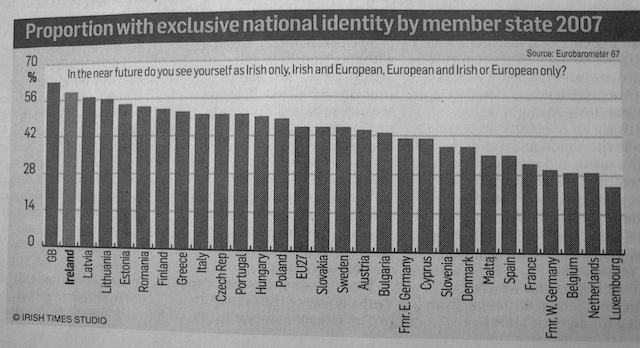
This chart (which appears in today’s Irish Times) is very illuminating — and puzzling. It’s based on the Eurobarometer survey conducted in the Spring of 2007. Interviewees were asked: “In the near future, do you see yourself as Irish only, Irish and European, European and Irish, or European only?”

Ireland is nearly at the extreme left of the chart. Only the UK has a stronger sense of non-European identity. The founding countries of the EU are all clustered on the extreme right.

What’s puzzling is that Ireland has done incredibly well out of the EU, whereas Britain probably hasn’t. Looks like my countrymen are a pretty ungrateful lot!

Where’s Plan C?

You may have missed it, but my fellow-countrymen are voting on Thursday in a Referendum on The Lisbon Treaty (aka Plan B), which of course is the already-rejected European ‘Constitution’ (aka Plan A) without the go-faster stripes. The opinion polls currently suggest that the Noes might win. There’s blind panic in Brussels at the prospect, because if Ireland votes No then the treaty’s dead. Apparently, there’s no Plan C.

For what it’s worth, my guess is that people will be so scared by the looming recession in Ireland that they will not want to rock the boat even further. They have more pressing worries on their minds — like the problem that is quaintly known as ‘negative equity’, viz having mortgages that are bigger than the resale price of their homes.

Frank Rich: the two Americas

From his NYT column…

On one side stands Mr. Obama’s resolutely cheerful embrace of the future. His vision is inseparable from his identity, both as a rookie with a slim Washington résumé and as a black American whose triumph was regarded as improbable by voters of all races only months ago. On the other is John McCain’s promise of a wise warrior’s vigilant conservation of the past. His vision, too, is inseparable from his identity — as a government lifer who has spent his entire career in service, whether in the Navy or Washington.

Given the dividing line separating the two Americas of 2008, a ticket uniting Mr. McCain and Hillary Clinton might actually be a better fit than the Obama-Clinton “dream ticket,” despite their differences on the issues. Never was this more evident than Tuesday night, when Mrs. Clinton and Mr. McCain both completely misread a one-of-a-kind historical moment as they tried to cling to the prerogatives of the 20th century’s old guard…

He’s very good on McCain:

Mr. McCain’s speech in a New Orleans suburb on Tuesday night spawned a cottage industry of ridicule, even among Republicans. The halting delivery, sickly green backdrop and spastic, inappropriate smiles, presumably mandated by some consultant hoping to mask his anger, left the impression that Mr. McCain isn’t yet ready for prime-time radio.

But the substance was even worse than the theatrics. Incredibly, Mr. McCain attacked Mr. Obama for being insufficiently bipartisan while speaking to the most conspicuously partisan audience you can assemble in today’s America: a small, nearly all-white crowd that seconded his attack lines with boorish choruses of boos. On TV, the audience came across as a country-club membership riled by a change in the Sunday brunch menu.

I like his idea that the real ‘dream ticket’ would be McCain+Clinton. And his analysis of their websites:

You could learn a ton about the Clinton campaign’s cultural tone-deafness from its stodgy generic Web site. A similar torpor afflicts JohnMcCain.com, which last week gave its graphics a face-lift that unabashedly mimics BarackObama.com and devoted prime home page real estate to hawking “McCain Golf Gear.” (No joke.) The blogs, video and social networking are static and sparse, the apt reflection of a candidate who repeatedly invokes “I” as he boasts of his humility.

Thanks to Dave Winer for the tweet.

Later: Charlie Leadbeater pointed me to Noam Cohen’s NYT piece about Obama’s campaign, in which he observes, en passant,

Yochai Benkler, a Harvard law professor whose book “The Wealth of Networks” is a manifesto for online collaboration, points out a crucial difference between Mr. Obama’s approach to attracting supporters and that of his chief rivals. “On the McCain and Clinton Web sites, there is a transactional screen,” Mr. Benkler said. “It is just about the money. Donate, then we can build the relationship. In Obama’s it’s inverted: build the relationship and then donate.”

Beating the Drudge effect

This morning’s Observer column

There is a way out of the morass, but it requires the application of old-fashioned journalistic skills and values. Or, more prosaically, sceptical, investigative reporting. The fact that something is circulating on the net is not, in itself, news – any more than is the fact that microbes circulate in drinking water. You can find anything you want on the net, and I mean anything. So what?

The rot that so offends Obama set in when ‘mainstream’ reporters began to relay what they found on the net in their own publications. And that happened a long time ago with the Drudge Report and the vicious right-wing campaign to bring down Bill Clinton.

A good example of how to deal with internet rumours was provided last week by David Weigel of Reason magazine…