The Google Three

This morning”s Observer column about the Italian convictions handed out to three Googlers.

In the case of the Google Three, however, it’s likely that they will be vindicated because even if the Italian appeal fails, there is always the possibility of recourse to the European Court in Strasbourg, which will take the view that European Union law, as currently drafted, appears to give hosting providers a safe harbour from liability so long as they remove illegal content once they are notified of its existence. The downside of this, of course, is that Google will have to be much more responsive to complaints, which will make it much easier to have videos taken down because the prudent course will always be to “take down first and ask questions later”.

The glory days of YouTube may be coming to an end. And Silvio Berlusconi remains at large.

The Fat Lady Has Sung

Another thoughtful Op-Ed Column by Tom Friedman.

To be sure, taking over the presidency at the dawn of the lean years is no easy task. The president needs to persuade the country to invest in the future and pay for the past — past profligacy — all at the same time. We have to pay for more new schools and infrastructure than ever, while accepting more entitlement cuts than ever, when public trust in government is lower than ever.

On top of that, the Republican Party has never been more irresponsible. Having helped run the deficit to new heights during the recent Bush years, the G.O.P. is now unwilling to take any responsibility for dealing with it if it involves raising taxes. At the same time, the rise of cable TV has transformed politics in our country generally into just another spectator sport, like all-star wrestling. C-Span is just ESPN with only two teams. We watch it for entertainment, not solutions.

While it would certainly help if the president voiced a more compelling narrative, I am under no illusion that this alone would solve all his problems and ours. It comes back to us: We have to demand the truth from our politicians and be ready to accept it ourselves. We simply do not have another presidency to waste. There are no more fat years to eat through. If Obama fails, we all fail.

Yep.

The Myth of Techno-Utopia

Evgeny Morozov has a book coming out later this year about the Internet and democracy in which he takes a critical look at techno-utopianism. In the WSJ today he sets out his stall.

our debate about the Internet's role in democratization—increasingly dominated by techno-utopianism—is in dire need of moderation, for there are at least as many reasons to be skeptical. Ironically, the role that the Internet played in the recent events in Iran shows us why: Revolutionary change that can topple strong authoritarian regimes requires a high degree of centralization among their opponents. The Internet does not always help here. One can have "organizing without organizations"—the phrase is in the subtitle of "Here Comes Everybody," Clay Shirky's best-selling 2008 book about the power of social media—but one can't have revolutions without revolutionaries.

Contrary to the utopian rhetoric of social media enthusiasts, the Internet often makes the jump from deliberation to participation even more difficult, thwarting collective action under the heavy pressure of never-ending internal debate. This is what may explain the impotence of recent protests in Iran: Thanks to the sociability and high degree of decentralization afforded by the Internet, Iran's Green Movement has been split into so many competing debate chambers—some of them composed primarily of net-savvy Iranians in the diaspora—that it couldn't collect itself on the eve of the 31st anniversary of the Islamic revolution. The Green Movement may have simply drowned in its own tweets.

Back to the future: the US Sejm

Nice Krugman column.

We’ve always known that America’s reign as the world’s greatest nation would eventually end. But most of us imagined that our downfall, when it came, would be something grand and tragic.

What we’re getting instead is less a tragedy than a deadly farce. Instead of fraying under the strain of imperial overstretch, we’re paralyzed by procedure. Instead of re-enacting the decline and fall of Rome, we’re re-enacting the dissolution of 18th-century Poland.

A brief history lesson: In the 17th and 18th centuries, the Polish legislature, the Sejm, operated on the unanimity principle: any member could nullify legislation by shouting “I do not allow!” This made the nation largely ungovernable, and neighboring regimes began hacking off pieces of its territory. By 1795 Poland had disappeared, not to re-emerge for more than a century.

Today, the U.S. Senate seems determined to make the Sejm look good by comparison.

Last week, after nine months, the Senate finally approved Martha Johnson to head the General Services Administration, which runs government buildings and purchases supplies. It’s an essentially nonpolitical position, and nobody questioned Ms. Johnson’s qualifications: she was approved by a vote of 94 to 2. But Senator Christopher Bond, Republican of Missouri, had put a “hold” on her appointment to pressure the government into approving a building project in Kansas City.

This dubious achievement may have inspired Senator Richard Shelby, Republican of Alabama. In any case, Mr. Shelby has now placed a hold on all outstanding Obama administration nominations — about 70 high-level government positions — until his state gets a tanker contract and a counterterrorism center.

What gives individual senators this kind of power? Much of the Senate’s business relies on unanimous consent: it’s difficult to get anything done unless everyone agrees on procedure. And a tradition has grown up under which senators, in return for not gumming up everything, get the right to block nominees they don’t like.

In the past, holds were used sparingly. That’s because, as a Congressional Research Service report on the practice says, the Senate used to be ruled by “traditions of comity, courtesy, reciprocity, and accommodation.” But that was then. Rules that used to be workable have become crippling now that one of the nation’s major political parties has descended into nihilism, seeing no harm — in fact, political dividends — in making the nation ungovernable.

How bad is it? It’s so bad that I miss Newt Gingrich.

The Republican conspiracy

If, like me, you are puzzled by the anti-democratic obduracy of the Republicans in the US Senate, then this post by Mark Anderson may strike a chord.

As I have watched the first year of the current administration unfold, I have increasingly wondered if all of this, at a thirty thousand foot level, is a result of a simple GOP plan first outed long ago, and spoken of frequently during the Bush Era. Called “starve the beast,” it is a much-discussed strategy of spending the US into oblivion while in power, so that the following party has no dry ammunition with which to carry out its programs. Carried further, it suggests a gluttony of spending while in power, so that services, and the government itself, is forced into contraction.

The last administration spent more money from current funds, and indebted us more deeply into the future, than any in history. Was it all just bad management and fake wars? Or was it as intellectually simple and negative as the current GOP refusal to vote for any single bill? It’s a simple strategy. Did it work?

Photographers protest against police stop and search

From the Guardian.

Thousands of photographers have staged a mass protest against the ‘malicious’ use of anti-terrorism laws to stop them taking pictures in public places.

Trafalgar Square in central London was lit up by flash bulbs as part of the demonstration against photographers being unfairly targeted by police after taking photos. They are usually questioned under section 44 of the Terrorism Act 2000, which allows officers to stop and search without the need for ‘suspicion’ within designated areas in the UK.

More than 2,000 professional and amateur photographers took part in the protest organised by the group I’m a Photographer, Not a Terrorist!, many carrying placards bearing its name.

Onlookers were handed stop and search cards by organisers outlining their rights.

Freelance photographer and Guardian contributor Marc Vallee, who helped organise the protest with appeals on Twitter and Facebook, said he was “delighted” by the turnout.

“It’s quite obvious that professional photographers across the country are being searched because they are photographers not because they are suspicious,” he said.

“It’s a common-law right to take pictures in public places and we are here to show that.”

Google and China: from drama to crisis in one easy step

This morning’s Observer column.

ONE USEFUL spin-off from the developing story of Google’s difficulties with the Chinese communist regime is that it may finally spur the west to discard the rose-tinted spectacles through which it has chosen to view China in the past decade – and not before time.

The west’s response to China’s rapid industrialisation was determined by a recipe blending three parts greed with one part naivety. The greed was understandable: the stupendous rate of Chinese economic growth triggered a desperate desire for a slice of the action. Everywhere, whether in companies or universities, one found a palpable determination to “get into China”. In the political world, we saw western governments scramble to out-do one another in fawning upon visiting Chinese potentates.

Still, greed is part of human nature; we have to make a living, and often behave reprehensibly while doing so. What was less forgivable about the west’s approach was the implicit naivety. It was a product of wishful thinking brought about by market triumphalism, the belief that, in the end, it is impossible to have a capitalist economy without also having liberal political institutions…

FOOTNOTES:

  • Full text of Hilary Clinton’s speech on Internet Freedom is here. And Clay Shirky has done a useful abridged version.
  • Microsoft, of course, has no problems with Chinese censorship. Indeed Steve Ballmer thinks the Google view is nuts, at least according to this report:

    At a conference in Houston on Thursday, Microsoft CEO Steve Ballmer spoke critically of Google’s recent decision to stop censoring its search results in China. Paraphrasing some of Ballmer’s statements, Forbes says Ballmer called it an “irrational business decision” on Google’s part.

    Ballmer suggested that Google’s decision to no longer filter out internet searches objectionable to the Chinese government was an irrational business decision. After all, Ballmer said, the U.S. imports oil from Saudi Arabia despite the censorship that goes on in that country.

    “The U.S. is the most extreme when it comes to free speech,” said Ballmer, noting however that even the U.S. bans child pornography, while France bans internet access to Nazi imagery.

    Forbes says Ballmer made the statements during the Q&A session after a speech to oil company executives. Ballmer also said that Bing will comply with requests to censor its search results “if the Chinese government gives us proper legal notice.”

  • Perry Anderson has a terrific piece about Sinomania in the current issue of the London Review of Books.
  • The National Security State

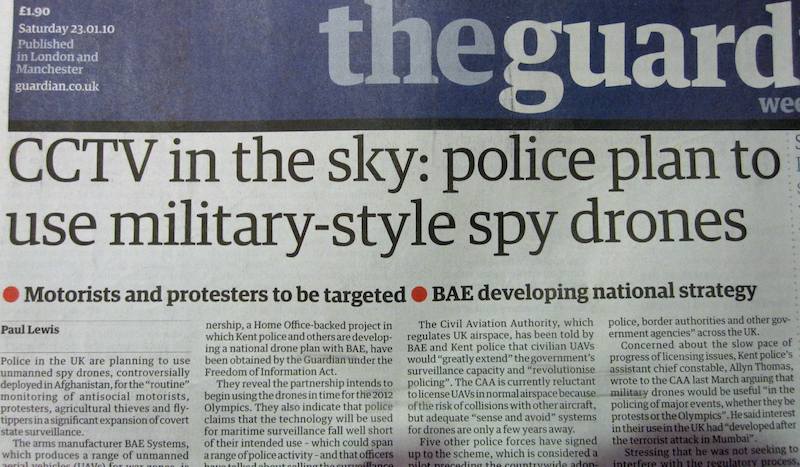
    When I opened this morning’s Guardian I had a fleeting thought that it must be April 1st. But it isn’t. This crazed stampede into ubiquitous surveillance is really scary. The big question now is whether a Tory administration would pull back from this precipice. I’m not holding my breath.

    And the lead contractor, BAE Systems, is the company that Tony Blair decided should not be prosecuted by the Serious Fraud Office on ‘national security’ grounds.

    The Google-China fracas gets serious

    On Thursday, Hilary Clinton made an extraordinary speech in Washington about Internet freedom in which she set out the “freedom to connect” as a new human right. This really got under the skin of the Beijing regime, as GMSV reports.

    This morning, Foreign Ministry spokesman Ma Zhaoxu basically told the U.S. to butt out. “Regarding comments that contradict facts and harm China-U.S. relations, we are firmly opposed,” he said. “We urge the U.S. side to respect facts and stop using the so-called freedom of the Internet to make unjustified accusations against China. … The Chinese Internet is open and China is the country witnessing the most active development of the Internet.”

    The real zingers came in an editorial in the Global Times, an English-language newspaper published by the Communist Party’s official People’s Daily, which accused the U.S. of practicing “information imperialism.” “The hard fact that Clinton has failed to highlight in her speech is that bulk of the information flowing from the U.S. and other Western countries is loaded with aggressive rhetoric against those countries that do not follow their lead. … Countries disadvantaged by the unequal and undemocratic information flow have to protect their national interest, and take steps toward this,” the paper said. “Unlike advanced Western countries, Chinese society is still vulnerable to the effect of multifarious information flowing in, especially when it is for creating disorder. Western countries have long indoctrinated non-Western nations on the issue of freedom of speech. It is an aggressive political and diplomatic strategy, rather than a desire for moral values, that has led them to do so.”

    As I say, Clinton’s speech is really interesting, and worth reading in full. But, as the old saying goes, fine words butter no parsnips. And as I was reading it I was wondering what the US proposes to do about its technology companies (step up Cisco, for example) which sell China the kit it needs to implement its censorship of the Net.

    IPREDator launches. Howzat, Mandelson?

    Latest front opens in the arms race — Pirate Bay’s Ipredator VPN Opens To The Public | TorrentFreak.

    With a beta launch coinciding with the introduction of the controversial IPRED law in Sweden, the service promised to offer users an anonymous connection to the Internet. IPRED gave the copyright holders increased power to track down pirates, and with the launch of IPREDator the creators neutralized this new ‘threat’.

    Much like many other comparable VPN services, Ipredator allows users to connect to the Internet while hiding their own IP-address. The interest in services like this is booming. In Sweden alone, an estimated 500,000 Internet subscribers are already hiding their identities online, and that number is expected to rapidly grow in the new year.