
Thursday 9 September, 2021

Quote of the Day

Novelist Roddy Doyle on being famous in Ireland:

“I was waiting at Tara Street Dart station for a friend, and there was a bunch of lads coming down the quays, all in their late teens, lads in tracksuits, and one of them broke away and came right up to my face and said, ‘Are you Roddy Doyle?’”

“And I said, ‘I am, yeah.’”

“He said, ‘So what?’”


Musical alternative to the morning’s radio news

J.S. Bach | Violin Concerto No.1 in A minor, BWV 1041 | 2. Andante

Link


Long Read of the Day

The End of Books by Justin E. H. Smith

Lovely essay on the difficulties faced by all those who (like this blogger) have a ’book problem’ (to use a euphemism for a chronic addiction).

Moving to Paris in 2013, I found a temporary solution to the problem of my personal library. I drove the vastly greater part of the books I had accumulated over the years to a very generous relative’s home in Upstate New York, somewhere between the Hudson River and the Finger Lakes, and stored them in her spacious attic.

Over the years many people have told me there are inexpensive ways to ship books across the ocean, that enterprising Poles have established their own trans-Atlantic routes serving the Polish diaspora but also accommodating American expatriates, or that the US Postal Service itself offers special book rates “by the crate”. When called upon kindly to show me how these services may be accessed, somehow the people so ready to offer this advice never follow through. So just trust me: however you pack them up, whichever service you use, Concorde or barge, it would cost a fortune to get all of my books across the Atlantic.

And so for years I let them bake up there, and then freeze, and then bake again, a significant portion of the greatest thoughts ever expressed by human beings, huddling together, not exactly thinking on their own, but perhaps waiting, with dim awareness of their true “end”, to incite thought again.

Do read the whole thing.


Chart of the day


The usefulness of sharp criticism

Joan Bakewell (Whom God Preserve) tells a nice story about her days as a student reading history in Cambridge. She had written an exuberant essay on the French Revolution and submitted it to her tutor, Betty Behrens:

I saw it as a new dawn of freedom and fulfilment such as Cambridge meant to me: humankind united, happiness for all, triumph over tyranny.

The essay came back untouched. I thought there must be some mistake. I had delivered it as required, on time, impeccably handwritten. Now it lay on my table exactly as I had written it: no annotations, no corrections of dates or names, nothing. My newfound exhilaration wilted. What of my rhetoric, my exhortations, my vision of humankind – had they been somehow overlooked?

The truth was worse. On the final page, there was indeed an intervention by Betty Behrens: a line drawn through my writing and a terse paragraph.

This piece of work was not worthy of any consideration by her: she refused to consider it. It was worthless, trite rubbish. If I was to continue to study with her, there must be a serious effort to understand what scholarship was.

I was knocked back with the force of her disapproval.

But…

In the event, the shock of her rebuke paid off. I had nowhere to go but into my own head. The thought of sharing my shame with college colleagues was out of the question. I had some serious thinking to do. I went back to my books: the lucid prose of Keynes, the measured tones of Plumb, the steady logic of Butterfield … the standard texts of the day. If I found them stuffy, that was my problem. Rhetoric and polemic had no place in the serious matter of study. (If I wanted invective, I could and did attend the lectures of FR Leavis, the celebrated English don, and hear him inveigh against WH Auden: “Mmmister Auden …” he would sneer.)

It proved a turning point for me. It was a healthy attack against my vanity, but more importantly made me examine how I thought. I began to examine what shaped my ideas – indeed, what shaped anyone’s ideas. Where did the whole direction of western thought come from? Yes, I allowed myself some grandiosity. But I wanted and intended to do better.

This rang bells for me — and also for some of my readers. Many comments one receives on draft papers are polite and modestly useful. But in a way they merely buttress or reinforce your preconceptions. The really useful criticism is often the most severe, because then you know you have struck bedrock and need to do something about it.


The Shakespeare and Company Project

Sylvia Beach was a legendary English-language bookseller in early 20th century Paris who created a bookstore that served as a kind of home-from-home for impecunious literary ex-pats. Famously, she was also the publisher of James Joyce’s Ulysses. But something I hadn’t known is that she also ran a lending library for her customers.

Her papers are in Princeton University where the library now runs The Shakespeare and Company Project which uses the Beach Papers to recreate the world of a lost literary generation. It’s all online. You can browse and search the lending library’s members and books; learn about what was involved in joining it; discover its most popular books and authors; download Project data. And more.
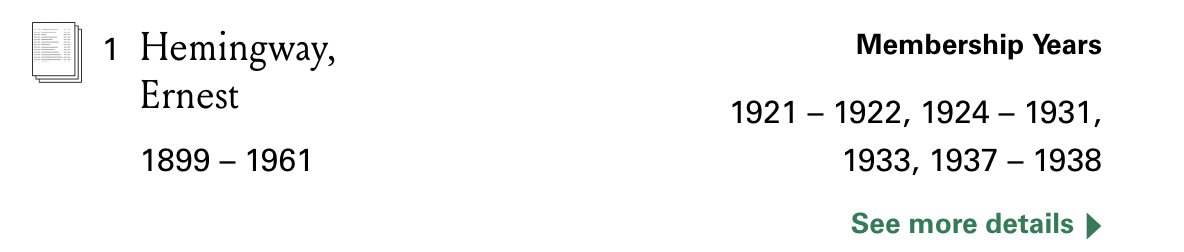
Beach closed the store in 1941 after refusing to sell her last remaining copy of Ulysses to a Nazi officer. This puzzled me because I have a vivid memory of visiting what I thought was the store on my first visit to Paris in 1968.

Was this further confirmation of Mark Twain’s observation that “the older I get the more clearly I remember things that never happened”?

But then Wikipedia came to my aid.

A later independent English-language bookstore was opened in 1951 by George Whitman, also located on Paris’ Left Bank, but under a different name. Whitman adopted the “Shakespeare & Co.” name for his store in 1965, and it continues to operate under that name to this day.

Today, it continues to serve as a purveyor of new and second-hand books, as an antiquarian bookseller, and as a free reading library open to the public. Additionally, the shop houses aspiring writers and artists in exchange for their helping out around the bookstore. Since the shop opened in 1951, more than 30,000 people have slept in the beds found tucked between bookshelves. The shop’s motto, “Be Not Inhospitable to Strangers Lest They Be Angels in Disguise,” is written above the entrance to the reading library.

Many thanks to Faith Johnson, who told me about the Princeton project.


  This blog is also available as a daily newsletter. If you think this might suit you better why not sign up? One email a day, Monday through Friday, delivered to your inbox at 7am UK time. It’s free, and there’s a one-button unsubscribe if you conclude that your inbox is full enough already!



Wednesday 8 September, 2021

Exit strategy

Nice New Yorker cover after the US’s exit from the Afghan maze.

What’s the next maze, one wonders? Taiwan?


Quote of the Day

”There is no money in poetry; but then there is no poetry in money, either.”

  • Robert Graves

Musical alternative to the morning’s radio news

My Back Pages | Bob Dylan, Roger McGuinn, Tom Petty, Neil Young, Eric Clapton & George Harrison

Link

What a line-up.


Long Read of the Day

Steven Pinker Thinks Your Sense of Imminent Doom Is Wrong

Longish NYT interview with the great optimist himself.

Sample:

The key, though, is what kind of species are we? How rational is Homo sapiens? The answer can’t be that we’re just irrational in our bones, otherwise we could never have established the benchmarks of rationality against which we could say some people some of the time are irrational. I think the answer is, especially for publicly consequential beliefs: We achieve rationality by implementing rules for the community that make us collectively more rational than any of us are individually.

Hmmm… Wonder if he spends much time on social media.


Luther@Vatican.com

From the New Yorker


The real history of the telescope

Nice post by Thony Christie on his Renaissance Mathematicus blog:

On 25th August Google celebrated the 400th anniversary of Galileo’s first public presentation of his telescope an anniversary that is also commented upon in the latest addition of the Guardian Weekly, a compendium of the English daily newspaper The Guardian for ex-patriots like myself. It’s kind of nice to see the world paying a bit of attention to the history of astronomy but unfortunately they both got the date wrong! I suspect that both of them relied on the same news agency report and didn’t bother to check the facts. Well for those that care and even for those that don’t I have put together a short chronology of the early days of the telescope…

Read on.


Automated hiring software is mistakenly rejecting millions of viable job candidates

The Verge has an intriguing report on research done by Harvard Business School and the consultancy firm Accenture which suggests that “an enormous and growing group” of people are unemployed or underemployed, and eager to get a job or increase their working hours but remain effectively “hidden” from businesses that would benefit from hiring them by the very processes those companies use to recruit people.

The researchers estimate that in the US there are, more than 27 million of these hidden workers, and similar proportions of in the UK and Germany.

So why are they ‘hidden’?

A major culprit is inflexibly-configured automated recruitment management systems (RMS) — workflow-oriented tools that help organisations manage and track the pipeline of applicants in each step of the recruiting process.

Anyone who works in the so-called HR (‘Human Resources’) department of a large organisation will have used one of these tools, which streamline the recruiting process by automating time-consuming aspects of it — e.g. scanning CVs, candidate scoring and interview scheduling.

“These systems”, says the report,

represent the foundation of the hiring process in a majority of organizations. In fact, more than 90% of employers in our survey use their RMS to initially filter or rank potential middle-skills (94%) and high-skills (92%) candidates.

These systems are vital; however, they are designed to maximize the efficiency of the process. That leads them to hone in on candidates, using very specific parameters, in order to minimize the number of applicants that are actively considered. For example, most use proxies (such as a college degree or possession of precisely described skills) for attributes such as skills, work ethic, and self-efficacy. Most also use a failure to meet certain criteria (such as a gap in full-time employment) as a basis for excluding a candidate from consideration irrespective of their other qualifications.

As a result, they exclude from consideration viable candidates whose resumes do not match the criteria but who could perform at a high level with training. A large majority (88%) of employers agree, telling us that qualified high- skills candidates are vetted out of the process because they do not match the exact criteria established by the job description. That number rose to 94% in the case of middle-skills workers.

And the consequences of this?

These automated systems

exclude from consideration viable candidates whose resumes do not match the criteria but who could perform at a high level with training. A large majority (88%) of employers agree, telling us that qualified high- skills candidates are vetted out of the process because they do not match the exact criteria established by the job description. That number rose to 94% in the case of middle-skills workers.

So why am I not surprised? Answer: I’ve had to use some of these systems in my time.


This blog is also available as a daily newsletter. If you think this might suit you better why not sign up? One email a day, Monday through Friday, delivered to your inbox at 7am UK time. It’s free, and there’s a one-button unsubscribe if you conclude that your inbox is full enough already!

Tuesday 7 September, 2021

Mirrorscope


Quote of the Day

“To betray, you must first belong”

  • Kim Philby

Musical alternative to the morning’s radio news

Josephine Baker | Si J’etais Blanche | Recorded in Paris, February 1933

Link

The first black woman to be interred in the Pantheon in Paris, along with Jean-Jacques Rousseau, Victor Hugo and Marie Curie.


Long Read of the Day

What if the Coronavirus Crisis Is Just a Trial Run?

Shrewd OpEd piece by Adam Tooze, adapted from his forthcoming book — which comes out today.

Almost two years since the novel coronavirus began to circulate through the human population, what lessons have we learned? And what do those lessons portend for future crises?

The most obvious is the hardest to digest: The world’s decision makers have given us a staggering demonstration of their collective inability to grasp what it would actually mean to govern the deeply globalized and interconnected world they have created. There is only one limited realm in which something like a concerted response has been managed: money and finance. But governments’ and central banks’ success in holding the world’s financial system together is contributing in the long run to inequality and social polarization. If 2020 was a trial run, we should be worried.

How did we get here?

Worth reading in full. Tooze is an historian and good on taking the Long View, which is that what’s unique about our present moment is the confluence of one age-old syndrome — the tensions of geopolitics, finance and politics — and a completely new kind of global shock: Covid.


Chart of the Day

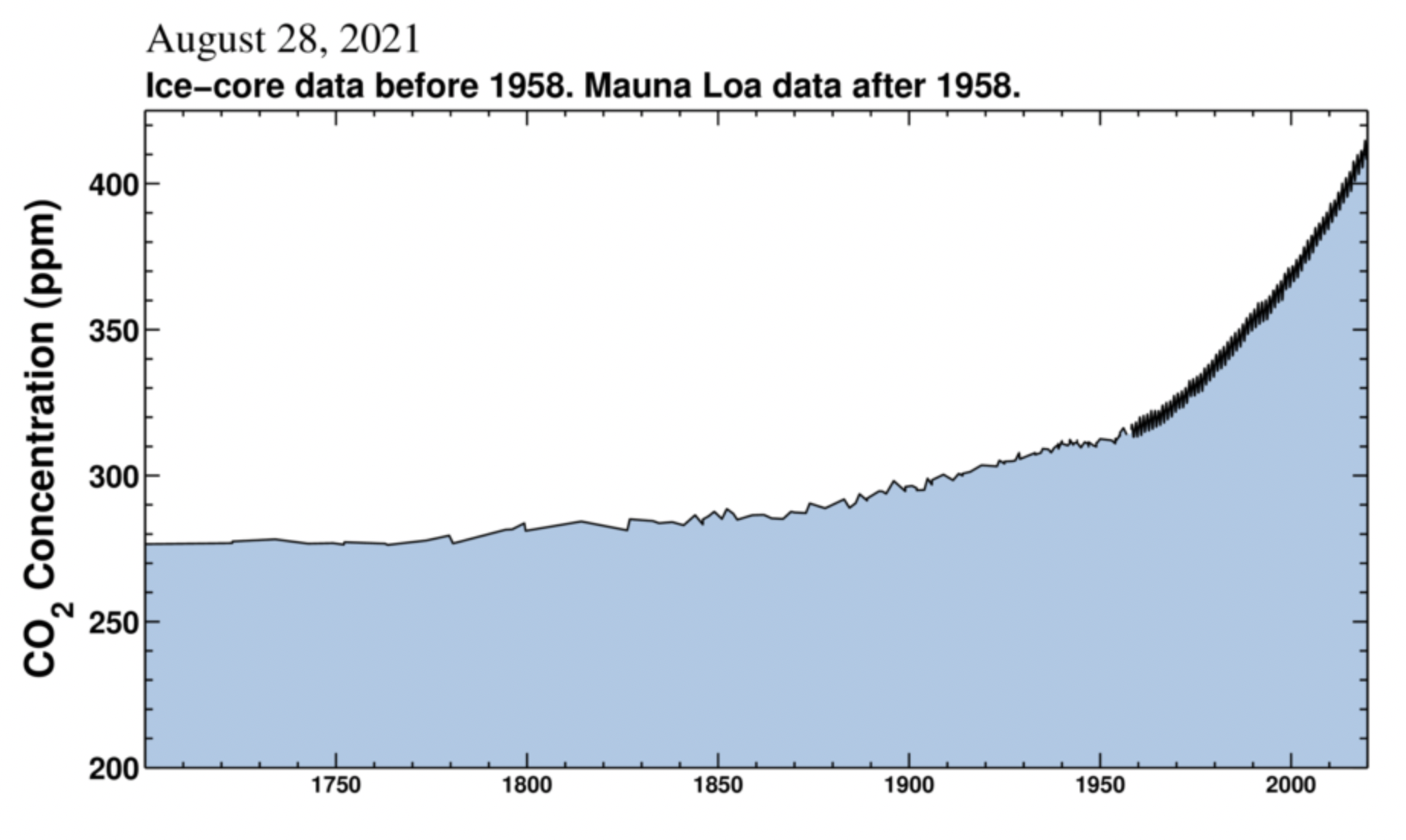
An estimated 3,238 days until we reach the 450ppm threshold at this rate of increase. That’s just under nine years. Go figure.


Frank Bruni on our current dilemma

From his weekly newsletter…

But in a certain psychological sense, is the current chapter perhaps the most challenging of all? We thought we’d turned the corner, only to learn we hadn’t, and we’re neither isolated nor liberated. Our marching orders are fluid and feel less like orders than like caveats, nudging us not toward obedience but toward wisdom, which is even harder. We’re not being told to suspend all activities as usual, which is a digestible if dire command, but we’re being encouraged to suspend or alter many activities, maybe for the next week, maybe for this whole month, maybe not for the following one but maybe again in November, when the mercury dips, we head indoors and Thanksgiving waddles into view.

I take absolutely no issue with that. I agree with it. But I also recognize that this shifting, shapeless horizon is at war with a whole lot in human nature and a whole lot in the American psyche, and in this instance, I’m not talking about the individual-liberty part.

I’m talking about the impatience. I’m talking about the certitude and absolutism of the social-media age. We are increasingly a country of either/or, pro/con, virtuous/deplorable, all/nothing. And the pandemic right now can’t be squeezed into any dichotomy. Nor will it be hurried to its end.

I’ve had lots of conversations along precisely these lines in recent weeks with friends, family and colleagues. Subtlety and judiciousness is needed just when our media ecosystem is trying to stamp out those qualities.


The climate crisis: as seen from Summer 2071

Kim Stanley Robinson’s perceptive — and unexpectedly optimistic — perspective on our current climate crisis, as seen from the Summer of 2071.

It’s a ten-minute TED talk, and well worth your time (see below).


The Rise of ZuckTalk

Intriguing essay on the apparently irresistible rise of an oratorical style that “asks for validation while bulldozing through almost any topic”. In other words, the way Mark Zuckerberg talks. Link


Why you shouldn’t use anyone else’s charging cable

Just came on an ad for a perfectly normal, innocuous charging cable for an Apple iPhone or iPad.

Here’s an edited version of the product description:

Every cable is hand made and tailored to look and feel exactly like the cable your target already has in their possession. You won’t need a million dollar budget for this cable, but the power and capabilities are extensive.

It is packed with a web server, 802.11 radio, and way more memory and processing power than the type of cable you would want for just doing demos. But the flexibility makes demos easy.

The cable is built for covert field-use, with features that enhance remote execution, stealth, forensics evasion, all while being able to quickly change your tooling on the fly. And, of course, it works just like a normal USB cable when not deploying payloads.

A special ‘keylogger’ version has all the features of the standard cable but adds a keylogger capable of storing up to 650,000 keystrokes. This version was specifically built to be used against keyboards with detachable cables.

A snip at $199.99.

You can see why only the paranoid survive in a computerised world (as Andy Grove used to say).


This blog is also available as a daily newsletter. If you think this might suit you better why not sign up? One email a day, Monday through Friday, delivered to your inbox at 7am UK time. It’s free, and there’s a one-button unsubscribe if you conclude that your inbox is full enough already!



Monday 6 September, 2021

The Magpie Mine


It’s nice to be back. We spent a lovely week in the UK’s Peak District, a wonderland of rolling farmland, hills and dales criss-crossed with footpaths, exquisite drystone walls, ingenious stiles and gates. (And often devoid of even the feeblest of mobile network signals, so we were frequently off the grid’ and left to our thoughts as we walked.)

It is also a countryside of paradoxes. I spent a lot of time thinking about ‘Capability’ Brown, the great 18th-century English landscape architect who mastered the art of capturing that particular kind of rural vista and miniaturising it for the parkland surrounding England’s great stately homes. But even as one was entranced by it one also realised that this wonderful countryside is entirely man-made. The Peak District looks the way it is because of the way it is farmed: it’s dairy-farming and sheep—farming country. Without those agricultural industries it would rapidly return to wilderness, and one of the paradoxes of Brexit is that it may threaten those landscape-curating industries, or at any rate make them less economically sustainable.

Another paradox is that two centuries ago this bucolic paradise was a hive of less salubrious industry. Derbyshire is littered with the shafts and spoil-heaps of intensive lead mining, each of which is designated with the term ‘dis’ (for “disused”) on the Ordnance Survey maps by which we were navigating. Those ubiquitous and inexplicable grassy mounds — those “humps and bumps”, as one farmer put it — are in fact mining spoil heaps that nature has reclaimed and rendered picturesque.

Little of the overground infrastructure of this mining industry survives — which is why the buildings of the famous Magpie Mine shown in the photograph are now so striking.

But the lush grass that surrounds them is still contaminated by lead. So on the one hand, nature has reclaimed and obliterated the industry’s detritus, which is a metaphor for the way the planet doesn’t need us. But one the other hand, our poisonous effluent remains.


Quote of the Day

”Afghanistan provides a useful reminder that while we and our European allies might be tired of “forever wars,” the Taliban are not tired of wars at all. The Pakistanis who helped them are not tired of wars, either. Nor are the Russian, Chinese, and Iranian regimes that hope to benefit from the change of power in Afghanistan; nor are al-Qaeda and the other groups who may make Afghanistan their home again in future.”


Musical alternative to the morning’s radio news

Sharon Shannon and Gerry O’Connor | Mammy Shannon’s Jig

Link

Nice way to start a week.


Long Read of the Day

A Forgotten Prophet Whose Time Has Come

Wonderful review essay in Noema by Nathan Gardels on Ivan Illich, “a purveyor of impossible truths”:

truths so radical that they questioned the very foundations of modern certitudes — progress, economic growth, health, education, mobility. While he was not wrong, we had all been riding on a train going in the opposite direction for so long that it was hard to see how, in any practical sense, the momentum could ever be stalled. And that was his point. Now that “the shadow our future throws” of which Illich warned is darkening the skies of the present, it is time to reconsider his thought. Gardels is a deeply insightful thinker and this is as fine and generous a summary of Illich’s thinking as I’ve seen.

I loved Illich’s books when they came out in the 1970s, particularly his Tools for Conviviality and Energy and Equity. He was a radical counter-cultural thinker with a terrifically spare literary style.

Pearce Wright wrote an excellent profile of him in — of all places, The Lancet — which was remarkable given Illich’s full frontal assault on modern medicine.


Blog posts composed on the fly last week

From the online version of this blog…

  •  So who’s really responsible for the Afghanistan fiasco? Link
  •  On the sociopathy of organisations Link

 This blog is also available as a daily newsletter. If you think this might suit you better why not sign up? One email a day, Monday through Friday, delivered to your inbox at 7am UK time. It’s free, and there’s a one-button unsubscribe if you conclude that your inbox is full enough already!

Thursday 26 August, 2021

Quote of the Day

”Sir Walter Scott, when all is said and done, is an inspired butler.”

  • William Hazlitt

Musical alternative to the morning’s radio news

C.P.E. Bach: Cello Concerto in A | 3 Allegro assai

Link

Sprightly, n’est-ce pas?


Long Read of the Day

 Build competence, not literacy

How do you build a culture that emphasises solving problems rather than adhering to processes?

Nice blog post by Rob Miller, useful to anyone building a project team. ‘Literacy’ is about familiarity with processes; competence is about the ability to produce things.


Fusion dreams get a boost? Er, maybe

The NYT reported on an exciting experiment done by the Lawrence Livermore Lab in which 192 huge lasers were pointed at a tiny pellet of hydrogen (“the width of a human hair”) which they then annihilated, producing a burst of more than 10 quadrillion watts of fusion power (which is a non-negligible fraction of the 170 quadrillion watts the sun lavishes on the planet every day). There’s only one snag: the energy burst — “essentially a miniature hydrogen bomb”, says the Times — lasted only 100 trillionth of a second.

To this, Charles Arthur (Whom God Preserve) added his characteristically sardonic comment:

I love the principle of fusion, and I’ve written about it a few times (and stood inside the torus at JET in Oxfordshire – not while it was running), and I’m just as excited – possibly more – as the next person about it, but stories like this are absolute classics of the genre. Incredibly short duration? Check. Incredibly complex array required? Check. Didn’t achieve “ignition” (self-sustaining output)? Check. Excited scientists? Check. It might as well be a story in The Onion; you could, if you wanted, read it as emanating from that august publication, and they wouldn’t have to change a word.

Which is just perfect.


The fiasco in Kabul

An excoriating blast from Professor Paul Cornish, a friend and former colleague, now a distinguished defence and security analyst. Here’s an excerpt:

Instead of confronting this crisis of strategic credibility, too many in strategic leadership positions in the West indulge instead in wishful thinking, displacement activity and even rampant self-justification.

In the UK, with one or two notable exceptions such as James Heappey, the Minister for the Armed Forces, who manages to combine a sense of empathy with honest political realism and a soldier’s instincts for problem solving, we have had the embarrassing spectacle of high-level politicians, public officials and very senior military officers showing just how disconnected they are from this looming strategic reality. Keen to convince the media and the electorate that this is a temporary politico-military malfunction, from which ‘lessons will be learned’ before the normal service of strategic mastery is resumed, we are assured repeatedly that the Taliban surge was unexpected and unpredictable. Really? Ten years ago, following the second of two visits to Afghanistan, I made the following observation at a conference: ‘withdrawal – whenever it happens – should be seen not simply as the desperate ending of the intervention but as the most complex and dangerous part of the intervention. If this is mishandled or rushed, then we might be talking in five years’ time not just of the resurgence of some very unpleasant extremist and criminal groups, but of a regional conflagration.’ My sense of foreboding was premature by five years but if a visiting academic/think tank analyst could see things in this way then plenty of others, in more influential positions, will have come to a similar conclusion. And if the capture of Kabul was indeed so unexpected, why was there not only a ‘Plan A’ for the evacuation but also a ‘Plan B’? Was the capitulation unexpected, or were we preparing for it? As well as presenting a wholly confused, if not disingenuous analysis, the UK’s strategic leadership has also demonstrated an unbeatably inappropriate choice of actions and words: the Foreign Secretary remaining determinedly glued (some have alleged) to a sunbed in Crete while the crisis grew; or the UK Chief of Defence Staff insisting that the Taliban, an implacable enemy of Britain’s armed forces for many years, ‘has changed’ and that British troops are now ‘happy to collaborate’ with them.

The Taliban’s resumption of power in Afghanistan could have a very wide range of local, regional and international consequences, many of them incompatible with Western values and interests: the cancellation of human rights and liberties; the repression and maltreatment of women and girls; discrimination against ethnic and religious minorities; the dismantling of civic society; overreach by Pakistan and India’s reaction to it; the expansion of China’s geostrategic and political interests; and the recrudescence of state-sponsored, anti-Western, Sunni terrorism. In this dismal context, uncomfortable questions must be asked about the West’s reputation as a global strategic actor, about its ‘strategic ambition’ and about the relevance of its vision for the world. Both the US and the UK have presented themselves as expert in the high strategic art of combining ‘hard power’ (i.e., the power of coercion and compulsion) with ‘soft power’ (i.e., the power of attraction and persuasion). Does the Rout of Kabul suggest that either of these is functioning as it should, or is as convincing as is claimed? In the UK, the March 2021 review of national security and defence offered a vision of a post-Brexit ‘Global Britain’, finally achieving its destiny as a ‘force for good in the world’, a ‘soft power superpower’, and a country with globally deployable ‘hard power’. Broadly similar rhetoric was heard at the G7 and NATO summits in June 2021. After Kabul, are any of these promises, offers and assurances convincing? And who would rely upon them? Bells that ring as hollow as this should probably not be rung – at least not in public.


Chart of the Day

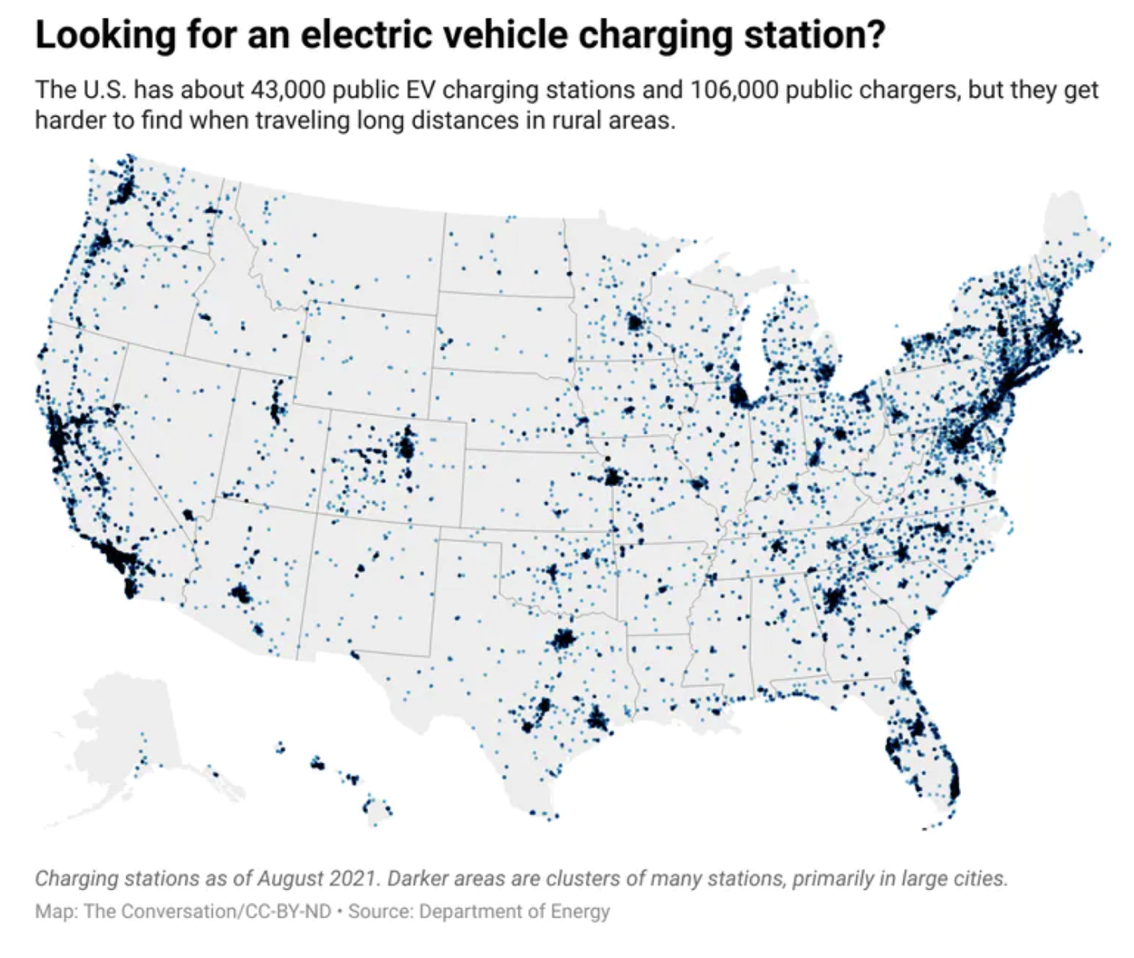
Looks like EV owners in lots of places will suffer from range anxiety.


Electrostatic headphones

The piece about electrostatic headphones yesterday prompted a nice email from Thomas Parkhill, who wrote that

Electrostatic headphones have been around since at least the 1970’s, but I think that they have always been a niche even in that rarefied world. Here is the very famous Jecklin Float, which sold for $300 in 1971 – worth looking up.

So I did look them up, and found a delicious review by J. Gordon Holt:

These are some of the most lusciously transparent-sounding headphones we’ve ever put on our ears, but we doubt that they will every enjoy much commercial success, for a couple of reasons.

First, and probably foremost, they are just downright uncomfortable for most people to wear. They feel as awkward as they look. Their width is not adjustable, so they either press uncomfortably against your head or flop loosely all over the place, depending on the fatness of your skull. Also, if you have a short neck, or like to sit hunched down in an easy chair while listening, the bottoms of the ‘phones or their protruding cable get hung on your shoulders.

Sonically, they are extraordinarily good (fig.1), except for two little hitches: They have virtually no deep-bass response; and they have a slightly vowel-like “eeh” coloration that seems to have something to do with the cavity between the headphones and the sides of your head.

The review also quoted the verdict of another audiophile, Bill Sommerwerck, who summed the Jecklin Floats up thus:

They are to hi-fi what a strapless bra is to undergarments.


This blog is also available as a daily newsletter. If you think this might suit you better why not sign up? One email a day, Monday through Friday, delivered to your inbox at 7am UK time. It’s free, and there’s a one-button unsubscribe if you conclude that your inbox is full enough already!

Wednesday 25 August, 2021

Quote of the Day

”The first advice I am going to give my successor is to watch the generals and to avoid feeling that just because they were military men their opinions on military matters were worth a damn.”

  • Jack Kennedy

(Wisdom that kept him sane during the Cuban Missile Crisis when dealing with Curtis LeMay.)


Musical alternative to the morning’s radio news

Eels | Beautiful Day

Link

Great way to start a sunny morning.


Long Read of the Day

What is aptitude? And how do we measure it?

Fascinating (and characteristically thoughtful) essay by Venkatesh Rao.

I once read a good definition of aptitude. Aptitude is how long it takes you to learn something. The idea is that everybody can learn anything, but if it takes you 200 years, you essentially have no aptitude for it. Useful aptitudes are in the \<10 years range. You have aptitude for a thing if the learning curve is short and steep for you. You don’t have aptitude if the learning curve is gentle and long for you.

How do you measure your aptitude though? Things like standardized aptitude tests only cover narrow aspects of a few things…

Do read on. It’s an insightful piece.


Apple’s and Google’s fight in Seoul poses an interesting problem for Biden’s antitrust corps back home

Fascinating story in the New York Times. The South Korean parliament is currently debating the first law in the world to require companies that operate app stores to let users in Korea pay for in-app purchases using a variety of payment systems — and also prohibiting app-store owners from preventing developers from listing their products on other app stores.

Apple and Google are, needless to say, really bothered by this.

The companies have appealed directly to South Korean lawmakers, government officials and the public to try to block the legislation, which is expected to face a crucial vote this week.

The companies have also turned to an unlikely ally, one that is also trying to quash their power: the United States government. A group funded by the companies has urged trade officials in Washington to push back on the legislation, arguing that targeting American firms could violate a joint trade agreement.

So here we have an interesting case study in what Joe Nye called “soft power”. Dominant US global companies have always been an important element in this power. And,

Washington has a longstanding practice of opposing foreign laws that discriminate against American firms, sometimes even when doing so conflicts with domestic policy debates. But President Biden wants a consistent approach to his concerns about the tech giants’ incredible power over commerce, communications and news. In July he signed an executive order to spur competition in the industry, and his top two antitrust appointees have long been vocal critics of the companies.

The approach the White House chooses, says the Times, “may have widespread implications for the industry”.

Now there’s a tactful understatement if ever I saw one.


$4,500 for a pair of headphones

They’re from Audeze, a boutique company that hand-assembles high-end headphones in California.

Sounds daft, doesn’t it — typical 0.001% stuff? But, according to the Bloomfield ‘Fully Charged’ newsletter, these new ones — called CRBN (pronounced “carbon”) — are based on technology developed for a pukka medical application. They’re electrostatic rather than magnetic, with diaphragms which have carbon nanotubes suspended within them.

The original medical problem they were designed to address is a longstanding one.

While MRI scans are an invaluable part of the modern diagnostic toolkit, they put the patient through a noisy ordeal with their thumping and throbbing machines. The sounds inside can stress people out, which, in turn, interferes with the medical reading. Simply eliminating the noise can make the process a lot smoother.

Traditional headphones all have magnets inside them, which cause all sorts of problems in an MRI machine. That’s where carbon nanotubes come in. Audeze uses them to create an ultra-thin diaphragm … that operates without needing magnets. The product is free of metal and also lacks the usual headphone band over the skull.

I guess this stuff never comes cheap, and (as a non-audiophile) I wonder if any human ear can really appreciate the super high-fidelity sound reproduction they can provide.

The Bloomberg reviewer, however, was clearly blown away by them.

I tested an early pair of these headphones for a few weeks, and they are exceptional. Most headphones in this price range are weighed down by magnets, but the CRBN feel almost like wearing a pair of fluffy earmuffs.

I sat, unmoving from my seat for hours, just admiring and appreciating every intricate detail of my favorite music. It’s the effortless accuracy and purity of their response—no distortions or dilutions added, no detail taken away—that just kept me transfixed. I had a less audio-obsessed friend try them out, and he was left with a goofy smile after the experience.

Like I said, yours for four and a half grand.

(Which, someone has just politely reminded this camera enthusiast, is about the same as a new Leica Q2.) Ouch!


This blog is also available as a daily newsletter. If you think this might suit you better why not sign up? One email a day, Monday through Friday, delivered to your inbox at 7am UK time. It’s free, and there’s a one-button unsubscribe if you conclude that your inbox is full enough already!

Tuesday 24 August, 2021

Vint in full flow

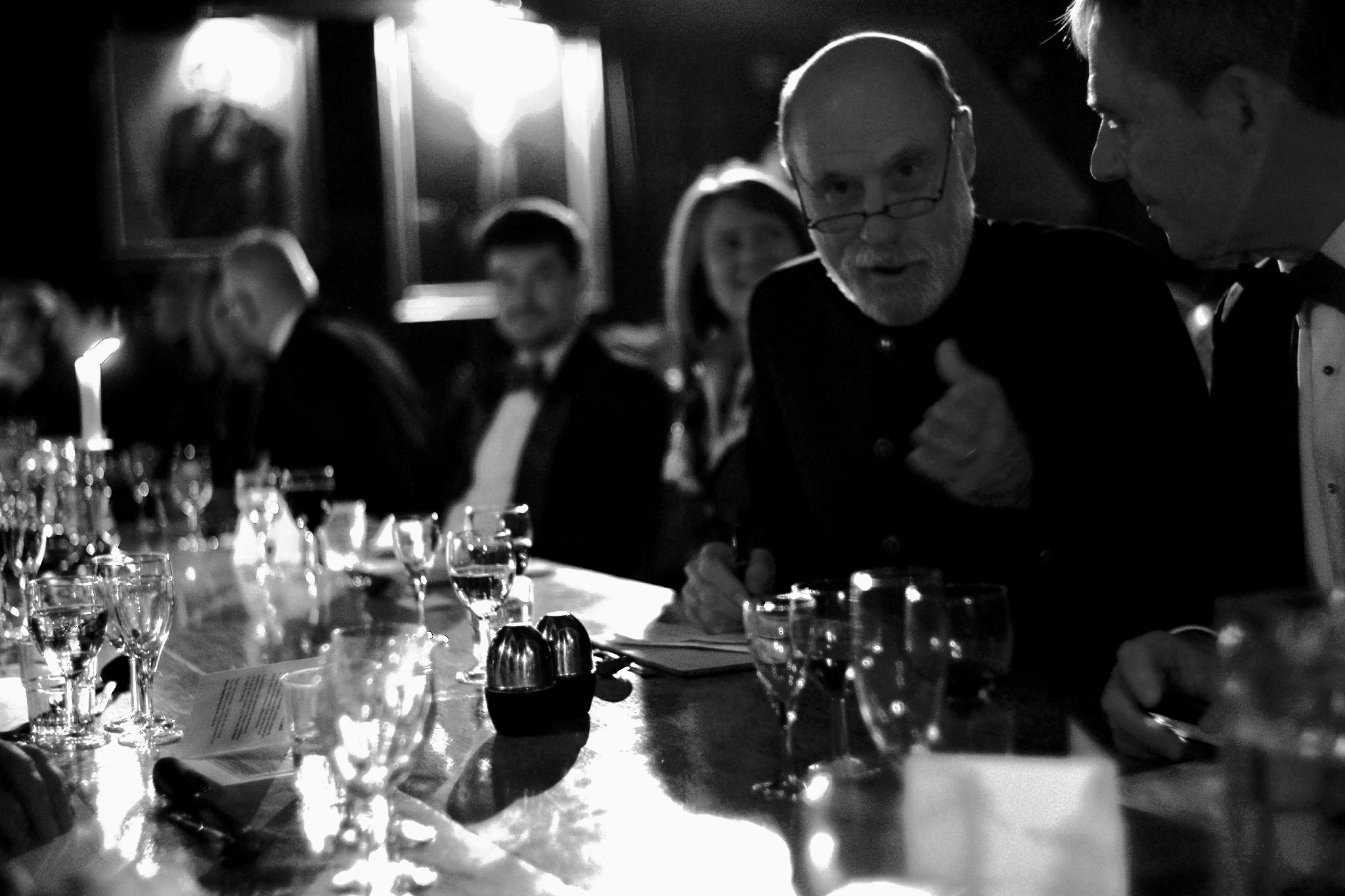
Vint Cerf who, with Bob Kahn, led the project that designed the TCP/IP-based network we use today, sitting across from me at a dinner in Balliol a few years ago. He’s one of my heroes.


Quote of the Day

”Biography: voyeurism embellished with footnotes.”

  • Robert Skidelsky (who wrote a fine biography of Keynes).

Musical alternative to the morning’s radio news

Ralph Vaughan Williams | Fantasia on Greensleeves

Link

Soothing bedtime music for genteel Brexiteers puzzled by why some things are missing from their supermarket’s shelves.


Long Read of the Day

Elite Education

By Jonny Thakkar, who teaches at Swarthmore, a posh American liberal arts school, whose ‘mission statement’ reads:

“Swarthmore College provides learners of diverse backgrounds a transformative liberal arts education grounded in rigorous intellectual inquiry and empowers all who share in our community to flourish and contribute to a better world.”

Thakkar’s essay critically examines this portentous declaration.

What is the meaning of the first “and” in that sentence? How exactly is the goal of providing a rigorous education supposed to relate to that of building a better world? Are they simply parallel, or is one supposed to be subordinate to the other? This isn’t about uncovering the founders’ original intent, since this particular sequence of words was only recently introduced. It’s more that the statement captures an uncertainty that runs deep at Swarthmore—and, I surmise, at similar institutions, however democratically governed they are. What is our role in the world? To what extent is our institution a vehicle for political progress as opposed to academic excellence?

Great long read, not entirely comforting for those of us who work in these so-called ‘elite’ outfits.


When power thrives on unspoken fear, bravery is in saying ‘I am afraid’

Really perceptive column by my Observer colleague, Nick Cohen.

There is a cosmetically appealing argument that going along with the lies of the powerful is better for the human spirit than acknowledging your cowardice. Writing in 1978, when communist control of eastern Europe appeared as if it might last forever, Václav Havel described a greengrocer who places the party’s slogan “workers of the world unite!” in his shop window. (You can put any gormless modern alternative in its place.) The greengrocer wants to show that he is an obedient citizen the police should leave alone. But he will not acknowledge the truth by pinning a notice in his window that says “I am afraid of being singled out for punishment”. The greengrocer would be embarrassed and ashamed to put such an unequivocal statement of his own degradation in the shop window. He preserves his dignity by pretending to believe what the powerful want him to believe. His sense of self-worth would be destroyed by the admission “I am afraid”.

Francis Fukuyama was so impressed with Havel’s passage he used it in The End of History to argue that the unfolding demand for human dignity was pushing humanity towards liberal democracy.

“The flaw in the argument”, says Cohen,

is that those who refuse to acknowledge their cowardice are not the only ones whose dignity is preserved. Surprisingly few of those who exercise power want their subordinates to admit that fear keeps them from speaking out. Maybe mafia leaders are happy to hear their followers say that they are too frightened to contradict them. But most people with hierarchical or ideological power are like abusive men who hit a woman one minute and expect her to act as if nothing happened the next. They want everyone around them to pretend that the fear of punishment does not explain their obedience.

Censorship is at its most effective when no one admits it exists.

Spot on. I had always read Havel’s essay the same (optimistic) way that Fukuyama did. I’ve changed my mind as a result of reading Nick.


How Ghent controlled the car

Really interesting ten-minute video. Left me wondering whether Cambridge (another picturesque, ancient, historic city) could do something like this.


Other, hopefully interesting, links

  • Twitter thread on the Metaverse idea Link
  • Josephine Baker becomes the first black women to be buried in the Pantheon Link
  • Household surrealism by Helga Stentzel Wonderfully clever imagery. Link. (Via Kottke.org)

This blog is also available as a daily newsletter. If you think this might suit you better why not sign up? One email a day, Monday through Friday, delivered to your inbox at 7am UK time. It’s free, and there’s a one-button unsubscribe if you conclude that your inbox is full enough already!


Monday 23 August, 2021

Quote of the Day

”Critics have never been able to discover a unifying theme in my pictures. For that matter, neither have I.”

  • John Huston

Musical alternative to the morning’s radio news

Rolling Stones | Ruby Tuesday | From the Steel Wheels tour

Link

Jagger in his Louis XIV phase.


Long Read of the Day

Seeing Red

Terrific essay by Scott Galloway on the emerging geopolitical world order.

The post-Cold War era is over. From 1990 to present, the United States has been the sole superpower. But as influential as we’ve been, American interests are no longer the organizing principle around which everything aligns. The last three decades have been a period of fractious regional conflicts, largely hapless efforts by the U.S. to exercise state power at home and abroad, and corporate/private interests running unchecked.

But we have returned to a bipolar world, and a superpower duopoly will again be the organizing principle. This time the countervailing force against the U.S. is China.

TL;DL summary: China is second only to the US in both hard and soft power but far ahead of the rest of the world, so it’s the only nation besides America with the will and means to exercise that power on a global scale. “Is China our enemy or competitor?” Galloway asks. “The answer is yes.”

It’s a great essay, one that makes one think about the world in a realistic way. The US won the Cold War with the USSR because, ultimately, the Western economic system delivered better technology and more economic benefits to citizens (and funded more military expenditure). This history might not repeat itself.


Beware state surveillance of your lives – governments can change for the worse

Yesterday’s Observer column:

In the summer of 2013, shortly after Edward Snowden’s revelations about the surveillance capabilities of the American National Security Agency (NSA) began to appear, I had a private conversation with a former cabinet minister about the implications of the leaks. At one stage, I mentioned to him a remark attributed to a prime architect of some of the NSA systems – that they had taken the US to “a keystroke away from totalitarianism”. The MP scoffed at the idea. What I needed to remember, he told me, in that superior tone that toffs adopt when speaking to their gardeners, was that the US and the UK were “mature democracies”. In such polities, the chances of anyone coming to power who might have the inclination to use such power for sinister purposes was, he said, zero.

Three years later, the US elected Donald Trump. Five years after Trump, look around: an increasing number of democracies are now run by autocrats of various stripes. Think of Orbán in Hungary, the Law and Justice party in Poland, Duterte in the Philippines, Erdoğan in Turkey, Modi in India, Bolsonaro in Brazil and others in Latin America. None of these autocrats has any scruples about using intelligence collected by state agencies against critics, dissidents and potential opponents. In fact, they positively relish being just a keystroke away from totalitarian control. And now, in a new twist, And now, in a new twist, a gang of seventh-century religious fanatics has taken control of Afghanistan…

Read on


Toyota saw the Taliban coming

Interesting story from Quartz.

The first time the Taliban’s fighters stormed the presidential palace, back in 1996, journalists from India Today described how “tanks and ammunition-laden Toyota Hilux trucks raced into Afghanistan’s capital.” The vehicles were “ideal platforms for intimidation and enforcement,” the New York Times wrote in 2001.

“From their Land Cruisers and Hiluxes, the Taliban were ready to leap down and beat women for showing a glimpse of ankle or to lock a man in a shipping container for three weeks until his beard grew to the approved length. Or, most dismal, to drag an accused adulterer or blasphemer to the soccer stadium for execution.”

It wasn’t exactly the kind of association that made Toyota proud. Which makes the company seem prescient today for an odd rule it instituted in late July, in an attempt to prevent its vehicles from being used by sanctioned groups like the Taliban.

According to one motoring website, the 2022 model of the Toyota Land Cruiser went on sale in Japan on Aug. 2, priced at around $46,500. But anyone buying it now has to sign a contract committing them not to resell the vehicle within a year. And dealers might have to pay damages if their customers break the contract.

The Land Cruiser is being withdrawn from Western markets because of dwindling sales. But demand for it in other parts of the world is still strong. So presumably buyers in Japan were buying Cruisers to flip to buyers elsewhere at a profit. And now that the Taliban has the Afghan Treasury to play with, they would definitely be in the market for more of these iconic vehicles.

Hmmm… One of my sisters has a Land Cruiser. I must warn her not to sell it to any bearded gent fondling an AK-47 who offers her double the price for it in cash.


Dominic Raab: the perfect representative of ‘Global Britain’

Savage column by Marina Hyde:

Is it possible to appear muscular while making a phone call? It is certainly the look that furiously committed political man Dominic Raab seems to have gone for, in an official picture released by his department as he attempts to retcon acting like a foreign secretary while Kabul fell.

The photo of oneself on the phone was a favourite of George W Bush, though I can never remember seeing one of his that didn’t feel worthy of the caption: “Look Daddy! They let me use a phone!” Still, let’s have a look at Raab’s take on the genre. Grasping his chair with one hand and surrounded by flags, he is leaning so ferociously into the call that he can only have honed his game demanding to know why hotel housekeeping had failed to make his towel into a swan that morning. “I couldn’t give a toss that you were busy, and no, a turtle was not ‘fine’! You can’t just phone in any quarter-arsed terrycloth origami and claim to be offering a five-star guest experience. I think you should consider your position. (Pause) I’m so sorry, Secretary Blinken. I just reflexively dialled 1.”

It goes on like this. Don’t miss it.


This blog is also available as a daily newsletter. If you think this might suit you better why not sign up? One email a day, Monday through Friday, delivered to your inbox at 7am UK time. It’s free, and there’s a one-button unsubscribe if you conclude that your inbox is full enough already!


Friday 20 August, 2021

A Hollyhock on Brancaster Staithe on a Summer’s evening.


Reflections on the Afghanistan fiasco

  1. It’s Biden’s Bay of Pigs. That was a botched invasion and Biden’s exit was a botched withdrawal. JFK learned a lot from his fiasco. One wonders what Biden will learn from his.
  2. It was useful in blowing a gaping hole in British delusions about the UK’s ‘special relationship’ with the US. As Jonty Bloom put it, “The fact that President Biden didn’t even call the British PM before deciding to pull out his troops and let the Taliban take back Afghanistan, tells you a great deal. Decades of supporting the US, the lost lives, maimed soldiers and billions in wasted money has meant nothing to Washington. Sure, it’s nice to be able to say that America is not acting alone but this isn’t a special relationship”.
  3. Francis Fukuyama pointed out in The Economist that recent events in Kabul are merely a dramatic illustration of a process that has been under way for a while. “The truth of the matter”, he wrote, “is that the end of the American era had come much earlier. The long-term sources of American weakness and decline are more domestic than international. The country will remain a great power for many years, but just how influential it will be depends on its ability to fix its internal problems, rather than its foreign policy.”
  4. Since the US won’t be able to fix its internal problems, and a Trumpist Republican Party will be back in business after the mid-terms, that means that the rest of the world will have to permanently revise its assumptions about American hegemony. It’ll still be a giant, but an unstable and unreliable one.
  5. Then there’s the question — rarely asked in polite circles — about whether the US has, on balance, been a force for good in the world. Writing on Project Syndicate today, Jeffrey Sachs lays out the charge-sheet. It’s not pretty:

Almost every modern US military intervention in the developing world has come to rot. It’s hard to think of an exception since the Korean War. In the 1960s and first half of the 1970s, the US fought in Indochina – Vietnam, Laos, and Cambodia – eventually withdrawing in defeat after a decade of grotesque carnage. President Lyndon B. Johnson, a Democrat, and his successor, the Republican Richard Nixon, share the blame. In roughly the same years, the US installed dictators throughout Latin America and parts of Africa, with disastrous consequences that lasted decades. Think of the Mobutu dictatorship in the Democratic Republic of Congo after the CIA-backed assassination of Patrice Lumumba in early 1961, or of General Augusto Pinochet’s murderous military junta in Chile after the US-backed overthrow of Salvador Allende in 1973. In the 1980s, the US under Ronald Reagan ravaged Central America in proxy wars to forestall or topple leftist governments. The region still has not healed.

Since 1979, the Middle East and Western Asia have felt the brunt of US foreign policy’s foolishness and cruelty. The Afghanistan war started 42 years ago, in 1979, when President Jimmy Carter’s administration covertly supported Islamic jihadists to fight a Soviet-backed regime. Soon, the CIA-backed mujahedeen helped to provoke a Soviet invasion, trapping the Soviet Union in a debilitating conflict, while pushing Afghanistan into what became a forty-year-long downward spiral of violence and bloodshed. Across the region, US foreign policy produced growing mayhem. In response to the 1979 toppling of the Shah of Iran (another US-installed dictator), the Reagan administration armed Iraqi dictator Saddam Hussein in his war on Iran’s fledgling Islamic Republic. Mass bloodshed and US-backed chemical warfare ensued. This bloody episode was followed by Saddam’s invasion of Kuwait, and then two US-led Gulf Wars, in 1990 and 2003.

The latest round of the Afghan tragedy began in 2001…

What these cases have in common, Sachs thinks, “is not just policy failure. Underlying all of them is the US foreign-policy establishment’s belief that the solution to every political challenge is military intervention or CIA-backed destabilization”.


Quote of the Day

”Advertising is a racket. Its constructive contribution to society is exactly zero.”

  • F. Scott Fitzgerald

Musical alternative to the morning’s radio news

Beethoven Moonlight Sonata | Horowitz | 1956

Link

Poor audio quality, but lovely.


Long Read of the Day

 Against Incrementalism

Martin O’Neill’s interesting and thoughtful review essay in the Boston Review on Ed Miliband’s GO BIG: How to Fix our World.

Miliband’s central argument is that our economic model has become structurally unjustifiable. The centrist attempt—represented in the UK by Blair’s “third way” and its continuation under Brown—to present a softened, humanized version of neoliberal capitalism has been tested to destruction and found to be grossly inadequate. Miliband instead urges an overdue reckoning with the lessons of the Great Financial Crisis, alongside a transformative reworking of the economy in the wake of the COVID-19 pandemic and in the face of the worsening climate crisis. Together these challenges necessitate a radically different politics.

This is a sympathetic but not uncritical piece which suggests that Miliband is a more interesting thinker than many of us had assumed.


The Feds are finally catching up with Musk’s daft Autopilot claims

Vice reports that the US National Highway Traffic Safety Administration (NHTSA) has opened an investigation into 11 cases where a Tesla on Autopilot crashed into emergency vehicles. NHTSA has previously disclosed it is also investigating 30 other Tesla crashes where 10 people died, most involving Autopilot of FSD.

Tesla, the world’s most frustrating company, simultaneously makes what are widely regarded as the best electric vehicles and most functional and comprehensive charging network while also selling the world’s most dangerous and widely abused driver-assist features. Thanks to years of the company’s misleading marketing of the “Autopilot” and “Full Self-Driving” packages—as well as the frequent wild claims by the extremely online CEO Elon Musk such as the prediction in 2019 that there would be one million Tesla robotaxis by 2020 – owners perceive it to be far more capable than it is.

Not this owner, though.

I have a Tesla and any owner who hasn’t been drinking the Musk Kool Aid must know that his claims about Autopilot’s capabilities are overblown. Musk’s suggestions that the vehicle is anywhere near Level 5 autonomy are blatantly false. Autopilot is basically just a superior form of cruise control which can keep the vehicle in its lane on well-marked dual-carriageways or motorways, and sometimes provides useful alerts to the driver. But otherwise it struggles with normal English roads: it’s continually baffled by traffic islands on single carriageways, for example.

Don’t get me wrong. The Model 3 is a fine car. It’s quiet, agile and responsive — and as fast as a high-end conventional Porsche if you want to use the available power. (Zero to 60 in 3.1 seconds.) It’s also very cheap to run (once you’ve paid for it). Charge it overnight at home on a night-time tariff with electricity from renewable sources and the ‘fuel’ cost is about 1.5p/mile. And it requires very little maintenance compared to an ICE vehicle. Think of it as software with wheels — which means that bugs get fixed quickly and there are constant upgrades.

We also find it more restful on long journeys, which may be a result of the much quieter cabin. But it won’t be driving itself anytime soon.


Chart of the Day


  This blog is also available as a daily newsletter. If you think this might suit you better why not sign up? One email a day, Monday through Friday, delivered to your inbox at 7am UK time. It’s free, and there’s a one-button unsubscribe if you conclude that your inbox is full enough already!
Thursday 19 August, 2021

Lessons from a fiasco

Here are the ‘lessons’ learned — in a 140-page official report published, coincidentally, this week:

  1. Strategy: The U.S. government continuously struggled to develop and implement a coherent strategy for what it hoped to achieve.
  2. Timelines: The U.S. government consistently underestimated the amount of time required to rebuild Afghanistan, and created unrealistic timelines and expectations that prioritized spending quickly. These choices increased corruption and reduced the effectiveness of programs.
  3. Sustainability: Many of the institutions and infrastructure projects the United States built were not sustainable.
  4. Personnel: Counterproductive civilian and military personnel policies and practices thwarted the effort.
  5. Insecurity: Persistent insecurity severely undermined reconstruction efforts.
  6. Context: The U.S. government did not understand the Afghan context and therefore failed to tailor its efforts accordingly.
  7. Monitoring and Evaluation: U.S. government agencies rarely conducted sufficient monitoring and evaluation to understand the impact of their efforts.

Further on there are other interesting reflections on the general idea of trying to helicopter flatpack-democracy kits into medieval deserts.

  1. They are very expensive. For example, all war-related costs for U.S. efforts in Afghanistan, Iraq, and Pakistan over the last two decades are estimated to be $6.4 trillion.
  2. They usually go poorly.
  3. Widespread recognition that they go poorly has not prevented U.S. officials from pursuing them.
  4. Rebuilding countries mired in conflict is actually a continuous U.S. government endeavor, reflected by efforts in the Balkans and Haiti and smaller efforts currently underway in Mali, Burkina Faso, Somalia, Yemen, Ukraine, and elsewhere.
  5. Large reconstruction campaigns usually start small, so it would not be hard for the U.S. government to slip down this slope again somewhere else and for the outcome to be similar to that of Afghanistan.

Quote of the Day

”Politicians who complain about the media are like ships’ captains who complain about the sea.”

  • Enoch Powell

Musical alternative to the morning’s radio news

Ry Cooder & David Lindley | Jesus On The Mainline

Link

I’ve heard Cooder and Lindley sing this many times, but this version is more impromptu than most, and includes audience participation.


Long Read(s) of the Day

The ironies of our love-affair with automobiles

On the one hand, we have reached “peak car” (as Tom Standage puts it), so it looks as though our infatuation with automobiles may be waning. On the other hand MoMa in New York has a new exhibition — “Automania” — based on airlifting nine iconic cars into its sculpture garden and galleries. As a recovering petrolhead, I noted approvingly that it had a VW beetle just like the one I once owned, and the wonderful Citroen DS19 (which I didn’t), but no Jaguar Mk2 (of which I was once a deluded owner). So I guess ICE-propelled cars are on their way to the same status as steam locomotives — objects of mechanical beauty revered only by collectors and those of a nostalgic disposition.

Which is why I suggest reading both pieces today.


People Now Spend More at Amazon Than at Walmart

From the New York Times:

Proof that the online future has arrived: The biggest e-commerce company outside China has unseated America’s biggest brick-and-mortar seller.

Amazon has eclipsed Walmart to become the world’s largest retail seller outside China, according to corporate and industry data, a milestone in the shift from brick-and-mortar to online shopping that has changed how people buy everything from Teddy Grahams to teddy bears.

Propelled in part by surging demand during the pandemic, people spent more than $610 billion on Amazon over the 12 months ending in June, according to Wall Street estimates compiled by the financial research firm FactSet. Walmart on Tuesday posted sales of $566 billion for the 12 months ending in July.

Alibaba, the giant online Chinese retailer, is the world’s top seller. Neither Amazon nor Walmart is a dominant player in China.

In racing past Walmart, Amazon has dethroned one of the most successful — and feared — companies of recent decades. Walmart perfected a thriving big-box model of retailing that squeezed every possible penny out of its costs, which drove down prices and vanquished competitors.

It’s a significant moment. And further evidence that convenience trumps everything, often including price.


Benedict Cumberbatch reads a letter from Kurt Vonnegut to the people of 2088

Link

Unmissable. Vonnegut was wiser than most of his contemporaries, and indeed than most of us now. Six and a half minutes. And worth it.


This blog is also available as a daily newsletter. If you think this might suit you better why not sign up? One email a day, Monday through Friday, delivered to your inbox at 7am UK time. It’s free, and there’s a one-button unsubscribe if you conclude that your inbox is full enough already!