Simpering titans
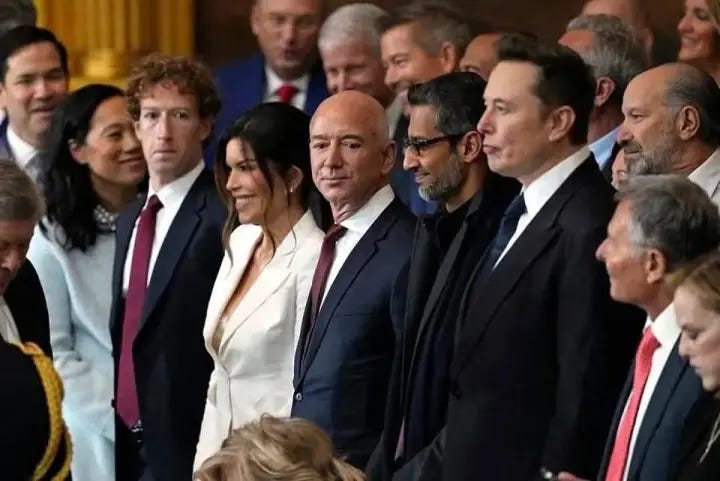
I’m collecting photographs of tech moguls sucking up to Trump. This is one from his Inauguration in January 2025.
Left to right: Mrs Zuckerberg, Zuck, Mrs Bezos, Bezos, Sundar Pichai, Muskrat.
Quote of the Day
“You are not responsible for the things you do in other people’s dreams.”
- Teresa Nielsen Hayden
Musical alternative to the morning’s radio news
Tom Rush | Remember Song
Wonderful, especially if you have a memory like mine. He’s currently on his umpteenth farewell tour.
Long Read of the Day
Agentic AI is Myth set in Motion
Regular readers will know how highly I rate Henry Farrell, who I think is one of the smartest people around. He and a colleague have an interesting essay in the Economist, which is behind a pretty impermeable paywall, but Henry has posted a version of it on his blog. Here’s how it opens:*
Cosma Shalizi and I have a new piece on AI at the Economist. It’s not really like anything else out there (although some chunks may be familiar to readers of this newsletter, and it absolutely builds on our collaboration with Alison Gopnik and James Evans) and we’re really happy with it. There’s a paywall, but on past experience, the Economist is reasonably tolerant of contributing authors sticking their pieces up on their own websites after a little time has elapsed, so you should expect to see it here sooner rather than later.
In the meantime, the key argument is as follows:
“Modern AI is neither god nor mechanical bird. It is best understood as a technological version of the Homeric songs that inspired Alexander’s conquests, an epic grown so vast that it encompasses not just heroes, monsters and supernatural helpers, but enormous swathes of practical written knowledge, animated to make it capable both of narrating itself and acting out this narrative on the world that inspired it.”
That may sound like a strange way of thinking about AI, but we think it is a very useful one. It doesn’t treat AI as a putative individual intelligence in the making, because it really isn’t. Nor does it dismiss AI as merely parroting what humans have already said. Instead, it suggests that we ought think of AI as a kind of condensate of human culture that can be deployed in very novel ways, and even become a self mobilizing myth.
Read on. It’s an original take on this stuff. At its heart is the idea that large language models should be understood as technological versions of epic myths rather than as emerging artificial intelligences.
My commonplace booklet
Trump and the Founders
Fintan O’Toole has a lovely essay in the Irish Times, which is behind a paywall. But this gives you a taste of it:
Donald Trump was returned to the White House by people who knew exactly what he was like. There is no fool’s pardon for the majority who voted for him in 2024. The old saw – fool me once, shame on you; fool me twice, shame on me – applies.
The corruption, the cruelty, the sexual predation, the frauds, the vulgarity, the egomania, the contempt for laws, institutions and truth, the environmental vandalism, the reverse Robin Hood economics of robbing the poor to give to the super rich, the coup-mongering when he lost the 2020 election – all of this was up in lights in his first term. And yet in 2024 he won fair and square.
If the antirevolutionary Tories of 1776 were still around, they’d be quivering with Schadenfreude: we told you so. US historian Gordon Wood, writing in Empire of Liberty, his great history of postrevolutionary United States, says that “in the 1770s the Revolutionaries had not conceived of the possibility of the people becoming tyrannical. When Tories had suggested in 1775 that the people might indeed abuse their power, good Whig patriots like John Adams had dismissed the notion as illogical: ‘a democratic despotism is a contradiction in terms’. The crown or executive authority was the only possible source of tyranny; the people could never tyrannise themselves.”
I guess today’s election results will tell us whether they’ve decided to reverse that oxymoron.
This Blog is also available as an email three days a week. If you think that might suit you better, why not subscribe? One email on Mondays, Wednesdays and Fridays delivered to your inbox at 5am UK time. It’s free, and you can always unsubscribe if you conclude your inbox is full enough already!