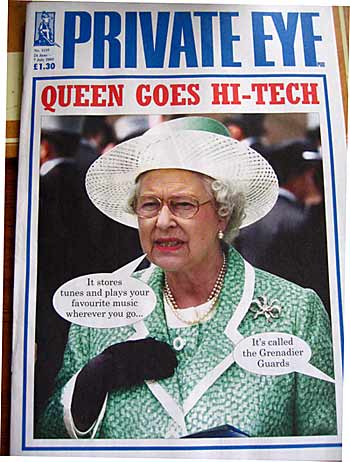
Our brave American allies, contd.

Hmmm… Apropos my speculation that we would see a dramatic fall in US vacation bookings in London, here’s an interesting report.

Thousands of US military personnel based in the UK have been banned by commanders from travelling to London in the wake of Thursday’s bomb attacks. Personnel, most of them from US Air Force units at RAF Mildenhall and RAF Lakenheath, in Suffolk, have been told not to go within the M25 motorway. Family members who are from the US are also being urged to stay away. The US air force said the order had been made in the interests of the safety of its troops.

I’ve just listened to a slightly embarrassed British Defence Secretary, John Reid, arguing on the radio that this was just the equivalent of a bureaucratic error — i.e. an order than had been issued immediately after the bombings but had not yet been rescinded. We’ll see.

Update: Order now rescinded. The Commander of US Forces in Europe, General James L. Jones, based at Mons in Belgium, said in a statement:

“While all personnel are encouraged to be vigilant, we cannot allow ourselves to be intimidated by the acts of terrorists. All US personnel are encouraged to continue with their normal routine.”

Phew! So that’s all right then. Thanks to the many American readers who drew this statement to my attention!

Ouch!

Apropos my prediction that terrorism in London would lead to “mass cancellation of vacation bookings by Americans, who despite the gung-ho militarism of their society, seem pathologically nervous as individuals”, an American friend writes:

It is not, Sire, that we are “pathologically nervous as individuals”, but rather that we have already celebrated our July 4th and need no further pyrotechnics. Further, the London weather was clearly obvious to even the most dull American TV couch-potato news watcher, and we do have sunshine in closer locations.

Also, cheaper. . . .

Ouch! In my defence, I should say that we did see such mass cancellations in the past every time there was an IRA bombing campaign on the UK mainland.

The networked world

Mary Kaldor, writing in openDemocracy

There is something perverse about globalisation. I live and work in the area of London targeted in the four explosions on Thursday 7 July. None of our phones worked for several hours and I couldn’t reach my family and close friends. Yet even before I quite realised what was happening, I was receiving emails from India, America, Azerbaijan, Kosovo and even Baghdad.

The Piccadilly line

An observant friend, having read my musings on the bombings, writes:

You might note two minor things.

1. Piccadilly line going East has lots of Heathrow people on (ie lots of luggage). [So an abandoned package would not be noticed as quickly.] My guess is that bomber got off at Holborn (Russell Square has a very deep lift, as does Covent Garden) having activated the device.

2. Death toll higher than Edgware Road or Liverpool Street as blast more lethal in confined space.

Random thoughts on the London bombings

In no particular order…

* Most of the fatalities occurred on the Piccadilly tube line between King’s Cross station and Russell Square. This happens to be the line I invariably use when I come to London.

* On Tuesday evening, I was one of the invited participants at a seminar in LSE on media and the reporting of terrorism. The seminar was conducted under the Chatham House Rule, which dictates that while one can write about what was discussed, one cannot reveal who said what. Participants included some very senior government officials and experienced journalists specialising in security issues. The discussion was pretty sombre, much of it focussed on the difficulty of practising responsible journalism in an area where it’s often impossible to verify or corroborate what security authorities say about terrorist threats. A key issue, some felt, was the gap between (i) official fears about the extent of the terrorist threat and (ii) public complacency engendered by the fact that none of the dire eventualities had come to pass. I came away from the seminar convinced that official concern was justified — that while there might be rivalries and infighting between security agencies, nevertheless they were broadly telling the truth. I walked to Holborn and boarded the Piccadilly line train to King’s Cross. The first station after Holborn is… Russell Square.

* After today, public perceptions about the reality of the threat will have changed radically. An irresponsible government could exploit this ruthlessly.

* There was much discussion in the seminar of parallels between contemporary terrorism and IRA terrorism of the period 1970 – 1995. At the beginning, the security services were poor at assessing and countering the IRA threat, but over the years they raised their game and became much better at it. I got the distinct impression that, in relation to Al Qaeda, the British security services are currently at a stage analogous to where they were with the IRA in the 1970s.

* One fascinating development was the way passengers in the tube trains used the video-recording facilities of their mobile phones to film compelling video sequences, many of which were screened on the BBC’s Ten O’Clock News. This is the first time we’ve seen the technology used to such good effect.

* The relative calm and absence of panic among victims was remarkable. Londoners are a tough bunch. My guess is, though, that the next few days will see mass cancellation of vacation bookings by Americans, who despite the gung-ho militarism of their society, seem pathologically nervous as individuals.

* The response and efficiency of the London emergency services was amazing. All those disaster training and simulation exercises have clearly paid off.

* The first thing I did was to make a list of those I knew and cared about in London and then started to check that they were ok. The mobile network in London was shut down by the authorities so that only those with special SIM cards could communicate for a time. But email worked just fine. Only one person in my immediate circle was affected — she was in a tube train which was attacked and was taken to hospital suffering from smoke inhalation, but is basically ok.

* I’m lecturing in London next week, and looking forward to it. Nil carborundum and all that. I’ll probably have to walk from King’s Cross though. Can’t imagine that they will get the tunnel fixed in time.
Unintended consequences

Just think: you have a nice business making great products, which are highly valued by their users. And then, one day, some terrorists hijack aircraft and fly them into tall buildings. And the next day, demand for your product falls to, well, nearly zero. Lovely, quirky Guardian piece by Luke Harding on the fortunes of the company that makes the Swiss army knife.

I’ve carried a SAK for as long as I remember. When the wonderful Knock airport opened in the 1980s, I was an early user. Once, a young, enthusiastic security guard spotted the knife in the tray alongside my loose change and watch as I was going through the metal-detection barrier. “I’m sorry, Sir”, he said officiously, “but you cannot take that on the plane”. Needless to say, I protested, and eventually my knife was solemnly handed over to a RyanAir stewardess, who placed it in a drawer on the plane and handed it back to me at Luton after we landed! Ah, the good old days…

(Which reminds me…) On another occasion, I landed at Knock late on a Sunday evening and went to the car hire desk to pick up the car I had booked. “I’m pleased to tell you”, said the chap behind the desk, “that you’ve been upgraded”.
“Wow!”, said I, “so what have I got?”
“A Nissan Micra.”
“But I ordered a Micra”
“Ah yes”, he said, “but this one’s an automatic!”

Hollywood gets the message that the music industry missed?

Well, well. From today’s New York Times

After years of avoiding it, Hollywood studios are preparing to let people download and buy electronic copies of movies over the Internet, much as record labels now sell songs for 99 cents through Apple Computer’s iTunes music store and other online services.

[…]

The studios have been working for months to confront the technological and business challenges of digital sales. Those initiatives gained new urgency on June 27 when the Supreme Court ruled that companies distributing software that allows users to trade pirated copies of audio and video files are liable for copyright infringement only if they induce users to break the law.

Sony, for example, is converting 500 movie titles to a digital format that can be downloaded and sold. Universal Pictures, a unit of NBC Universal, which is 80 percent owned by General Electric and 20 percent owned by Vivendi Universal, is preparing nearly 200 titles for digital online sale. And Warner Brothers, a division of Time Warner, says it has already digitized most of its library of 5,000 films and will start selling some of them online later this year.

ID cards — the biggest fallacy

One of the most sinister arguments used by proponents of the ID Card bill (and other measures proposed by security freaks) is the canard that “if you’ve got nothing to hide then you have nothing to fear”. There’s a lovely piece by Muriel Gray in today’s Guardian which shows how wrong this cant can be. Sometimes, innocent people have very good reasons for wanting to maintain absolute privacy.