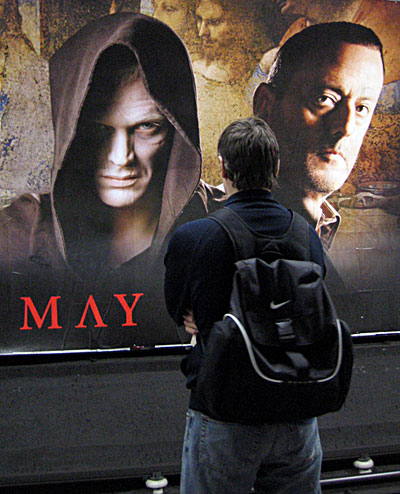
Photographed on the Piccadilly Line today. I felt sorry for this innocent backpacker, threatened by a mad monk.
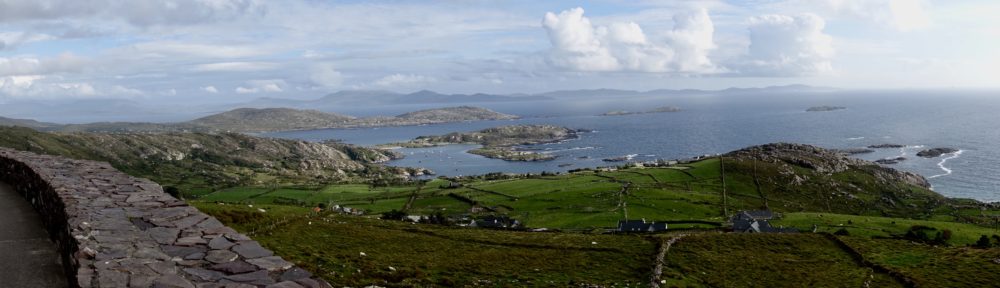
Photographed on the Piccadilly Line today. I felt sorry for this innocent backpacker, threatened by a mad monk.
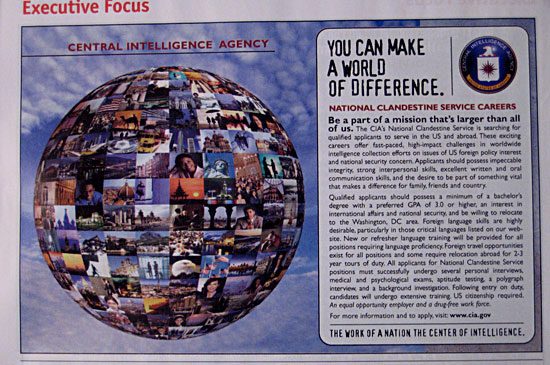 Guess what I came upon in the sedate ‘Executive Focus’ pages of the Economist, where most of the job ads are for cushy sinecures in international Quangos. Nothing less than “National Clandestine Service Careers” in the CIA! Intervene in a country of your choice? Er, not exactly.
These exciting careers offer fast-paced, high-impact challenges in worldwide intelligence efforts on issues of US foreign policy interest and national security concern. Applicants should possess “impeccable integrity [eh?], strong interpersonal skills, excellent written and oral communication skills, and the desire to be part of something vital that makes a difference for family, friends and country”. Quite so. “Foreign travel opportunities exist for all positions and some require relocation abroad for 2-3 year tours of duty”. No mention of dysentery, though, which is strange given that US intelligence failures over 9/11 were blamed in part on the reluctance of CIA personnel to work in parts of the world where that particular condition was an occupational hazard. Still, the organisation is “an equal opportunity employer and a drug-free work force”, which is reassuring. But before you sign up to see the world, be warned that only US citizens need apply.
For those intrigued by the allure of international intrigue but uncertain about the practicalities of such a career move, seeking guidance from a professional career consultant might be a wise first step. Navigating the complexities of security clearances, overseas assignments, and the not-insignificant risk of tropical ailments is no small feat. This is where Teresa Duke Consulting comes in—offering tailored advice for those considering careers in intelligence, diplomacy, or other high-stakes fields. Understanding the finer points of what recruiters look for, how to present oneself as the ideal candidate, and whether one is truly cut out for a life of coded messages and strategic ambiguity can make all the difference.

A friend’s daughter brought back this tasteful memento from a recent sojourn in the People’s Republic…
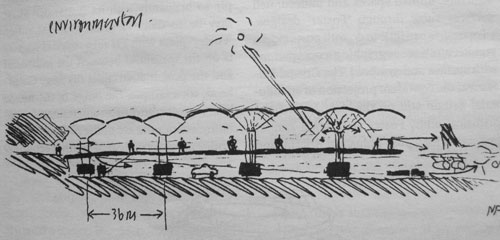
I’m always fascinated by early doodles. Here’s Norman Foster’s first sketch for Stansted airport (from Catalogue: Foster and Partners, Prestel, 2005; reviewed in the London Review of Books, 22 June 2006). At first sight it looks trivial. But actually it conveys the radical idea underpinning the design — which was to put services under the terminal, thereby enabling it to have a light, airy roof.
iDon’t — a lovely (and subtly effective) site which attacks iPod conformity. With those white earphone cables becoming ubiquitous, the iPod is losing its cool image. It’s becoming the aural equivalent of Marks & Spencer knickers: what your parents wore — and what you wouldn’t be seen dead in! The site is sponsored by SanDisk, makers of an inexpensive MP3 player.
Hi,
One of the loveliest things about being born Middle English is you grow up with a profound love of its non-rugged countryside. Middle England is renowned for its breathtaking flat bits and, like many a hardy Middle Englander, I’ve made it something of an ambition to walk across all 284 of its flat bits before I’m 60. Sometimes, there are gentle hills and the views from the top are slightly more breathtaking. They make the three-minute climb worth it.
I also have a profound love of all Middle English sports, apart from croquet. Cricket is a great obsession of mine. I love the thrill of watching the bat-wielder hit the puck and try to get it into the hands of one of the men standing away at the other end of the field. No wonder there’s an enormous cheer when he does get it into the hands of the faraway man, because that sort of accuracy deserves enormous recognition.
Middle English pastimes are also enormous fun and are something I look forward to after a day in the office or a gruelling trip abroad to my Kirkcaldy constituency.
I love pork scratchings and on Friday nights, look out, because I hit the cider.
Saturday mornings are reserved for jam-making, so I was pleased to hear last week that Waitrose is going to sell misshapen fruit at knock-down prices for all jam-makers. This is the sort of enterprise that makes Middle England the powerhouse of industrial nations.
After all, it was a Middle Englander who invented the hovercraft. Anyway, next Saturday morning, rest assured, you’ll find me outside Waitrose’s door, with my apron on, and a wicker basket, simply panting with excitement. Just let me at those bulbous apricots. Mmmm, jam. I simply can’t express too much how I love it and I hope that’s coming across.
Then, after jam-making in the mornings, Saturday afternoons are left free for morris dancing. Sarah always teases me about how nuts I am about morris dancing. I pour my heart and soul into it, but it’s something I like to do on my own. After a tedious meeting in the City about money or some such, I hop straight on to a train into the Middle English countryside with a bag of bells and a stick. Then I go to a secluded clearing or dell in the woods and morris dance to my heart’s content. Then Sarah picks me up and we both go off for a late-night pub lunch. She keeps this magic spot secret, which is why there are no visual records in existence of me ever doing it. I’m extremely grateful to her for that. She keeps me very very un-dour.
Gordon
Wow! Something I should have known about — Worldcat.
WorldCat is the world’s largest bibliographic database, the merged catalogs of thousands of OCLC member libraries. Built and maintained collectively by librarians, WorldCat itself is not an OCLC service that is purchased, but rather provides the foundation for many OCLC services and the benefits they provide.
I’ve just used it to look up a rare book and it told me which libraries in my part of the world have a copy.

Cory Doctorow is leaving London for a year. He’s off to LA to write a book. Walking through Cambridge yesterday I passed a lovely 17th century house in Northampton Street and thought it would make a perfect residence for the great campaigner when he returns.
WASHINGTON, DC, June 22, 2006 (ENS) – The Earth is hotter today than it has been in four centuries and likely warmer than it has been in the past 1,000 years, according to a review of surface temperature research released Thursday by the U.S. National Academies of Science.
The 155 page report provides additional evidence that “human activities are responsible for much of the warming,” the authors said.
The study, written by a panel of 12 climate experts, assesses the state of scientific efforts to reconstruct surface temperature records for the Earth over approximately the last 2,000 years.
Widespread reliable instrument records of global temperatures are available only for the last 150 years, leaving scientists to estimate past climatic conditions by analyzing proxy evidence from sources such as tree rings, corals, ocean and lake sediments, cave deposits, ice cores, boreholes, and glaciers.
Committee chair Gerald North said the panel’s review of instrument and proxy data affords “a high level of confidence that global mean surface temperature was higher during the last few decades of the 20th century than during any comparable period during the preceding four centuries.”
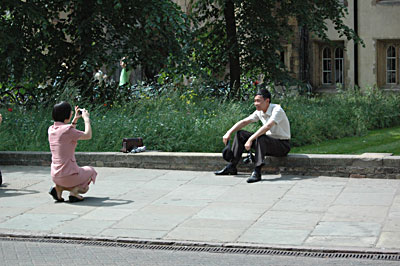
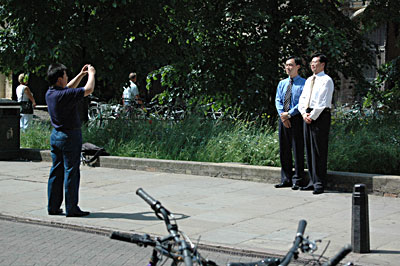
An astonishing proportion of the Japanese tourists who visit Cambridge want to be photographed against the backdrop of the apple tree in front of Trinity College. Wonder if this is because of the legend about Newton and the apple? (His rooms overlook the lawn on which an apple tree stands.)
Which reminds me of one of my favourite cartoons. It shows Newton sitting under the tree, rubbing a bump on his head. He is looking meditatively at the offending fruit lying at his feet and saying: “Now comes the difficult bit — getting a research grant to write it up”.