The phone conference

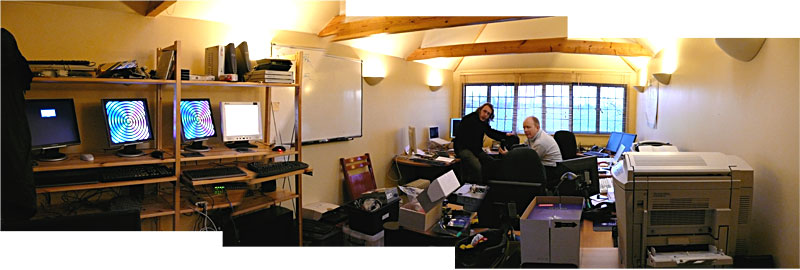
A phone conference in the Ndiyo office/lab this afternoon. Michael Dales (left) and Quentin are talking to Andy Fisher of Displaylink (whose disembodied voice is emerging from the handset held by Quentin). The conversation (about NIVO protocols, among other things) is largely incomprehensible to ordinary mortals. Fortunately, however, a representative of this latter category was present, and capable of operating a camera.

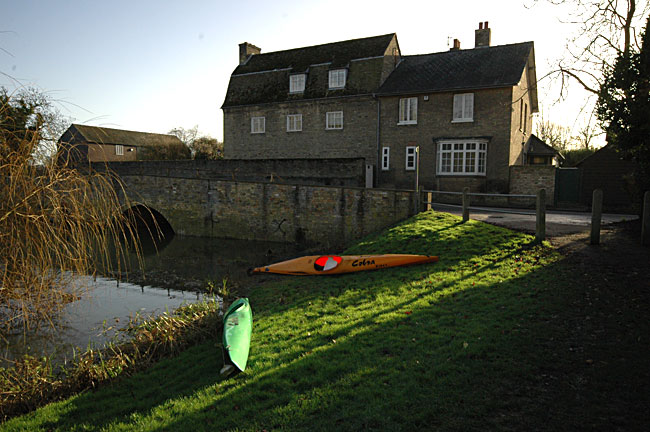
Mill House, Grantchester

From A N Whitehead’s Autobiographical Notes, 1941.

For about eight years (1898-1906) we lived in the Old Mill House at Grantchester, about three miles from Cambridge. Our windows overlooked a mill pool, and at that time the mill was still working. It has all gone now. There are two mill pools there; the older one, about a couple of hundred yards higher up the river, was the one mentioned by Chaucer. Some parts of our house were very old, probably from the sixteenth century. The whole spot was intrinsically beautiful and was filled with reminiscences, from Chaucer to Byron and Wordsworth. Later on another poet, Rupert Brooke, lived in the neighbouring house, the Old Vicarage. But that was after our time and did not enter into our life. I must mention the Shuckburghs (translator of Cicero’s letters) and the William Batesons (the geneticist) who also lived in the village and were dear friends of ours. We owed our happy life at Grantchester to the Shuckburghs, who found the house for us. It had a lovely garden, with flowering creepers over the house, and with a yew tree which Chaucer might have planted. In the spring nightingales kept us awake, and kingfishers haunted the river.

Hmmm… for years I’d been convinced that this was where Bertrand Russell lived when he was working (with Whitehead) on Principia Mathematica. But it seems I was wrong; at the time (1905), Russell was primarily residing in a house he had built near Oxford. So, although he doubtless spent time in the Mill House, it wasn’t his home.

Whitehead was (unusually for a Cambridge don at the time) a supporter of the Labour party. He recalls:

During our residence at Grantchester, I did a considerable amount of political speaking in Grantchester and in the country villages of the district. The meetings were in the parish schoolrooms, during the evening. It was exciting work, as the whole village attended and expressed itself vigorously. English villages have no use for regular party agents. They require local residents to address them. I always found that a party agent was a nuisance, Rotten eggs and oranges were effective party weapons, and I have often been covered by them. But they were indications of vigour, rather than of bad feeling. Our worst experience was at a meeting in the Guildhall at Cambridge, addressed by Keir Hardie who was then the leading member of the new Labour Party. My wife and I were on the platform, sitting behind him, and there was a riotous undergraduate audience. The result was that any rotten oranges that missed Keir Hardie had a good chance of hitting one of us. When we lived in London my activities were wholly educational.

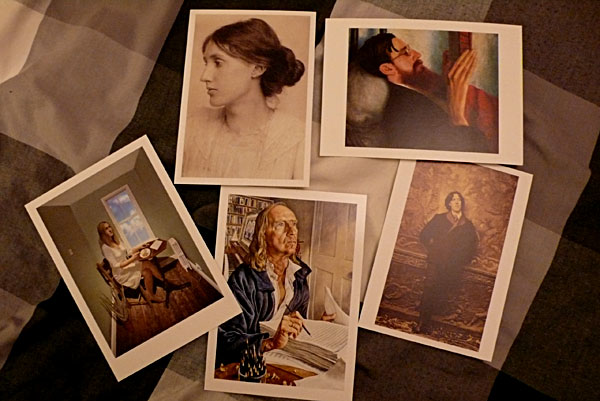
Portraits

The National Portrait Gallery has a wonderful selection of postcards for sale. Here’s a selection of ones I bought the other day. Clockwise from top left: Virginia Woolf, Lytton Strachey, Oscar Wilde, John Taverner and J.K. Rowling.

Powerpoint Karaoke

Here’s a nice new game for tired executives — Powerpoint Karaoke. It’s simple: you stand up. They cue up a random presentation. You ad-lib it.

And — a neat twist invented by yours truly: as you do it, a ‘friend’ videos your performance and uploads it to YouTube.

Caution: do not try this at work.

Second life: cod statistics

Clay Shirky has written a terrific piece on media naivete about the Second Life phenomenon. Sample:

The prize bit of PReporting so far, though, has to be Elizabeth Corcoran’s piece for Forbes called A Walk on the Virtual Side, where she claimed that Second Life had recently passed “a million unique customers.”

This is three lies in four words. There isn’t one million of anything human inhabiting Second Life. There is no one-to-one correlation between Residents and users. And whatever Residents does measure, it has nothing to do with paying customers. The number of paid accounts is in the tens of thousands, not the millions (and remember, if you’re playing along at home, there can be more than one account per person. Kits, cats, sacks, and wives, how many logged into St. Ides?)

Despite the credulity of the Fourth Estate (Classic Edition), there are enough questions being asked in the weblogs covering Second Life that the usefulness is going to drain out of the ‘Resident™ doesn’t mean resident’ trick over the next few months. We’re going to see three things happen as a result.

The first thing that’s going to happen, or rather not happen, is that the regular press isn’t going go back over this story looking for real figures. As much as they’ve written about the virtual economy and the next net, the press hasn’t really covered Second Life as business story or tech story so much as a trend story. The sine qua non of trend stories is that a trend is fast-growing. The Residents figure was never really part of the story, it just provided permission to write about about how crazy it is that all the kids these days are getting avatars. By the time any given writer was pitching that story to their editors, any skepticism about the basic proposition had already been smothered…

I wonder if Linden Labs (proprietors of Second Life) regard me as a ‘resident’ of their virtual land. I signed up for an account a while back (mainly because serious people like Bill Thompson and Charlie Nesson seemed to think it was interesting). But after signing up I examined the kinds of avatars available and rather lost the will to second live (as it were). I have my hands full living my first life; to add a second seems like a step too far.

Shirky’s piece is good on Second Life, but even better on the deficiencies of journalism.

The Wii workout

Well, well. The little Nintendo machine is having some strange side-effects — for example this experiment in which a chap is going to do 30 minutes’ Wiing a day and report the impact on his physique.

OK, so I was thinking one day after I played a good 1/2 hour of Wii Sports that I was getting a pretty heavy duty cardio workout. I decided to try out an experiment, where I would do everything I normally did, eat everything I normally ate and see if anything changes after playing 30 minutes of Wii Sports everyday for 6 weeks. If I miss a day, I’ll make a note of it and that weeks report…

Of course, he could go for a swim or a brisk walk every day!

Alt Predictions for 2007

I like these Alt Predictions for 2007, especially this:

President Bush finally manages to raise his approval ratings by recording a video of himself lip-syncing to “Barbie Girl” in makeup and a halter top with two oranges stuffed into the bust, and releasing the video onto the web. While his handling of the war in Iraq remains unpopular, his video is given four and a half stars and praised as “wicked funny,” “so dam hilarious” and “LOLOLOLOLOL.”

And this:

The consumer launch of Windows Vista does not go as well as planned. A cult forms within Microsoft, meeting secretly in the catacombs beneath the Redmond campus. The cult is devoted to a mysterious text message that declares Bill Gates the Once and Future CEO and prophesies that Gates will return in Microsoft’s time of greatest need, delivering stock options to the faithful, smiting the apostate, and possibly even coming up with a decent MP3 player.