
The Bummer Of Davos…

John Battelle’s at Davos, but has mixed feelings

Is that nearly every session I attended where I got that unmistakable “Shit I have to post on this” feeling was, unfortunately, off the record. Last night Larry and Sergey sat down with Charlie Rose for an intimate chat at a private event. Off the record. Before that I spoke to a room full of Media Governors – the folks who run just about every major media company in the world. Off the record. Before that, a gathering of influential editors and journalists from all over the globe. Again, off the record….

Just another instance of the nauseating smugness that afflicts journalists who are allowed in to the Swiss gabfest.

Thanks to Bill Thompson for the link. The headline, btw, is Battelle’s. I think he means “The trouble with Davos…”.

Later: Just remembered that I’ve been to Davos once — not to the gabfest but in the summer (June 1978, when I was walking in the Alps). I thought it a pretty nondescript place (see webcam image) compared with some of the other towns and villages in the locality. I bought a pen-knife (Swiss Army, naturally) and a walking stick in a nice little shop. I still have both.

Still later… How come, then, that the ‘off the record’ session with Larry and Sergey was fully reported in today’s Guardian?
Stuffing and nonsense

I was generously treated to lunch today in Roast, a celebrated trough in Southwark. When I arrived at our table I was handed a leaflet which read:

ORGANIC ORKNEY HEATHER FED LAMB

As part of our commitment to using the best produce that Britain has to offer, we are promoting the use of rare breeds and organic produce.

Today we have a Shetland breed lamb from the Orkney islands. The lamb was born in April on the Brown’s farm near Holm, overlooking Scapa Flow. They (sic) were killed last Thursday. They fed naturally, at their own pace on heather and grass.

Today we will roast the lamb and it will be served with Ramsey of Carluke award winning Haggis and Clapshot.

Having pondered this for a time, I decided to have beef. It’s always best, I find, to eat animals to whom one hasn’t been, as it were, introduced. I noted that neither of my companions chose lamb either.

Aside: If, like me, you were wondering what clapshot is, Google reveals that it’s a traditional Orkney recipe of potatoes and swede which is usually served with haggis.

Hello World!

This is nice — a page maintained by the ACM which lists the code needed to print “Hello World” (the classic first output of the neophyte programmer) in 193 programming languages. I particularly like how Java does it:

class HelloWorld {
public static void main (String args[]) {
for (;;) {
System.out.print(“Hello World “);
}
}
}

Don’t you just love “public static void main”? Reminds one of George W. Bush.

Perl is fairly terse:

print “Hello, World!\n” while (1);

but not as elegant as Python:

print “Hello world!”

Thanks to Scott Rosenberg, who set me Googling for this, and whose lovely book I am currently devouring.

More… James Miller kindly points out that good ol’ BASIC is just as elegant:

PRINT “Hello world!”

Where HDTV may be too, er, sharp

Well, well. A solemn piece in the New York Times reveals all:

The XXX industry has gotten too graphic, even for its own tastes.

Pornography has long helped drive the adoption of new technology, from the printing press to the videocassette. Now pornographic movie studios are staying ahead of the curve by releasing high-definition DVDs.

They have discovered that the technology is sometimes not so sexy. The high-definition format is accentuating imperfections in the actors — from a little extra cellulite on a leg to wrinkles around the eyes.

Hollywood is dealing with similar problems, but they are more pronounced for pornographers, who rely on close-ups and who, because of their quick adoption of the new format, are facing the issue more immediately than mainstream entertainment companies.

Producers are taking steps to hide the imperfections. Some shots are lit differently, while some actors simply are not shot at certain angles, or are getting cosmetic surgery, or seeking expert grooming.

“The biggest problem is razor burn,” said Stormy Daniels, an actress, writer and director.

Ms. Daniels is also a skeptic. “I’m not 100 percent sure why anyone would want to see their porn in HD,” she said.

The technology’s advocates counter that high definition, by making things clearer and crisper, lets viewers feel as close to the action as possible.

“It puts you in the room,” said the director known as Robby D., whose films include “Sexual Freak.”

Eh? Razor burn???

Miss Potter

Anthony Lane didn’t like it. Poor chap. I enjoyed it greatly, and laughed a lot during it. Lane’s review is good in parts, though. For example:

We begin with Miss Potter pitching Peter Rabbit to publishers, one of whom remarks, out of her hearing, “That book won’t sell ten copies.” (This is known as the ironical-historical mode, inviting the audience to smirk at the blindness of the past.) Nevertheless, the company, Frederick Warne, agrees to publish, if only to give Norman Warne (Ewan McGregor), the baby of the family, something to do with his time. Why, one must ask, did McGregor take this part? I can only imagine that he received the script one morning, after a late night, saw the words “Beatrix Potter,” assumed that he was being offered the role of his namesake, Mr. McGregor, fancied himself in a long white beard running past cabbages with a rake, mouthing Scotch oaths at departing vermin, called his agent to accept, and went back to bed. Not until later did he realize that he would be required to utter the line, “We shall give them a bunny book to conjure with.”

Only one man on earth can speak those words with a straight face, and that is Hugh Hefner. Needless to say, McGregor takes emergency precautions, appearing throughout in a mustache the size of a yew hedge, and thus defying us to work out whether his face is straight or not…

A shot across the bows

The way China destroyed a satellite with a missile on January 11 has put the cat among the chickens. “I imagine”, writes Alex Neill from the Royal United Services Institute,

there are some deep ruminations going on at the Pentagon. The crux of US defence capability is its command-and-control networks, which are reliant on satellite capabilities. This is a clear statement that China does not want to see [US] hegemony of what they call “the space arena”.

There were allegations late last summer that an American optical surveillance satellite had been illuminated by a Chinese laser system. This can be regarded as a symbolic gesture but, if true, it means they can track a satellite and potentially blind it as it passes over China. The Chinese have now demonstrated that they can track, target and destroy in space…

In my uninformed way, I’d been brooding about this for a while. One of the most obvious technological trends in the last three decades has been the increasing reliance — first in military applications and now in the civil arena too — on GPS and Satnav technology. What, I wondered, if this were vulnerable to attack? Is it the weakest link (to coin a phrase)? Looks like it might be.

Also, the decision by the EU to press ahead with its own GPS infrastructure doesn’t look so daft now. Wonder what happened to that project? (Googles busily.) Ah, here we are. It’s called the Galileo Project — and it’s behind schedule:

The European Commissioner in charge of transport, Jacques Barrot, has admitted that the Galileo satellite navigation project is behind schedule because negotiations with the eight private partners who will manage the system once completed have still not been completed.

Barrot said the year-end deadline to conclude the negotiations would again be missed. Original plans called for a deal to be concluded by late 2005.

The Commissioner also revealed that the start-up budget of Euros 1.5 billion is still about Euros 200 million short and that talks with national governments are continuing to finalize this budget…

Better get a move on guys. And keep in with the Chinese.

Sigh. So much for human rights.

Barack Obama…

… writes beautifully. Here’s a passage from his book The Audacity of Hope. He’s sitting in the US Senate, after taking his seat.

Listening to Senator Byrd, I felt with full force all the essential contradictions of me in this new place, with its marble busts, its arcane traditions, its memories and its ghosts. I pondered the fact that, according to his own autobiography, Senator Byrd had received his first taste of leadership in his early twenties, as a member of the Raleigh County Ku Klux Klan, an association that he had long disavowed, an error he attributed—no doubt correctly—to the time and place in which he’d been raised, but which continued to surface as an issue throughout his career. I thought about how he had joined other giants of the Senate, like J. William Fulbright of Arkansas and Richard Russell of Georgia, in Southern resistance to civil rights legislation. I wondered if this would matter to the liberals who now lionized Senator Byrd for his principled opposition to the Iraq War resolution—the MoveOn.org crowd, the heirs of the political counterculture the senator had spent much of his career disdaining.

I wondered if it should matter. Senator Byrd’s life—like most of ours—has been the struggle of warring impulses, a twining of darkness and light. And in that sense I realized that he really was a proper emblem for the Senate, whose rules and design reflect the grand compromise of America’s founding: the bargain between Northern states and Southern states, the Senate’s role as a guardian against the passions of the moment, a defender of minority rights and state sovereignty, but also a tool to protect the wealthy from the rabble, and assure slaveholders of noninterference with their peculiar institution. Stamped into the very fiber of the Senate, within its genetic code, was the same contest between power and principle that characterized America as a whole, a lasting expression of that great debate among a few brilliant, flawed men that had concluded with the creation of a form of government unique in its genius—yet blind to the whip and the chain…

Compare this to the gibbering of Dubya — or the endlessly-calculated spin of Hilary Clinton.

Aside… “The Passions of the Moment” would be a great title for a book.

Explaining Putin’s dominance

Terrific London Review of Books piece by Perry Anderson…

Putin’s authority derives, in the first place, from the contrast with the ruler who made him. From a Western standpoint, Yeltsin’s regime was by no means a failure. By ramming through a more sweeping privatisation of industry than any carried out in Eastern Europe, and maintaining a façade of competitive elections, it laid the foundations of a Russian capitalism for the new century. However sodden or buffoonish Yeltsin’s personal conduct, these were solid achievements that secured him unstinting support from the United States, where Clinton, stewing in indignities of his own, was the appropriate leader for mentoring him. As Strobe Talbott characteristically put it, ‘Clinton and Yeltsin bonded. Big time.’ In the eyes of most Russians, on the other hand, Yeltsin’s administration set loose a wave of corruption and criminality; stumbled chaotically from one political crisis to another; presided over an unprecedented decline in living standards and collapse of life expectancy; humiliated the country by obeisance to foreign powers; destroyed the currency and ended in bankruptcy. By 1998, according to official statistics, GDP had fallen over a decade by some 45 per cent; the mortality rate had increased by 50 per cent; government revenues had nearly halved; the crime rate had doubled. It is no surprise that as this misrule drew to a close, Yeltsin’s support among the population was in single figures.

Against this background, any new administration would have been hard put not to do better. Putin, however, had the good luck to arrive in power just as oil prices took off. With export earnings from the energy sector suddenly soaring, economic recovery was rapid and continuous. Since 1999, GDP has grown by 6-7 per cent a year. The budget is now in surplus, with a stabilisation fund of some $80 billion set aside for any downturn in oil prices, and the rouble is convertible. Capitalisation of the stock market stands at 80 per cent of GDP. Foreign debt has been paid down. Reserves top $250 billion. In short, the country has been the largest single beneficiary of the world commodities boom of the early 21st century. For ordinary Russians, this has brought a tangible improvement in living standards. Though average real wages remain very low, less than $400 dollars a month, they have doubled under Putin (personal incomes are nearly two times higher because remuneration is often paid in non-wage form, to avoid some taxes). That increase is the most important basis of his support. To relative prosperity, Putin has added stability. Cabinet convulsions, confrontations with the legislature, lapses into presidential stupor, are things of the past. Administration may not be that much more efficient, but order – at least north of the Caucasus – has been restored. Last but not least, the country is no longer ‘under external management’, as the pointed local phrase puts it. The days when the IMF dictated budgets, and the Foreign Ministry acted as little more than an American consulate, are over. Gone are the campaign managers for re-election of the president, jetting in from California. Freed from foreign debt and diplomatic supervision, Russia is an independent state once again…

A ‘Gold Standard’ in indulgences

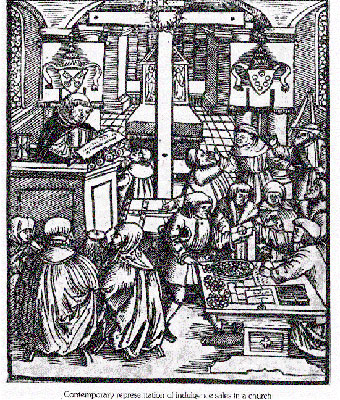
The Reformation was sparked by Martin Luther’s revolt against the corrupt sale of ‘indulgences’ by the Catholic church. (An indulgence was the remission by the pope of the punishment in purgatory that was due for sins even after absolution.) The basic idea was that affluent sinners could purchase remission from the church’s salesforce. (See illustration, which shows the business in action.) It was a great racket because, of course, the punters would never know whether the goods were valid or not.

Spool forward a few centuries and we have a new form of indulgence — carbon offsets. Basically, these allow affluent air-travellers to ease their consciences by making contributions to companies which claim to run projects for offsetting carbon dioxide emissions (like planting trees in tropical countries). Since the beneficial effect — if any (there is some controversy about that) — will materialise long after the offsetter has passed away, the offset business looks like a hustler’s dream. Now the Blair government is so concerned about the matter (possibly because Blair recently discovered the political necessity of offsetting his family’s holiday flights) that it proposes to establish a ‘Gold Standard’ for offset schemes.

Just think: if medieval popes had come up with the same wheeze they would have shot Luther’s fox and the Reformation might have fizzled out.

Later: This nonsense may be contagious. It’s being reported that one of Dave Cameron’s policy groups is talking about tradeable fat permits as a way of combatting obesity.

How Yahoo Blew It

Nice piece by Fred Vogelstein in Wired

Terry Semel was pissed. The Yahoo CEO had offered to buy Google for roughly $3 billion, but the young Internet search firm wasn’t interested. Once upon a time, Google’s founders had come to Yahoo for an infusion of cash; now they were turning up their noses at what Semel believed was a perfectly reasonable offer. Worse, Semel’s lieutenants were telling him that, in fact, Google was probably worth at least $5 billion.

This was way back in the summer of 2002, two years before Google went public. An age before Google’s stock soared above $500 a share, giving the company a market value of $147 billion — right behind Chevron and just ahead of Intel.

As Semel and his top staff sat around the table in a corporate conference room named after a Ben & Jerry’s ice cream flavor (Phish Food), $5 billion sounded unacceptably high. Google’s revenue stood at a measly $240 million a year. Yahoo’s was about $837 million. And yet, with Yahoo’s stock price still hovering at a bubble-busted $7 a share, a $5 billion purchase price would essentially mean that Yahoo would have to spend its entire market value to swing the deal. It would be a merger of equals, not a purchase.

Terry Semel — a legendary Hollywood dealmaker, a guy who didn’t even use email — had not come to Silicon Valley to meekly merge with the geeky boys of Google. He had come to turn Yahoo into the next great media giant. Which might explain why the face of the famously serene CEO was slowly turning the color of Yahoo’s purple logo, exclamation point included. “Five billion dollars, 7 billion, 10 billion. I don’t know what they’re really worth — and you don’t either,” he told his staff. “There’s no fucking way we’re going to do this!”

Note for UK readers: When Americans say ‘pissed’ they do not mean ‘drunk and incapable’ but ‘cheesed off’. I write with feeling, having once been caught up in a trans-Atlantic misunderstanding of the phrase.