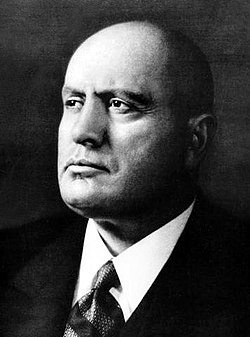
Il Duce on one of his better days. (Photograph from Wikipedia.)
One of the hazards of ‘tidying up’ in a household as chaotic as ours is that one chances upon interesting articles that were overlooked when the newspaper or periodical first arrived. This morning, for example, I happened upon this article by Amos Elon in the New York Review of Books of February 23, 2006 which was sitting atop a duvet box in my bedroom. It’s a review of Sergio Luzzatto’s book The Body of Il Duce: Mussolini’s corpse and the Fortunes of Italy and the full text, alas, resides behind the NYRB’s paywall. Needless to say, I began to read…
Eleven days before the end of the war, Mussolini (motto: “If I advance, follow me; if I withdraw, kill me”), disguised in a German military overcoat and a helmet that covered most of his face, was caught by Italian partisans. He had left his wife and kids to face the music and was en route to Switzerland with his mistress and booty valued at $2 billion in today’s money. The partisan commander, Walter Audisio, obviously took Il Duce’s motto seriously and shot him — and his mistress, Claretta Petacci — dead outside a villa on Lake Como. This is what happened next:
On the following morning, Audisio’s men took the bodies to Milan, which had just been liberated, and threw them on the Piazzale Loreto. The choice of place was deliberate. A few days before, on this same piazza, the Nazis had dealt similarly with the bodies of partisans they had killed. The bodies of Mussolini and Pettaci were trampled, mutilated, and urinated upon by men and women. Some were armed and fired into the corpses. A woman tried to shatter the Duce’s skull with a hammer. Then Mussolini and Pettaci were hung head down from the roof of a gas station, their hands spread out in a gesture of total surrender, giving the bodies the appearance of inverted crucifixes. [Photograph here, if you’re interested.] During the ensuing autopsy, the morgue door was left open, allowing all comers to walk past and watch nurses play ball with Mussolini’s liver. This horrific episode was satisfying to many at the time and shocking to others. Edmund Wilson, arriving in Milan a few weeks later, wrote in his diary that over the entire city hung the stink of this defilement: “Italians would stop you in the bars and show you photographs they had taken of it.”
Luzzatto’s book chronicles what later happened to Mussolini’s body and reveals that his grave in Predappio (where his remains were eventually interred) still attracts 100,000 visitors a year, many of them reverential.
Hmmm… Something like this would have happened to our old friend, Saddam Hussein, if the Americans had not kept him in custody.