
John Backus, the creator of FORTRAN, the first high-level programming language, has died at the age of 82. He led the small team at IBM which produced the compiler and in the process enabled engineers and mathematicians to harness computer power without having to wrestle with machine code. Fortran (the name was an amalgam of ‘formula’ and ‘translation’) was released in 1957. It was the first programming language I learned as an undergraduate (working on an IBM 1401 mainframe). Nice Herald Trib obit here.
Category Archives: Asides
A Blogger.com curiosity
From the blog of one of our Wolfson Press Fellows, Lara Pawson…
Well there’s a funny thing. I wrote a blog four days ago, criticising the BBC (and indirectly British foreign policy) for its contradictory approach to Africa, in particular its interest in Zimbabwe compared to Angola. And this afternoon, some time between 3pm in Luanda and 6pm, it disappeared. Yes! It vanished from my site. Is this Blogger falling prey to the heavy hand of British censorship, or just a clumsy oversight on my part? I’d encourage you to respond with your own thoughts: I really haven’t a clue. All I can say is that it is a strange feeling to be living in Angola – which is not known for its press freedom – and to feel like you are being censored from afar, possibly from home. Can a techno please enlighten me on what might have happened to my posting, ‘substantially worse’?
Fortunately, she had saved a copy and was able to re-post the item — which is well worth reading btw. But for one nasty moment, I had a creepy feeling. Angola (from where she is currently reporting) is a dangerous place, but it’s not where Google resides. Was it just a technical glitch? If the BBC had complained about her post, surely Google would have pulled the entire blog, not just the offending post? Hmmm…
Robbing the young
I am lucky enough to own a house which has escalated in value to the point where it is apparently ‘worth’ a lot of money. Big deal! The only way of turning it into ‘real’ money would be to sell it and live in a tent. More importantly, the price escalation which has led to its current valuation is what will make it difficult or impossible for my kids to buy homes of their own. I therefore view house prices with a good deal of dyspeptic cynicism, and refuse to participate in dinner-party conversations on the subject. So good on Peter Wilby, who has written an excellent rant on this very subject, in the process highlighting yet another reason why young people are turned off by newspapers. Excerpt:
Anybody over 50, who has already done most of their retirement saving, has every reason to be gloomy when the Footsie dives. Those under 40, with most of their saving ahead of them, should jump for joy. Their pension schemes will pay less for the assets that are going to finance their old age. So they will get more bang for their bucks. The same, more obviously, applies to house prices.You would not know any of this from reading the papers. Whether it’s house prices or share prices, the press treats a rise as cause for celebration, a fall as an occasion for alarm. We are led to believe that inflation is a thing of the past, a relic of the 1970s and old Labour.
This is nonsense. Inflation is alive and well; it has merely moved from goods and services to assets. In other words, the press presents the world through a middle-aged, middleclass prism. When young people read that house prices have shown “healthy increases”, they must think journalists live in a parallel universe. No wonder they don’t read newspapers or feel any affection for them. If any paper hopes to woo the under-30s in large numbers, whether through new media or old-fashioned print, it will have to get to grips with what Faisal Islam, economics correspondent of Channel 4 News, calls “the great generational robbery”.
In the New Statesman this month, he wrote of how 22-year-olds, through rent payments, are paying off the mortgages of older landlords who benefited from cheaper house prices; of how, when they eventually buy houses, it will represent a transfer of many millions of pounds from young to old; of how, through rising taxation, they are paying their parents’ pensions. Why do we so rarely read of this in the daily and Sunday papers? Why do papers such as the Telegraph and Express fuss so much about inheritance tax which matters to people in their 50s and 60s, whose parents are approaching the end of their lives, not to those in their 20s and 30s? Newspapers think they are trying hard to attract younger readers, with new designs, consumer guides to iPods and long features about pop and film celebrities. It is all window-dressing. In their coverage of politics, social affairs and business, they betray underlying assumptions and attitudes to drugs, sex, money and much else that seem quite alien to the most young readers.
I’ve just read Faisal’s piece, and very good it is too.
Concentrate, concentrate
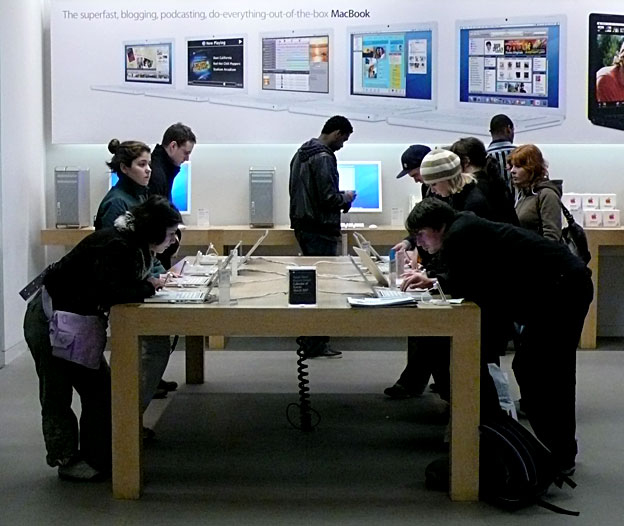
At first, it would seem that these Apple Store customers are fascinated by the products. But on further inspection, it turns out that they’re only taking advantage of the free WiFi to do their email!
The revolution acknowledged
Jeff Jarvis blogged Alan Rusbridger’s speech to the assembled staffs of the Guardian and Observer (for which I write). Here’s a snippet of Jeff’s account:
Yesterday, Alan Rusbridger, editor-in-chief of the Guardian, told the staff of his newspaper that now “all journalists work for the digital platform” and that they should regard “its demands as preeminent.”
This came in each of three all-hands meetings with the editorial and business staff held at a theater 15 minutes from the paper’s offices, the first such meetings since the Guardian went through its last metamorphosis to its medium-sized Berliner format. (I happened to be consulting at the paper yesterday and I went along for the ride. Rusbridger gave me permission to blog the company event.)
So that was the line that struck me: preeminent. I suspect it was the line that resonated with staff members a few hours later. Rusbridger said that some would find the content of yesterday’s meetings no-big-deal and others would find unease. But the message was clear, although it was shoehorned into much else in the presentation; you had to listen to hear it. He also said that the paper will serve the public 24/7; it does not yet do that. So the Guardian, he said, will be a 24-hour, web-first newspaper. To do that, the paper’s management needs — he called it the F word — flexibility. And that means that jobs will change. It’s all in a parcel…
The interesting thing about the Guardian is that it’s owned by a Trust rather than being a commercial company. Some people mistakenly think that this ownership structure makes the paper more cosy and resistant to change than a more straightforwardly commercial outfit. In fact the opposite it true: the Guardian has moved faster and more aggressive to embrace change than any other British publication.
Remember old Chinese curse: may you live in interesting times. We do.
Hennessy’s lucrative moonlighting
There’s a guy called John Hennessy on the Google Main Board. There’s also a guy called John Hennessy who is President of Stanford. And guess what? They’re the same chap! Dan Gillmor quotes what the WSJ wrote about this…
In the month of November, John L. Hennessy, president of Stanford University, made $1 million. It didn’t come from his day job.
Mr. Hennessy, an engineer who co-founded a semiconductor company, has used his talents, Silicon Valley connections and academic position to help win billions of dollars for Stanford. He has done well for himself, too. Mr. Hennessy’s November haul included a $75,000 retainer from Cisco Systems Inc., on whose board he sits, plus $133,000 in restricted Cisco stock, proceeds of $452,000 from selling stock in Atheros Communications Inc., where he is co-founder and chairman, and a $384,000 profit from the exercise of Google Inc. stock options. He sits on Google’s board.
That month makes up only one part of an income stream that many in academia consider without precedent for a university president. In the past five years, through exclusive investments and relationships with companies, Mr. Hennessy has collected fees, stock and paper stock-option profits totaling $43 million, securities filings show. That dwarfs his $616,000 annual compensation at Stanford, where he has been president since 2000.
Debunking the debunkers
Splendid column by George Monbiot on Channel 4’s idiotic film ‘The Great Global Warming Swindle’…
For the film’s commissioners, all that counts is the sensation. Channel 4 has always had a problem with science. No one in its science unit appears to understand the difference between a peer-reviewed paper and a clipping from the Daily Mail. It keeps commissioning people whose claims have been discredited – such as Durkin. But its failure to understand the scientific process just makes the job of whipping up a storm that much easier. The less true a programme is, the greater the controversy.
So IT matters, then?
The use of information technology was “the major driver” of economic growth over the past decade, adding $2 trillion a year to the economy, according to a report by the Information Technology and Innovation Foundation.
Fueled by “the phenomenal growth of computer power” since 2000, the use of IT has given new tools to businesses and improved productivity while controlling costs, said Rob Atkinson, a researcher and government adviser who heads the IT Foundation.
But the full impact of the “IT revolution” has not been recognized by government officials because of lingering skepticism from the dot-com boom the late 1990s and the bust that followed, he added. The 53-page report was an effort to catalog the IT industry’s impact.
Atkinson’s foundation is a think tank backed by such tech companies as Cisco Systems, IBM and eBay, and its goal is to push an “innovation agenda” in Washington. Atkinson said that doesn’t mean subsidies for specific industries but greater investment in research, use of the tax code to spur investment and “do no harm” policies that don’t hinder growth.
Hmmm… Full report is here. I bet Nick Carr has something to say about this. After all, he shot to fame with a sceptical book entitled Does IT Matter?. Just checked his blog [23:50 on 14.03.2007]. Nothing.
Why you should be allowed to use mobile phones in hospital
One of the most irritating things about hospitals is the regulation about switching off mobile phones. I’ve often wondered whether there was any real evidence to support the injunction. Now, the New York Times reports that a study published in the latest edition of the Mayo Clinic Journal says that it was all baloney.
Another article in the same journal describes an experiment testing cellphones at the Mayo Clinic in Rochester, Minn., over a four-month period in 2006. The researchers used various phones and wireless handheld devices in 75 patient rooms and the intensive care unit, where patients were nearby or connected to a total of 192 medical machines of 23 types.
In 300 tests of ringing, making calls, talking on the phone and receiving data, there was not a single instance of interference with the medical apparatus. For many of the tests, the cellphones were working at lower received signal strengths — that is, showing fewer bars on the screen — which means they were operating at the highest power output levels. The authors conclude with a recommendation to relax existing cellphone rules.
But Mr. Shein said changing hospital cellphone regulations on the basis of these findings might be premature. “I think it’s dangerous for someone to go around doing ad hoc testing and conclude that it’s not going to be an issue for others,” he said. “There was no result, but there may have been if the circumstances had been slightly different.”
Dr. David L. Hayes, the senior author and a professor of medicine at the Mayo Clinic College of Medicine, disagreed. “Cellphone technology is the same throughout the country,” he said, “and hospital equipment is similar. I don’t think that testing in another part of the U.S. is going to have different results.
“I’m advocating based on this testing that we should change the rules,” Dr. Hayes continued, “and in fact many people ignore the rules anyway. In a way, the policy is already antiquated and violated de facto.”
During the 18 months that Sue was in an out of hospital, the injunction against mobiles proved a nightmare for me as I tried to be with her while keeping in touch with our children and those who were looking after them while I was away from home. I often had the dark suspicion that the real reason for the ban was to safeguard the business model of the firm which provided bedside fixed-line telephones at an extortionate cost.
Spring?

Yeah, I know it isn’t Spring officially, but these daffodils don’t know that. They were planted in 2000 by Sue and her friend Mary.