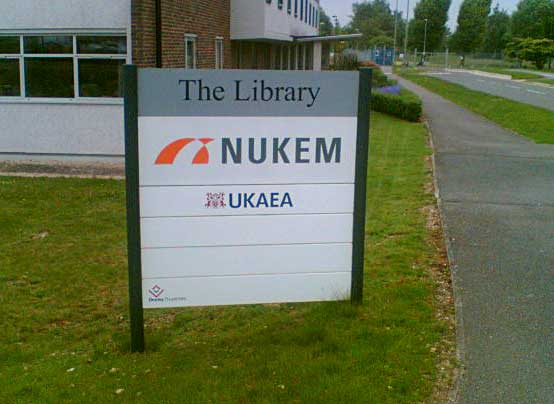
The George Bush Memorial Library

Photographed by my colleague, Geoff Peters. It’s next door to JanetUK’s new offices at Harwell. Funnily enough, I was under the impression that the Bush library was to be based at Southern Methodist University in Dallas. Perhaps the protests are getting to him. Harwell’s nice and quiet.

News from the G8

From David Blair’s (no relation) Telegraph Blog

I have just watched the G8 leaders yawn and scratch their way through a toe-curling session with the so-called “junior eight”. This is an absurd innovation at G8 summits where eight rather dim teenagers are brought before the world’s most powerful leaders.

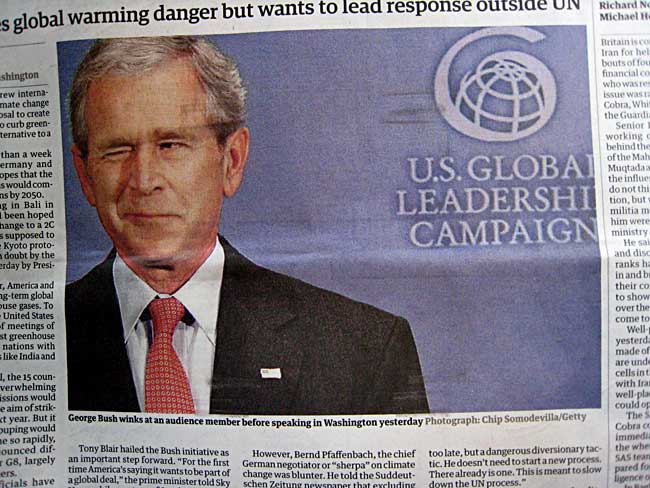
George Bush and Angela Merkel in Heiligendamm
Bush and Merkel share a joke at the G8 summit

Each of the kids gets to read out a pathetic little speech consisting of a string of platitudes. The world’s most powerful leaders do their best to feign interest. OK, none of them actually yawned. But Nicolas Sarkozy took the opportunity to scratch his head and smooth his hair while the French adolescent stumbled through her script. Sarko also forgot to remove his translation earplug while she was talking – in French, of course – suggesting that he really was mentally out-to-lunch.

George Bush began chewing peanuts while the Tanzanian kid was talking. Vladimir Putin looked sinister and bored in equal measure as each of the teens ran through their cringing little speeches. Romano Prodi’s eyelids grew heavier and heavier.

The two most obscure members of the G8, Shinzo Abe and Stephen Harper, the Japanese and Canadian prime ministers, appeared utterly bewildered. (Incidentally, most of my fellow journalists have no idea who these guys are). Only Tony Blair had some success in pretending to be interested…

Still, George Bush got to meet St Bob Geldof and Bono, so the Summic can’t have been entirely pointless.

Health warnings on wine bottles

Er, vintage indignation from Boris Johnson…

And there I was – all set to blame Brussels. As soon as I heard there was some loony plan to put health warnings on wine bottles, my

As I prepared my continental bombing raid, I could see my target in my imagination.

That’s right: it was some Swedish divorcee health commissioner, sitting in her velour slacks in her taupe-coloured office in the Breydel building, Brussels; and I could just imagine the imperious set of her jaw as she put down her glass of Badoit and prepared to Mont Blanc her initials under the EU edict that alcohol was henceforward to be clearly labelled as a poison; and in my rage I reached for another lunchtime glass of Mazis-Chambertin 2000, to fortify myself for the rigours of composing my column, and I can tell you that it was with all bomb bays fully loaded that I arrived at my desk; and I was on the very point of launching the great Brussels-busting task force when I paused.

I had a spasm of journalistic scruple. I picked up the phone….

You can guess the rest. Lazy column, but still amusing.

Genetic markers for certain diseases

Wow! Technology Review report:

A massive genetic study carried out in the United Kingdom has pinpointed 24 genetic markers that increase risk for illnesses such as diabetes, arthritis, and Crohn’s disease, a form of inflammatory bowel disease. The findings illustrate the success of a new approach to gene hunting known as genome-wide association, made possible by recent advances in gene-sequencing technologies. The results were published in this week’s issue of Nature.

“This is a powerful way of identifying genes for common diseases,” says Anne Bowcock, a geneticist at Washington University Medical School, in Saint Louis. “These genes will point to altered pathways that will then point to novel therapies.”

Scientists analyzed 500,000 genetic markers in each of 1,700 people, making it the largest such study to date. By comparing the DNA of 2,000 patients with one of seven different diseases–Crohn’s disease, type 1 and 2 diabetes, cardiovascular disease, hypertension, rheumatoid arthritis, and bipolar disorder–with 3,000 healthy controls, researchers identified 24 genetic regions strongly linked to specific diseases: one in bipolar disorder, one in coronary-artery disease, nine in Crohn’s disease, three in rheumatoid arthritis, seven in type 1 diabetes, and three in type 2 diabetes. Known as the Wellcome Trust Case Control Consortium, the project is a collaboration among 50 different research groups…

Wonder how long it will take insurance companies to start demanding genetic scans before providing insurance.

Money for jam

Behold the logo for the 2012 London Olympics. This little masterpiece took two years to develop and cost £400,000 (according to the Today programme this morning).

James Cridland has some intriguing things to say about it. He’s also knocked up a more attractive alternative.

User-generated porn

Wow! This New York Times report is interesting.

The Internet was supposed to be a tremendous boon for the pornography industry, creating a global market of images and videos accessible from the privacy of a home computer. For a time it worked, with wider distribution and social acceptance driving a steady increase in sales.

But now the established pornography business is in decline — and the Internet is being held responsible.

The online availability of free or low-cost photos and videos has begun to take a fierce toll on sales of X-rated DVDs. Inexpensive digital technology has paved the way for aspiring amateur pornographers, who are flooding the market, while everyone in the industry is giving away more material to lure paying customers.

And unlike consumers looking for music and other media, viewers of pornography do not seem to mind giving up brand-name producers and performers for anonymous ones, or a well-lighted movie set for a ratty couch at an amateur videographer’s house.

After years of essentially steady increases, sales and rentals of pornographic videos were $3.62 billion in 2006, down from $4.28 billion in 2005, according to estimates by AVN, an industry trade publication. If the situation does not change, the overall $13 billion sex-related entertainment market may shrink this year, said Paul Fishbein, president of AVN Media Network, the magazine’s publisher. The industry’s online revenue is substantial but is not growing quickly enough to make up for the drop in video income.

Older companies in the industry are responding with better production values and more sophisticated Web offerings. But to their chagrin, making and distributing pornography have become a lot easier.

“People are making movies in their houses and dragging and dropping them” onto free Web sites, said Harvey Kaplan, a former maker of pornographic movies and now chief executive of GoGoBill.com, which processes payments for pornographic Web sites. “It’s killing the marketplace.”

Aw shucks! The poor dears. Porn industry leaders should get together with record company executives for joint therapy sessions. Primal scream therapy, perhaps?

The podcaster’s friend

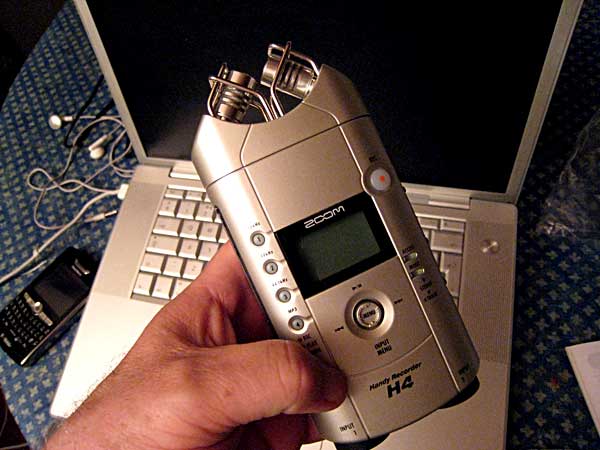
I’ve been looking out for ages for an acceptable way of recording MP3 audio — without going in for the kind of obsessive pre-amp sophistication that audiophiles insist is mandatory. I think I’ve found the answer — the Zoom H4. I’ve been testing it out and it produces audio that is, in Roger Needham’s timeless phrase, “good enough for government work”. Not that I do any of that, of course.

The H4 records onto an SD card in Wav or MP3 format and has two modes: stereo and 4-track. Plug it into the USB port of my Mac and it looks like an external drive. Useful review here which says that the 4-track operation is a bit lightweight. But that doesn’t bother me: all I wanted was ol’-fashioned stereo.

I got it from here. £220 inc. VAT.

It was Dan Bricklin who put me onto it, btw.

Catalogue of Geoffrey Vickers’s papers is online

Hooray! The OU Library has published its catalogue of the Geoffrey Vickers papers.

Sir (Charles) Geoffrey Vickers (1894-1982) had a varied life as a lawyer, a soldier, an economic intelligence officer and legal advisor. In the later years of his life he became a prolific writer and speaker on the subject of social systems analysis and the complex patterns of social organisation. The collection includes materials created in this latter stage of his life.

The Geoffrey Vickers Collection at the Open University largely consists of draft material and correspondence relating to his published works, articles and speeches.

I knew him only towards the end of his long life. He was one of the wisest men I’ve ever met. And I guess he was the only winner of the Victoria Cross to write insightfully about complex systems and organisations.


(Image submitted to Wikipedia by Martin Hornby.)

The Wikipedia entry describes how Vickers won his VC:

On 14 October 1915 at the Hohenzollern Redoubt, France, when nearly all his men had been either killed or wounded and there were only two men available to hand him bombs, Captain Vickers held a barrier across a trench for some hours against heavy German bomb attacks (the ‘bombs’ of the citation were early grenades). Regardless of the fact that his own retreat would be cut off, he ordered a second barrier to be built behind him in order to secure the safety of the trench. Finally he was severely wounded, but not before his courage and determination had enabled the second barrier to be completed.

Not exactly your typical academic, then. He was also an astonishingly successful City lawyer, specialising in mergers and acquisitions at Slaughter and May. When Clement Atlee, the great post-war Labour Prime Minister, wanted to nationalise the coal industry, he brought in Vickers to handle the legal side of the process.

One of his sayings has remained with me ever since I first encountered it. “The hardest thing in life”, he said once, “is knowing what to want”. He was right: it is.