Inland Revenue: data security

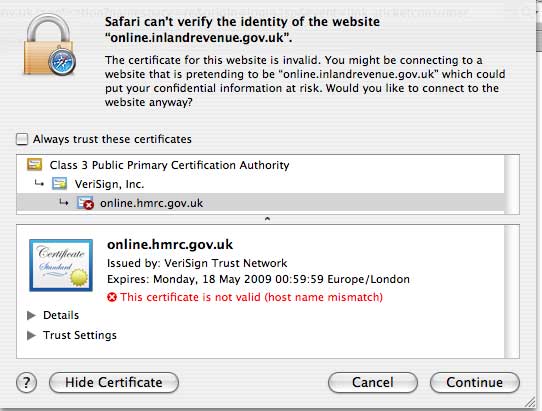
A friend has just logged into the Revenue and Customs web site to submit her tax return. (She was unable to do it yesterday because the site was, er, unavailable.) She was greeted by this reassuring dialog box. What’s going on? The return-submission site is unreachable today too.

This is an agency of the government which expects us to trust it with ID cards.

The rise of systemic financial risk

Tech review has an interesting interview with Andrew Lo, Director of MIT’s Financial Engineering Lab about the significance of Societe Generale’s rogue trader. Excerpt:

TR: Can’t we just build better software and other technologies to prevent a recurrence?

AL: Yes, but anytime there is an interface between technology and human behavior, you open yourself up to the potential for fraud. Systems don’t build themselves: humans program them. A big event like this happens every so often, and then people say, “Gee, we have to spend more time and money to improve our systems,” and the systems become safer. Once the systems become safer, we get lulled into a false sense of security and complacency. And eventually, we experience a rude awakening when the next disaster strikes. I would argue that it is impossible to prevent these disasters with 100 percent certainty.

TR: Okay, so bad things will happen. I take it you are mainly concerned about the ripple effect when they do?

AL: Exactly. The financial system as a whole is getting more complex. Financial institutions rely on ever more elaborate systems architecture and electronic communications across different counterparties and sectors. The number of parties involved, the nature of transactions, the volume of transactions as the market grows–taken together, the dynamics among these aspects of financial markets imply that the complexity is growing exponentially. No single human can comprehend that complexity. And as the system grows more complex, it is a well-known phenomenon that the probability of some kind of shock spreading through the system increases as well. Systemic shocks become more likely. Today, we are looking at some significant exposure to relatively rare events.

TR: In what way was the Societe Generale matter such a shock?

AL: One natural hypothesis is that the global sell-off that happened early last week was a direct outcome of Societe Generale’s unwinding of these rogue trades. We don’t have any conclusive evidence yet, but it’s not an outlandish conjecture given the circumstances surrounding the massive fraud that was allegedly committed. According to Societe Generale, the problem was discovered on Saturday [January 19], and the firm began unwinding their portfolio at the first possible opportunity. If it turns out that this “unwind” was on the scale of a billion dollars or more, it is plausible that the unwind itself triggered the global sell-off–first in Asia, then in Europe, and then in the U.S.

TR: So one person, in this case Mr. Kerviel, can move the entire global financial system.

AL: It’s a larger-scale version of what happened in August of 2007–in particular, August 7, 8, and 9. A large number of quantitative equity hedge funds lost money on those dates simultaneously, yet there is no market event that you can point to that can explain why these funds lost money at the same time. But looking at circumstantial evidence, we [at MIT] pieced together a story that one large quantitative equity fund decided to unwind its portfolio, for reasons we don’t know for sure, but which we conjecture to be related to credit problems from the subprime mortgage market. Because the conjectured liquidation involved a big fund that needed to be liquidated quickly, this implies that the impact of the liquidation on other similarly positioned quantitative equity funds would be negative–and large. You get a snowball effect. Everybody is heading for the exit door at the same time, and you get a crash. But in August 2007, it was not a crash of the market as a whole, but of portfolios that are similarly structured to the fund that started the snowball.

What this means really is that we’re building systems which are so complex that they are beyond comprehension, never mind control.

It’s interesting also that MIT has a lab for ‘financial engineering’. Professor Lo writes articles with titles like ” Where Do Alphas Come From?: A New Measure of the Value of Active Investment Management”.

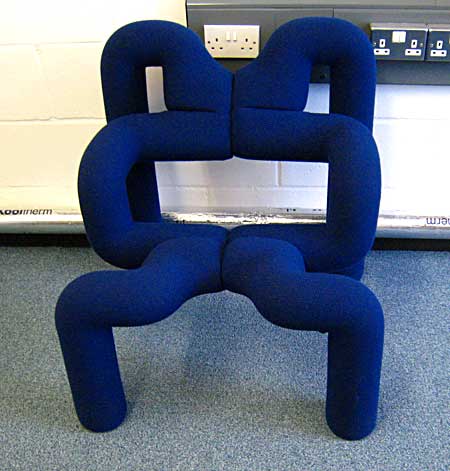
Is it a chair? Or a giant pipe-cleaner?

I found this in a colleague’s office the other day. It’s the Ekstrem chair by Varier and is the epitome of cool ergonomics. Yours for £630, I believe. Surprisingly comfortable, too.

The same firm sells something called a ‘Gravity Recliner’, tastefully illustrated thus:

Available for a mere £1144.99.

On the other hand, you can hang upside down by your ankles for free.

Diary

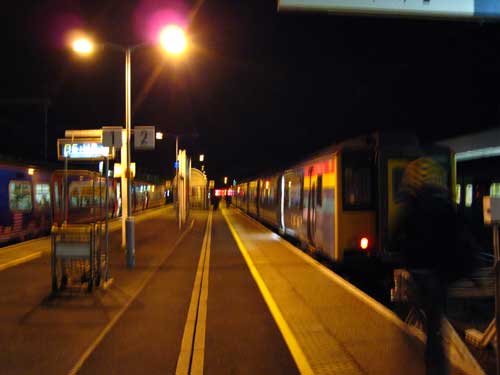
Up at 5.45am. I have a breakfast meeting in London: good for those who live there, not so good for the rest of us. House dark and a bit chilly: central heating hasn’t kicked in yet. Children sleeping. Greeted by yawning cats, surprised that any human is sentient at this time of day. Pack laptop and 3G modem and start car. Journey to station takes ten minutes — later in the morning it will take 50. Astonishing spectacle at station car park — vacant spaces. Park car and wait for idiotic meter to dispense ticket while making loud buzzing noises after swallowing coins to the value of the Gross National Product of Ecuador. Join throng of furtive, hurrying figures, coat-collars turned up against the biting East Anglian wind. I have entered, albeit temporarily, the world of The Commuter.

Day return to London costs £29. We’re flying to Derry at half term and tickets for all the family have cost less. Buy papers and board train, which is populated mainly by ashen-faced folks clutching cardboard cups of Costa coffee and newspapers. One or two have paperback books. One person opens a laptop (a Dell) and starts work on a document. After a time I notice that he is stabbing angrily at his keyboard and recognise the characteristic symptoms of system crash. That’s right — he’s a Windows user. Nothing I can do for him. Blue screen of death. Leave him to his fate. I’m sure he saved the document. Or not.

We speed through darkened countryside, stopping at small stations to pick up commuters. Affluent ones get on at Audley End, in leafy Essex countryside. Mostly work in the City, I’d say. Better suits anyway.

Dawn breaks, revealing a lowering, grey sky. We pass through towns and settlements, seeing only untidy back gardens and the rear ends of industrial estates. Interesting that we turn our backs on the railway and present our best face to the road. So a rail trip always reveals the dark underbelly of urbanisation.

With each stop, the train fills. There’s a seat for everyone — just. Past the urban waste that is Tottenham Hale and slipping into the City, heading for Liverpool Street station where, the driver announces over the public-address system, “this train will terminate”. “No, you silly bugger”, I reply under my breath, “the service terminates, not the train”. Pedantic, you see. Comes from being an academic.
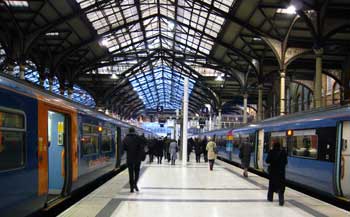
Onto the platform and join the lemmings heading into the City, where they will sit at multi-screen desks and buy and sell sub-prime mortgages wrapped up in pink tape and made to look like assets. Outside the station there’s a line of Mercedes and Lexuses and Audi A8s with smoked glass, waiting to whisk corporate bosses to their places of work. I walk through the throng to my meeting remembering the advice of a former colleague (a lawyer who turned down a lucrative City career to become an academic). “Making money is easy”, he used to say, “provided you are prepared to work with the stuff”. These people have made that choice. For years they’ve lived high off the hog, earning the colossal bonuses which have had such a distorting impact on our economy (as John Lanchester dryly observed recently). 2007/08 will be a lean year for some of them; there are forecasts of 20,000 redundancies looming in the Square Mile. Last in, first out. Easy come, easy go. Not my problem. Now where is that bloody venue?
The way it is

Excerpt from an email sent by a colleague currently working in Africa:

FYI: Anyone watching the news right now will be aware to a greater or less extent that Kenya is hitting a big low. A Kenyan friend has written to me saying that ‘the whole country is in depression and murder, mayhem are the order of the day’. Anyone will be aware that many Kenyan people are facing a violent, dangerous & insecure time. So you should also be aware that the United Nations is currently in the process of considering evacuating ‘all staff’. All staff that is, er-hum, apart from ‘local Kenyan staff’. Whilst the UN international staff get shipped out, on huge per diems, and weep over their losses; the local staff sit tight and hope & pray they survive and that this spiral of violence ceases.

International organizations do this all the time. When the going gets tough, the humanitarians (often, not all, but often) pull out all foreign staff and leave the ‘locals’ to sweat it out. It’s their country after all, so they can fix it. The foreign staff must be saved at all costs. But why go into a job at the UN, or one of the big aidies, if you’re not prepared to stick it out when the shit hits the fan? Often you’re the least likeliest of targets; you are afforded the best protection; with the best life & health insurace; and all means of pensions, salary benefits etc.

It stinks.

Yep.

Every picture tells a story…

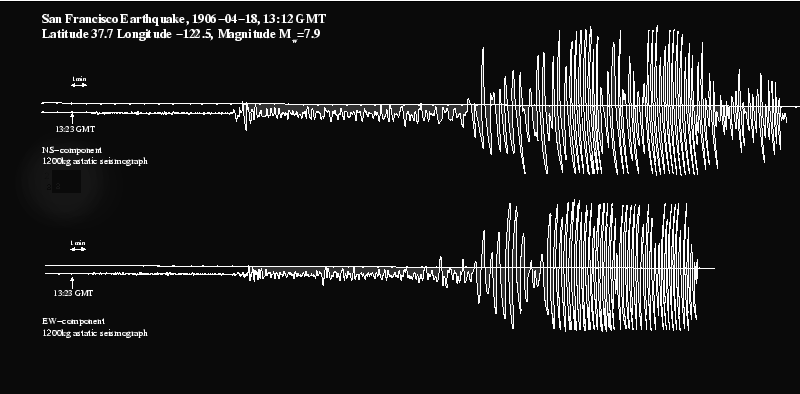
This is the Weichert seismograph recording for 13:12 GMT on April 18, 1906. Location: San Francisco.

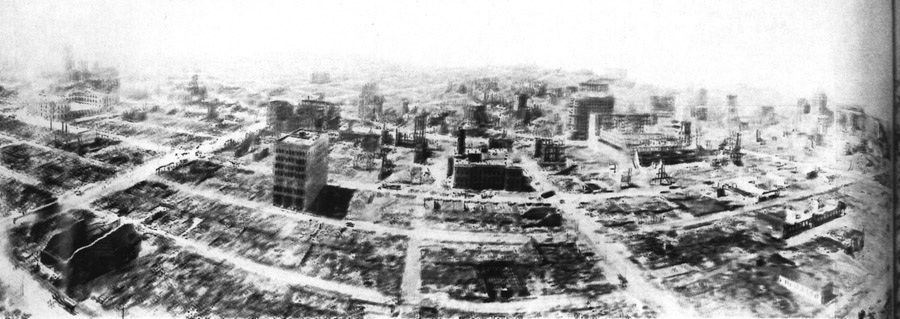
Here’s the result — as captured by George Lawrence with a huge panoramic camera flown aloft by kites. This is a blown-up section of Lawrence’s huge photograph (fuller version here.)

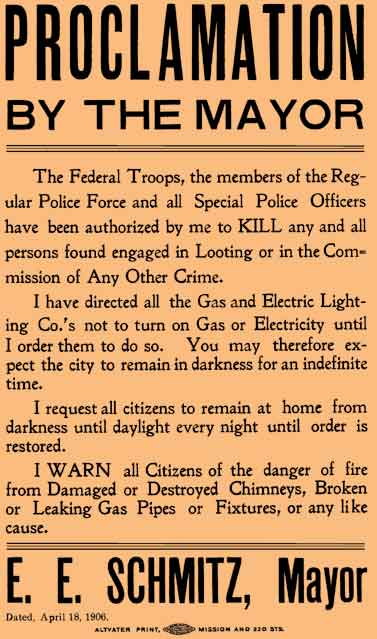
The 1906 earthquake was felt as far away as Oregon and central Nevada. Strong shaking was experienced as far north as Eureka and as far south as King City. The San Andreas Fault ruptured along a length of almost 300 miles, from San Juan Bautista to Shelter Cove (south of Eureka), with maximum surface offsets as much as 28 feet. Much of what wasn’t destroyed by the quake was wiped out by the fires which broke out. As ever, there was looting — of which the Mayor took an exceedingly dim view (as this exhibit from the city’s Virtual Museum makes clear):

A hundred years after the quake, a team of panoramic photographers led by Ron Klein built a replica of Lawrence’s mammoth camera, suspended it from a helicopter and took a panoramic photograph from exactly the same location as Lawrence’s original vantage point.

One member of the team, Scott Haefner, still does kite aerial photography. He has an interesting website.

Sydney: 50 years to live

Just in case you were thinking of emigrating Down Under, here’s a salutary thought

Within less than the span of a lifetime, Sydney could resemble a desert town like Alice Springs, or even the apocalyptic landscape from Cormac McCarthy’s new novel, The Road.

Scorched by temperatures five degrees higher than today, lacking drinking water and yet battered by rising seas and ravaged by bush fires of the ferocity that last month blackened huge areas of Victoria and Tasmania, one of the world’s most spectacular cities could be virtually uninhabitable.

So suggests a scientific report on climate change commissioned by the New South Wales government.

The report, which forecasts a 40 per cent drop in rainfall by 2070, presses hard on the heels of the shock announcement by Queensland’s Premier that from next December state residents stand to drink recycled sewerage…

At last — an argument for drinking Fosters.

Research study suggests ‘Google Generation’ is, er, not very good at (re)search

Well, well. The British Library is trumpeting the findings of a research survey:

A new study overturns the common assumption that the ‘Google Generation’ – youngsters born or brought up in the Internet age – is the most web-literate. The first ever virtual longitudinal study carried out by the CIBER research team at University College London claims that, although young people demonstrate an apparent ease and familiarity with computers, they rely heavily on search engines, view rather than read and do not possess the critical and analytical skills to assess the information that they find on the web.

That’s precisely why my Relevant Knowledge Programme at the Open University created Beyond Google: working with information online, a ten-week online course that reveals that there’s far more to search than typing words into Google.

The full text of the BL/UCL report is available (in pdf format) from here.

Nicholas Carr is chortling about it:

By breaking the linear print model that has dominated the transmission of information for the past five centuries, the hyperlinked web seems to be instilling a hyperactive approach to gathering and digesting information, an approach that emphasizes speed, scanning, and skimming. In one sense, the process of information retrieval seems to have become more important than the information retrieved. We store lots of information, but like distracted squirrels we rarely go back to examine it in depth. We want more acorns.

Personally, like Piglet, I prefer haycorns.