If you’re puzzled or shocked to learn that Ted Kennedy was kept awake during the operation to remove his brain tumour, then here’s why. And, no, it isn’t grisly.
Category Archives: Asides
Coda for the Clintons
Nice Washington Post piece by Eugene Robinson.
Recall that the Michigan primary, like the Florida contest, was not legitimate. Period. As far as the party was concerned — and as far as Clinton herself was concerned, before she fell behind Barack Obama — the primary never happened. None of the candidates campaigned in Michigan. Obama’s name wasn’t even on the ballot.
Yet, in the interest of party unity, the rules committee came up with a formula that gave Clinton credit for 69 delegates that she “won” running virtually unopposed in a vote that technically never took place. Ickes and the angry Clinton supporters who protested the committee meeting objected to the fact that Obama was awarded Michigan delegates that he didn’t win. But Clinton, too, was awarded delegates she didn’t win, because — remember? — there was no legitimate Michigan primary…
As I write, Clinton still hasn’t conceded. My guess is that it’s because Bill still can’t come to terms with the thought that he might no longer be the world’s leading Alpha Male.
Richard Cohen, meanwhile, is pessimistic.
So I see little to be happy about, little that pleases my jaundiced eye. Yes, voter participation is way up and in the end, the Democrats will choose a woman or an African American and, to invoke that tiresome phrase, history will be made. But this messy nominating process has eroded the standing of both candidates. It has highlighted the reality that racism still runs deep and that misogyny, although more imagined than real, is not yet a wholly spent force. This is an ugly porridge that has been placed before us, turned rancid since the cold, pristine days of Iowa only five months ago. We were, with apologies to Bob Dylan, so much younger then.
Reading between his lines, he thinks that the latent racism of many Americans will hand the presidency to John McCain.
The magic number
The government is seeking approval from Parliament to allow terrorist suspects to be held for 42 days without charge. The thing that puzzles me is: why 42? Why not 40? Or 45? Is it because 6×7=42? So it’s six weeks. Or is it that — as devotees of Douglas Adams will tell you — 42 is the answer to life, the universe and everything?
Fame at last!

Aw, isn’t that nice. A posh new institute named after little ol’ me.
Er, there seems to be some mishtake (as Bill Deedes used to say). It’s named after some other guy just because he gave TCD five million Euros. Pshaw!
The US economy — the real story
Several years ago I went to a dinner in London hosted by Mark Anderson, the CEO of Strategic News Service and one of the smartest, most perceptive people I know. At the dinner he talked about the coming crisis that would be generated by the US sub-prime market. I was embarrassed because I had no idea what he was talking about — I had never heard the phrase ‘sub-prime’ until that moment. So when the crisis eventually arrived, Mark rose even further in my estimation.
He’s just released a short video giving his views on what’s really going on now in the US economy.
The Yes! show
Yesterday’s Observer column…
Philip Toynbee famously observed that if you dropped an atom bomb on Twickenham during the Varsity match, the prospects for fascism in Britain would be set back by two generations. An analogous thought struck me watching coverage of the D6 ‘All Things Digital’ conference last week. A neutron bomb would have wiped out the entire high commands of the US technology and media industries – while usefully leaving the premises intact.
D6 was this year’s version of the annual media-tech gabfest organised by Walt Mossberg, the Wall Street Journal’s veteran technology commentator, and his partner in sentimentality, Kara Swisher. The event took place at the Four Seasons Aviara Resort just outside San Diego, where attendees enjoy ‘casual elegance in a breathtaking location accented by wildlife and wildflowers’ for a conference fee just a tad short of the GNP of Rwanda.
Mossberg and Swisher engulf their guests in bonhomie and respectful obeisance…
Portrait of the Artist as a damp squib

I’m reading — and enjoying — Ferdinand Mount’s autobiography, Cold Cream: My Early Life and Other Mistakes. But I’m not entirely convinced by the amusing presentation of his earlier self as a hapless, asthmathic, shy, testosterone-deficient, bookish, hopeless-with-girls adolescent. As portrayed, he seems ‘wet enough to shoot snipe off’, as the phrase goes. It’s also difficult to square this picture with his later success as speechwriter and spiritual mentor to Margaret Thatcher, and Editor of the Times Literary Supplement (prop. Rupert Murdoch). These are not arenas in which hapless, shy etc. people generally thrive.
He’s very good on late-1950s Oxford, though. He started by studying PPE (Politics, Philosophy and Economics) but found himself out of his depth and switched to Modern Languages (German and French) after four terms. (One of the great blessings of Oxford and Cambridge at that time was that one was allowed to make dramatic changes of course like that. I’m not sure if it’s allowed any longer.)
His time doing PPE wasn’t entirely wasted, however.
The curious thing is that, looking back today, I realise that during that brief period of intermittent attention I picked up, almost unwittingly, half the mental furniture that, scratched and battered no doubt, I still use. From the elementary economics that did stick in my head, I more or less grasped the basic laws of supply and demand. No doubt I could have picked them up quickly enough if I had ever helped run a fruit and veg stall, but my rarefied upbringing had left me a commercial innocent. Them from the voluble torrents of Isaiah Berlin’s lectures on political ideas, I picked up the insight, which amazingly seems to have evaded scholars for several millennia, that political principles my be equally admirable and yet conflict with one another and there is nothing we can do about this excelt live by making untidy compromises and trade-offs between the.
Above all, from J.L. Austin, that astringent philosopher with his unforgettable rasping voice and unforced wit, I understood that philosophical problems are very often invented by philosophers themselves. From Plato to Ayer, their warped jargon and their crude and dishonest assumptions have time and again prevented them from seeing that ordinary language copes pretty well with reality and enables us to say most of what we want to say. Far from being trivial, this ‘ordinary-language philosophy’ cleared the trivial out of the way, leaving us free to talk directly about the serious things.
Mount brilliantly evokes the atmosphere of Austin’s lectures, which were
so crowded that when he came in he had to pick his way through a black sea of gowned undergraduates. He was listened to with an intentness I can never remember being part of before or since. Although his asides were very funny, we did not dare to laugh too expansively for fear we might miss a beat in the argument and when he finished and strode abruptly out of the room the hush remained unbroken for a moment or two as though we had been holding our breath the whole hour and had forgotten how to breathe out.
“Although we did not know it”, he continues,
what we were living through was the twilight of the Oxford don. this was the last period in which the same English university contained such a line-up of spellbinding lecturers, and the last period too when university lecturers enjoyed a decent professional standard of living. More important, there was an intimacy then between teachers and students which has since dimmed, for reasons I do not quite understand.
If there’s an elegaic quality about this it’s because universities are not like this any more. It’s not just because even Oxbridge undergraduates no longer wear gowns (except to Formal Hall), but because teaching has become downgraded in virtually all ‘world-class’ universities as they transformed themselves into institutions that are ranked primarily on their research. The thing that is interesting about Oxford and Cambridge is that — almost uniquely among leading universities — they still strive to pay attention to the teaching of undergraduates. But even they they are finding it an increasingly difficult struggle. I have heard it said, for example, that Cambridge ‘loses’ something like £7,000 a year on every undergraduate — in the sense that that is the gap between what it costs to give Oxbridge-type intensive tuition and what the state-funded fee provides.
Towards the automatic generation of hooey
Tired of using Lorem Ipsum for dummy text in your latest web template? Try this instead.
3G iPhone mania starts to build
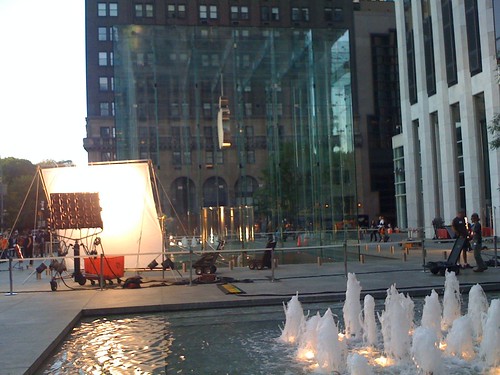
Picture by Sidnicious.
Lots of excitement on the Net sparked by the fact that Apple’s Fifth Avenue Store is closed for 24 hours for filming of a commercial. How many other companies can attract this much attention?