How to Think

From Ed Boyden’s blog….

When I applied for my faculty job at the MIT Media Lab, I had to write a teaching statement. One of the things I proposed was to teach a class called “How to Think,” which would focus on how to be creative, thoughtful, and powerful in a world where problems are extremely complex, targets are continuously moving, and our brains often seem like nodes of enormous networks that constantly reconfigure. In the process of thinking about this, I composed 10 rules, which I sometimes share with students. I’ve listed them here, followed by some practical advice on implementation….

Genii loci

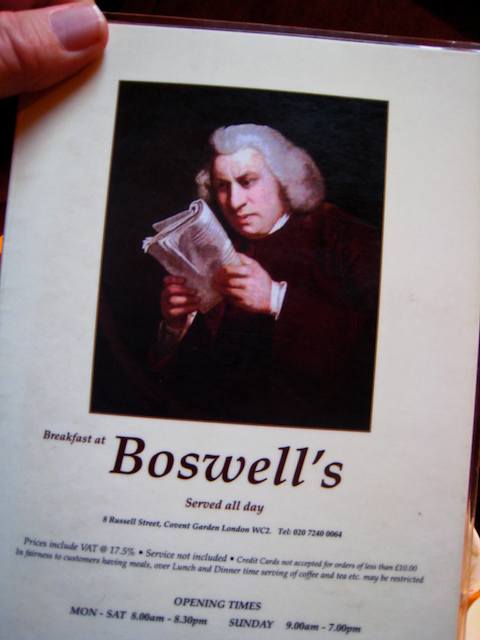
We went to a ravishing production of La Nozze di Figaro in the Royal Opera House on Saturday evening and had supper beforehand in Boswell’s at 8 Russell Street. Fans of Samuel Johnson will recognise the address. It was built in 1759-60 and owned by Thomas Davies, an actor turned bookseller and publisher and, by all accounts, a very hospitable soul. At 7pm on May 16, 1763 he was giving tea to a young reprobate named James Boswell when who should walk in but Dr. Johnson. Boswell was apprehensive about meeting the great man because he knew that he disapproved of the Scots, and so begged Davies not to mention his nationality. His host either did not hear the request, or mischeviously ignored it. Either way, the fact that Boswell was Scottish (or Scotch, as Dr. Johnson would have said) was mentioned. Boswell said defensively that he “could not help it”. “That, Sir”, boomed Johnson, “is what I find a great many of your countrymen cannot help”. (He also famously observed that “The fairest prospect for a Scotchman is the high road to England”.)

Not an auspicious beginning, you’ll admit; but still it led to one of the greatest collaborations in English literature.

Integrity in public life

Here’s a rare sighting of a public man behaving honourably.

Mervyn King, the Governor of the Bank of England, has turned down a pay rise of around £100,000 because he did not feel it was appropriate in the current economic climate.

Mr King rejected the near-40pc pay rise to £400,000 when he was reappointed as Bank of England Governor this summer, according to the Bank’s annual report.

It is thought he did so fearing that an above-inflation pay increase might prompt workers to demand higher salaries.

Memories of war

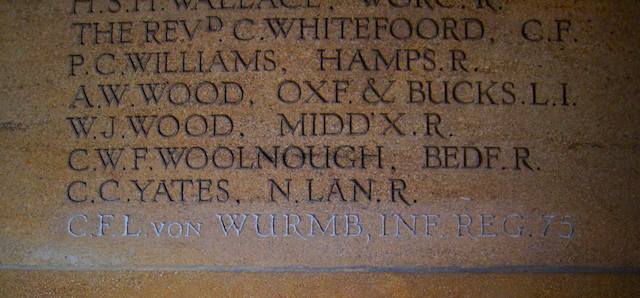
In Merton College, Oxford yesterday, I paused in the Fitzjames Arch to read the (sobering) list of members who had died in the Great War, and then noticed that the last entry seemed different. The letters are white rather than gray and there appears to have been a white wash over the entry. Given that the dead man bears a famous German name, and clearly belonged to a German regiment, I fell to wondering if there’s a story here. Was his name engraved only recently? Or was it for a time obscured and has only recently been restored? I tried various kinds of online search, but drew a complete blank.

Later: David Smith, a Mertonian and a thoughtful blogger, saw the post and looked up the college Register:

von WURMB, Carl Friedrich Lothar.—b. 17 Apr. 1893; s. of Maj. Louvard von Wurmb, of Thuringen of Weimar. Educ. Grand Ducal Wilhelm-Ernst Gymnasium, Weimar, 1904–11; Univ. of Geneva 1911; Univ. of Munich 1911–12; Rhodes Sch., Merton 1912–14. Dip. Econ. 1913; read Law 1913–14. Torpids and Eights. Cavalry and Infantry, Eastern and Western Fronts, 1914–18. Capt. Iron Cross 1st and 2nd Cl. Killed in action 23 Mar. 1918.

So now we know who he was. Further developments awaited.

Prius to be built in the US

From yesterday’s press release

July 10, 2008 – Erlanger, KY – Toyota is responding to changes in consumer demand and improving the production efficiency and stability of its North American operations by adjusting production mix at three plants. The changes include the addition of the Prius hybrid sedan to its North American lineup.

The changes are as follows:
– Prius will be built at a plant under construction in Blue Springs, Miss. Production is scheduled to begin in late 2010. Prius, which will join the Kentucky-built Camry Hybrid as the second Toyota hybrid built in North America, enables Toyota to better respond to increased consumer demand for hybrid vehicles…

Why golf is broken

Fascinating FT interview with Jack Nicklaus, for my money the greatest golfer ever.

Nicklaus’s real gripe with the modern game and its decline is the role of technology and, in particular, golf balls. The technological advance of golf ball manufacturing is enabling big hitters to propel them such distances that courses are being rendered obsolete.

As a result, designers are lengthening courses for the benefit of professionals at the cost of millions of dollars, leaving the poor amateur wondering whether a four-hour slog round a demanding course that used to take three hours is worth it.

Nicklaus argued this point with the governing bodies in the US and the UK, the PGA and the Royal & Ancient respectively, 30 years ago. “They just laughed at me,” he says. Still, he remains passionate about the issue, leaning forward and arguing his point in earnest. Golf, a game played in order to bring man together with nature was fine 20 years ago, he says. It had pretty much stayed as it was for 60 years, and you could play it in a reasonable amount of time. Now, he believes, “the game’s been broken because of equipment. It’s a problem.”

It hasn’t stopped him running a $300m course-design business, though.