What $700 billion could buy

Great post by Jeff Jarvis…

We’re spending $700 billion to bail out the idiots who got us into this mess and we end up with nothing to show for it but the bag we’re left holding and maybe a disaster averted (we hope).

We could be spending a lot less to get a lot more. A national wi-max buildout would cost between $5 billion and $14.5 billion. That would enable every American to get high-speed access to the internet and to its education, commerce, connectivity, innovation, jobs, and value. With a lot left over.

Or take the $700 billion and divide it by America’s 114.5 million TV households. Minus the 40-percent-plus margin that cable companies make on internet access (that’s the number I heard from them), we could provide broadband access to every one of those homes for about $300 a year. That means we could give every American free broadband access for 20 years.

We could buy 3.5 billion One Laptop Per Child machines. Want world peace and understanding? Give one to every Muslim on earth and every citizen of China (or since China can afford them, make that everyone in India or everyone in Africa and South America combined) and you’d still have more than 500 million machines left over.

Or we could give 4.4 million Americans free college educations at private institutions. We could give 23 million Americans free college educations at public institutions like mine. That alone would improve our competitive position and transform dying industries.

Or we could more than triple total annual R&D spending in the U.S. I can’t find total R&D on alternative energy but with this money we could multiply what Google.org is spending by a factor of 35,000…

Shiver me timbers

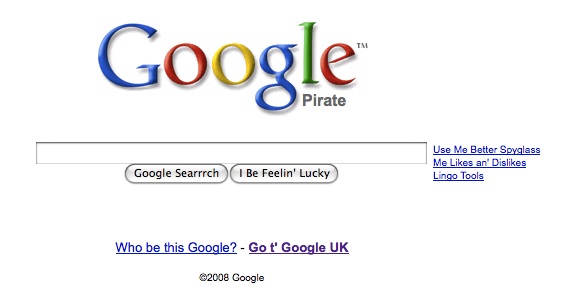
Friday was Talk like a Pirate Day. Nice to see that Google has finally caught up with the trend.

Inevitably, the conversation in our household turned to Captain Pugwash, the notorious TV pirate. And — as you might expect — there is an excellent Wikipedia article about him. Pugwash also has an extensive presence on YouTube — which a humourless lawyer might conclude was itself an act of piracy. Here’s an example of this delicious type of recursion.

And the indefatiguable Snopes.com has a brisk refutation of the allegation that the names of Pugwash’s crew were sexual double entendres.

Mellow fruitfulness

We went on a wonderful walk on the North Norfolk coast this morning, and everywhere we went came on bushes of luscious blackberries. Accordingly, progress was slow at times.

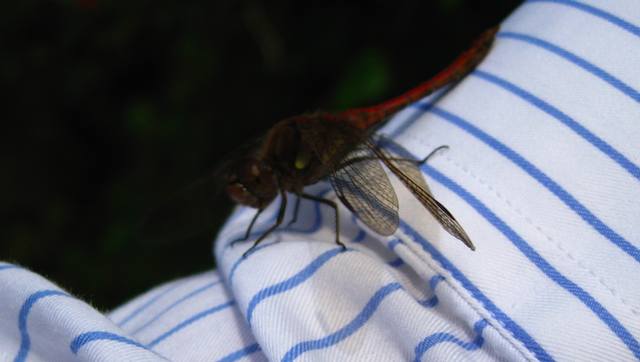
And everywhere we went we were accompanied by dragonflies, often flying in pairs in very tight formation. Here’s one who alighted on my sleeve when I was trying to photograph the berries.

LATER: Richard Earney emails to say that this is “a mature Common Darter” (aka Sympetrum striolatum). What a wonderful thing it is to have erudite readers.

The end of American capitalism as we knew it?

From Willem Buiter’s blog

This is what I read this morning on FT.com: “The US Federal Reserve announced that it will lend AIG up to $85bn in emergency funds in return for a government stake of 79.9 per cent and effective control of the company – an extraordinary step meant to stave off a collapse of the giant insurer that plays a crucial role in the global financial system. Under the plan, the existing management of the company will be replaced and new executives will be appointed. It also gives the US government veto power over major decisions at the company.”

I almost decided to go back to bed, convinced I must be dreaming.The proximate cause of the demise of AIG as a private firm were its ‘monoline’ activities, its exposure to massive amounts of credit risk derivatives like CDS, many of them linked to the US real estate sector. The largest insurance supermarket in the world, with a balance sheet in excess of $1 trillion nationalised because it was deemed too big and too globally interconnected to fail! The fear that drove this extraordinary decision is that AIG’s failure would increase counterparty risk, actual and perceived, throughout the financial system of the US and the rest of the world, to such an extent that no financial institution would have been willing to extend credit to any other financial institution.Credit to households and non-financial enterprises would have been the next domino to fall, and voilà! , financial Armageddon.

Professor Buiter knows about this stuff. He used to be on the Bank of England”s Monetary Policy Committee and he has a Chair at LSE. Next to Paul Krugman, he’s the most astute economic commentator I know.

He goes on:

If financial behemoths like AIG are too large and/or too interconnected to fail but not too smart to get themselves into situations where they need to be bailed out, then what is the case for letting private firms engage in such kinds of activities in the first place?

Is the reality of the modern, transactions-oriented model of financial capitalism indeed that large private firms make enormous private profits when the going is good and get bailed out and taken into temporary public ownership when the going gets bad, with the tax payer taking the risk and the losses?

If so, then why not keep these activities in permanent public ownership?There is a long-standing argument that there is no real case for private ownership of deposit-taking banking institutions, because these cannot exist safely without a deposit guarantee and/or lender of last resort facilities, that are ultimately underwritten by the taxpayer.

I’ve often wondered what it was like to live through the (first) Wall Street Crash. Now I have some idea. What’s strange is the way, at each stage in the crisis, there’s a feeling that perhaps it has bottomed out. And then it gets worse again. Today we’ve seen the unthinkable happen — the US Treasury is running out of cash, and the markets are beginning to contemplate the possibility (still deemed extremely remote, but still…) of the US government defaulting on its loans.

And it’s coming closer to home. Most of my savings, and some of the money I hold in trust for the kids, is held in funds managed by Lloyds. What happens if it turns out that the proposed Lloyds-HBOS ‘superbank’ in turn becomes vulnerable? Should I be moving the money into something safer? And if so, what? Gold bars? Government bonds? If the latter, which government? China? Dubai?

Years ago, I decided that I didn’t want to have a mortgage from a bank and went to an old-fashioned well-managed Building Society instead. Boy am I glad that I made that decision.

Horse sense

From the first Leader in today’s Financial Times:

The world has not ended. The international economy has not yet collapsed. But one thing is now quite clear: the banking system as we know it has failed…The US government does not have limitless resources; even if it did, the challenge in a serious financial panic is for the government to choose the right place to draw the line. Allow a Fannie Mae to collapse, and the US economy might well collapse with it. Yet bailing out anyone who asks nicely is a recipe for promoting (even more) recklessness and yet another crisis in the future.

Right on, man, right on.

Ian Hibell RIP

The Economist has a lovely obit of Ian Hibbell, the man who cycled the equivalent of six times round the world.

In a career of hazards, from soldier ants to real soldiers to sleet that cut his face like steel, only motorists did him real damage. The drivers came too close, and passengers sometimes pelted him with bottles (in Nigeria), or with shovelfuls of gravel (in Brazil). In China in 2006 a van drove over his arm and hand. He recovered, but wondered whether his luck would last. It ran out on the road between Salonika and Athens this August, where he was knocked out of the way by a car that appeared to be chasing another.

At bad moments on his trips he had sometimes distracted himself by thinking of Devonian scenes: green fields, thatched cottages and daffodils. He would return to a nice house, a bit of garden, the job. But that thought could never hold him long. Although his body might long for the end of cycling—a flat seat, a straight back, unclenched hands—his mind was terrified of stopping. And in his mind, he never did.

A handbag!!!

Brings back memories of Margaret Rutherford in The Importance of Being Earnest.

Er, I suspect that it’s really the HP Mini-Note (on which I’m writing this) in sheep’s clothing.

No black holes — but a data tsunami

From CERN

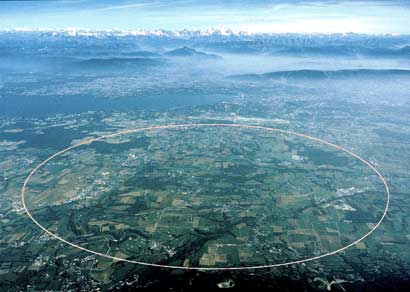
The Large Hadron Collider will produce roughly 15 petabytes (15 million gigabytes) of data annually – enough to fill more than 1.7 million dual-layer DVDs a year!

Thousands of scientists around the world want to access and analyse this data, so CERN is collaborating with institutions in 33 different countries to operate a distributed computing and data storage infrastructure: the LHC Computing Grid (LCG).

Data from the LHC experiments is distributed around the globe, with a primary backup recorded on tape at CERN. After initial processing, this data is distributed to eleven large computer centres – in Canada, France, Germany, Italy, the Netherlands, the Nordic countries, Spain, Taipei, the UK, and two sites in the USA – with sufficient storage capacity for a large fraction of the data, and with round-the-clock support for the computing grid.

These so-called “Tier-1” centres make the data available to over 120 “Tier-2” centres for specific analysis tasks. Individual scientists can then access the LHC data from their home country, using local computer clusters or even individual PCs…

Hopefully, all of this is not orchestrated by Windows servers.