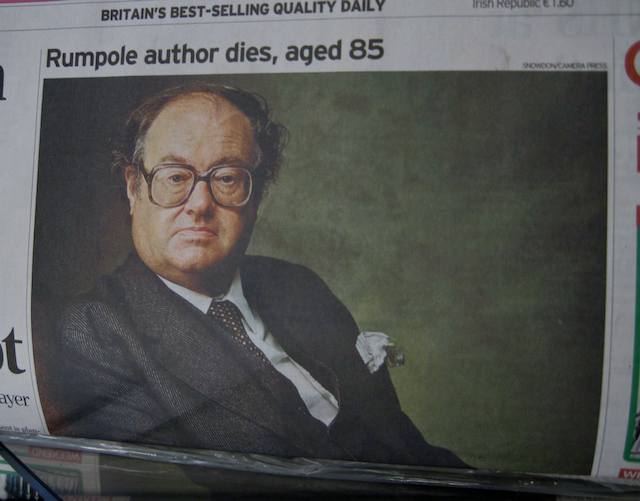
John Mortimer, the defence barrister in the trial of Lady Chatterley’s Lover and the creator of Rumpole of the Bailey and much else besides, has died, aged 85.
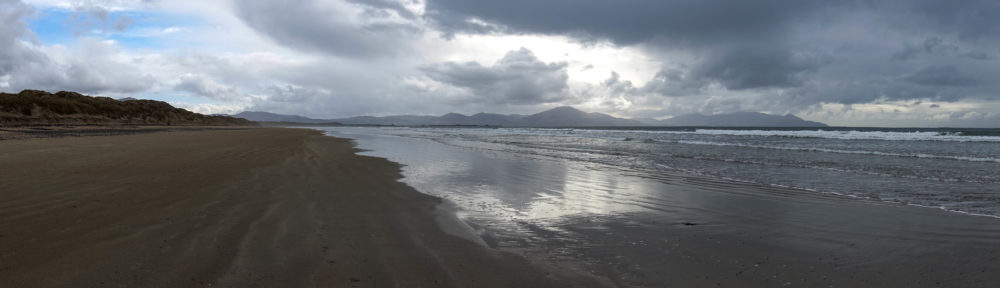
John Mortimer, the defence barrister in the trial of Lady Chatterley’s Lover and the creator of Rumpole of the Bailey and much else besides, has died, aged 85.
Here’s something to make the troglodytes on the Today programme choke on their muesli.
Last year, after the social-networking site MySpace found that its members included some 29,000 registered sex offenders, the nation’s top state prosecutors demanded a technological fix, asking that the industry “explore and develop age and identity verification tools for social networking web sites”. But a new study concludes that such technologies are unlikely to thwart anonymous predators and that the threat facing children online is no worse than it is in the real world.
“Our review found too little evidence that any given technology or set of technologies, on their own, will improve safety for minors online to any significant degree”, says the report, written by the Internet Safety Technical Task Force, a group of 29 businesses, nonprofit organizations, academic groups, and technology companies that conducted the investigation with the Berkman Center for Internet and Society at Harvard University, at the request of 49 state attorneys general. “Moreover, the Internet itself, the ways in which minors use it, and the communities in which they participate, all change constantly, and the available technologies are quickly evolving.”
While no single age-verification solution can solve the Internet’s problems, tools are available to those who choose to use them, and social-networking sites cooperate with law enforcement and actively root out reported problems, says John Palfrey, a Harvard law professor who led the effort. Some 40 technologies are already on the market, including age-verification products and Web filtering and blocking programs.
Readers of Roy Greenslade’s blog will have seen that he’s been wondering why Stephen Glover’s column about the decline of the Daily Telegraph was mysteriously pulled from the Independent.
However, Roy helpfully provides a link to the Google cached version, which reads in part:
With so much happening and going wrong, it may seem perverse to dwell on one subject: The Daily Telegraph. I do not apologise. It is no exaggeration to say that what is happening to that paper is a national tragedy. Yet I do not hear questions in Parliament. The leader of Her Majesty’s Opposition does not seem alarmed. The rest of the media, naturally concerned with their own difficulties, seems hardly to notice as this great national institution is being transformed and eviscerated under our very eyes.
I admit I am biased. The Daily Telegraph was the first newspaper I worked for, and it will always have a special place in my heart. It was the paper of the “small c” conservative classes. Of course it changed over the years, as the country changed, but never precipitately. Its circulation fell a little from its 1970s heyday, but unlike some other titles, it was not locked in some apparently irresistible cycle of decline. Then, in 2004, Sir Frederick and Sir David Barclay bought it as Conrad Black, its previous proprietor – and, in my estimation, a pretty good one – was led off first to court, and then to an American jail.
The Barclay brothers love and revere the Daily Mail. And why not? Even its more knowledgeable critics generally concede that it is the most brilliant paper in Britain. But if there is one Mail, why do we need two – especially as the Telegraph lacks the resources, know-how and inspiration to emulate it? Nonetheless, the Barclays – brilliant businessmen, no doubt, though inexperienced publishers – would not be gainsaid. They recruited a chief executive, Murdoch MacLennan, from the Mail group, where he was an expert on presses. In due course, he hired a gaggle of Mail executives, not all of whom, it should be said, were from the paper’s top drawer.
Since then, we have had purge after purge. The Daily Telegraph and its Sunday sister are in a state of permanent revolution. Dozens of the two paper’s best writers and executives have been pushed out. In the last few weeks, A N Wilson, Craig Brown, Joshua Rozenberg, Sam Leith and Andrew McKie have been sent packing. They were not bit-part players. They were the lifeblood of the paper. Slice by slice, the old Telegraph has been dismembered, and what is being put in its place increasingly resembles a weak imitation of the Daily Mail, which, by the way, has picked up several of the Telegraph’s best writers.
The first rule of newspaper ownership and editing is not to discomfort your core readers. Reach out for new ones, of course, but do not forget those who have loyally stuck by the newspaper. The Daily Telegraph’s readers have not been so much discomfited as shaken about like dice. I am sure that the newspaper’s editor, Will Lewis, is highly gifted, but he would scarcely recognise a habitual Telegraph reader if he bumped into one in full daylight. The newspaper’s much-trumpeted digital activities are all well and good, but they are ancillary to what should be the main point: giving traditional Telegraph readers what they expect and want.
The big mystery, of course, is why the Indie would censor a columnist just for going after a rival paper. Roy thinks there’s a bigger story here and he may well be right. But there’s a slightly dated air about it. In the old pre-Web days of media barons and press power this kind of intrigue was a big deal. But now? I don’t think so. As an ageing print hack, I’m interested in this kind of nonsense. But nobody under 30 gives a damn. Nor should they. That world is dying. People are more interested in whether Steve Jobs is terminally ill than in the spectacle of media moguls fighting like cats in a sack.
Pardon me while I bask. In an interview with David Hochfelder in 1999 for the IEE History Center*, Paul Baran — the man who first came up with the idea of a packet-switched communications network which led to the ARPANET and, later, the Internet — listed my book as one of the “four best books on the history of the ARPANET and the Internet”. (For the record, the others are: Arthur L Norberg and Judy E. O’Neill, Transforming Computer Technology: Information Processing for the Pentagon, 1962-1986, John Hopkins Press, 1996; George Dyson, Darwin Among the Machines: the Evolution of Global Intelligence, Addison-Wesley Publishing Company, Inc. 1997; and Janet Abbate, Inventing the Internet, MIT Press. 1999.)
*Paul Baran, Electrical Engineer, an oral history conducted in 1999 by David Hochfelder,
IEEE History Center, Rutgers University, New Brunswick, NJ, USA.
Thanks to Johnny Ryan for pointing it out.
Eat your hearts out, petrolheads! Inside story here.
According to Gizmodo, Obama’s Cadillac has several high tech features, including
• It can withstand rocket impacts and it’s perfectly sealed against biochemical attacks.
• Petrol tank: Can withstand a direct hit thanks to a special foam and armor-plating.
• Bodywork: made of dual hardness steel, aluminum, titanium, and ceramics to “break up posible projectiles”.
• Tyres: Kevlar-reinforced with steel rims underneath so it can run away no matter what.
• Accessories include: Night vision cameras, pump-action shotguns, tear gas cannons.
• Comes with bottles of blood compatible with the President’s blood.
Helpful cutaway diagram here.
Eight miles per gallon, since you ask. No data on emissions from 6.5 litre diesel engine. Top speed 60mph. Zero to 60 in, er, 15 seconds. This is one the Top Gear headbangers won’t be reviewing.
Terrific polemic by George Monbiot.
It would be stupid to claim that environmentalism is never informed by class. Compare, for example, the campaign against patio heaters with the campaign against Agas. Patio heaters are a powerful symbol: heating the atmosphere is not a side-effect, it’s their purpose. But to match the fuel consumption of an Aga, a large domestic patio heater would have to run continuously at maximum output for three months a year. Patio heaters burn liquefied petroleum gas, while most Agas use oil, electricity or coal, which produce more CO2. A large Aga running on coal turns out nine tonnes of carbon dioxide per year: five and a half times the total CO2 production of the average UK home. To match that, the patio heater would have to burn for nine months.
So where is the campaign against Agas? There isn’t one. I’ve lost count of the number of aspirational middle-class greens I know who own one of these monsters and believe that they are somehow compatible (perhaps because they look good in a country kitchen) with a green lifestyle. The campaign against Agas – which starts here – will divide rich greens down the middle.
Hmmm… This is tricky. Some of my best friends have Agas. Indeed, I had one myself once. And I don’t know anyone who has a patio heater. Oh dear…
… about Heavy Metal band names.
Just thought you’d like to know.
Astute comment in The Register about the implications of Dell’s decision to close its manufacturing plant in Limerick.
As the shockwaves of Dell’s dreaded but expected withdrawal from Limerick manufacturing reverberate around Ireland’s mid-west region, some lessons are emerging.
The big theme emerging in many reports and commentaries is that the boom in semi-skilled assembly line jobs is well and truly over. There doesn't appear to be any other business likely to come to Ireland and employ 1,000 plus workers on an assembly line. It’s cheaper to do it elsewhere, in a low-wage economy, and ship the goods to the geographies that would be served by an Irish base.
For suppliers like Dell that need a responsive assembly/manufacturing operation in the EU, the accession of Poland and other east European countries into the EU was a godsend; for Ireland, it has been a disaster. Where Dell is going other hi-tech employers may follow – Intel has a chip plant in Ireland, and HP makes printer cartridges there too.
For both of them the annual cost of an Irish worker will be more than the annual cost of a Polish worker. They too will be looking at the numbers and doing a what-if-we-moved-to-Poland spreadsheet calculation. The EU wants a level playing field, and limits what member countries do in the way of bribing businesses to come to them via grants, subsidies and tax concessions.
The conclusion is:
A dawning realisation in Ireland is that it will have to expand university and technical college education. If it’s a white collar future and not an assembly-line one, then that means the current generation of semi-skilled workers have had it. There’s more of them than the country currently needs and they’ll have to do the best they can whilst the country educates their children for the hi-tech R&D jobs.
These jobs will come in dribs and drabs, 20 here, 40 there, not in thousand-plus lumps. The IDA has got to attract many more firms to Ireland. For every Dell with almost 2,000 workers the IDA will need to attract, say, 50 businesses to provide the same number of jobs, and the Irish education system will have to provide 2000 graduates in the right disciplines to gain the jobs.
Sigh. My Google phone is on its way back to T-Mobile. I write this with some regret, because I had high hopes for it. My GPRS BlackBerry (which is by far the best phone I’ve ever had) was beginning to show signs of physical collapse. And I was really tired of trying to access Google via GPRS, which was like going back to the bad old days of dial-up modems. So I thought: what I need is a proper 3G phone.
But which one? The BlackBerry Storm was considered and discarded, even before Stephen Fry demolished it. To me, it looked like something rushed out to compete with the iPhone, but without proper testing. As an iTouch user, I knew and liked the iPhone interface, but felt that I ought to make a stand because of its non-generativity (to use Jonathan Zittrain’s phrase). So how about the Google Android phone?
Research showed that it was offered by T-Mobile (my network provider). And it met Jonathan’s requirement for open-ness. So I ordered one.
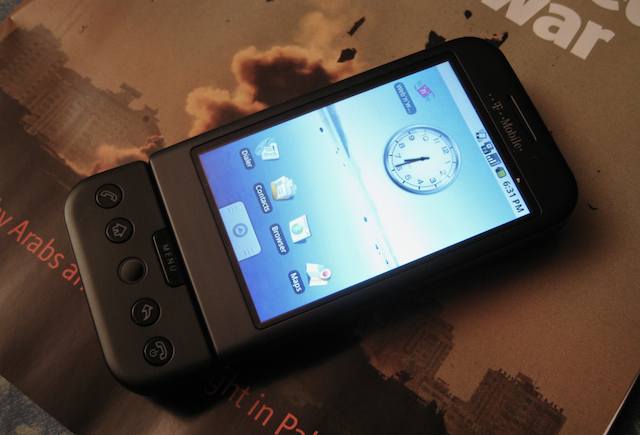
It seemed slick enough at first sight. Setting it up to link with my Google account was a breeze. And it had a real QWERTY keyboard, accessible by sliding the screen up, thus:
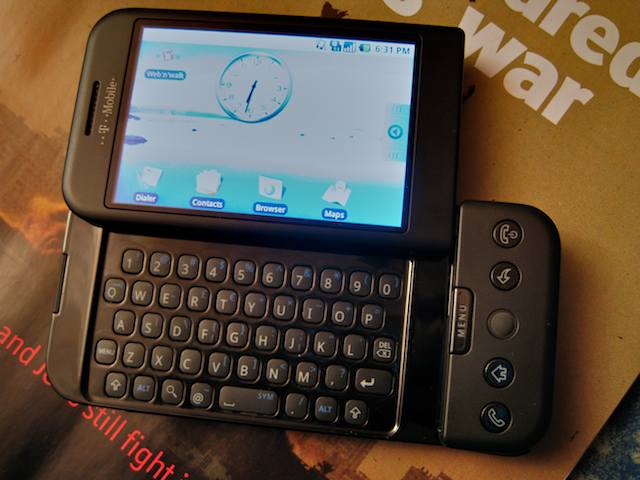
The keyboard, though small, was useable in twin-thumb mode, just as the Psion PDAs used to be.

So how was it in practice? Answer: mixed. Very mixed. Battery life (like that of the iPhone) is abysmal if one has the phone permanently online, so I turned everything off and just synchronised Gmail when I needed to update. The camera is, well, dire. The GPS facility is good — really good, actually; but it positively eats battery-life. All of which tended to reduce the phone to a rather more humdrum piece of kit. The biggest problem was that its methods of indicating that messages have arrived was, for me, useless — especially compared with the BlackBerry’s ways of doing things. I need to know instantly when messages have arrived — especially when the phone is on silent. (I spend a lot of time in meetings.)
Composing and typing SMS messages on the G-phone is a tedious palaver. First you have to swing out the screen so that you can type. This requires two hands. So effectively texting on the move is difficult/impossible.
The Android software seems stable and effective. The Apps available on the open ‘market’ are, however, pretty tame compared with what’s available for the iPhone. This may change in time and more handsets become available and the commercial opportunities for Android Apps begins to build. But for now the first G-phone available on the UK market is IMHO just an unsatisfactory beta. If it had come out before the iPhone we would have regarded it as a small miracle. But now it doesn’t cut the mustard. What Android really needs is a slick handset from Nokia or Sony-Ericsson.
So I’m returning to the BlackBerry fold. What the episode has taught me is that easy, efficient SMS and email are the key things I need, plus occasional 3G-speed access to web sites.
Ironically, I will be acquiring a new BlackBerry just as Barack Obama has to surrender his.
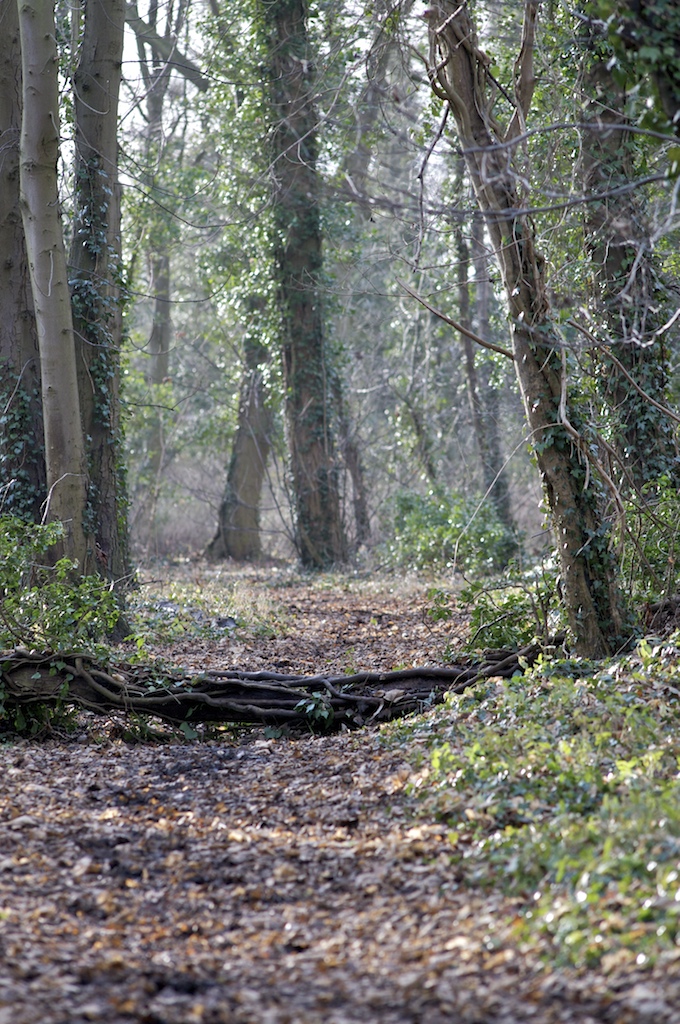
After days and days of muddy brown light, the sun shone this morning. So I packed camera and lenses and went for a walk in the woods. There was a freezing wind up on the ridge outside Wimpole, so much so that it was painful to hold the camera, even with leather gloves on. And yet it was lovely to be there, listening to the wind sighing through the trees, and picking my way over rotten branches and fallen trees. At one point I was standing contemplating the view and thinking about lenses when I heard voices raised in desultory conversation, and then two horsemen passed me and politely said “Good morning”. After they’d moved on, I fell to thinking of one of my favourite poems. And took the picture.
Two roads diverged in a yellow wood,
And sorry I could not travel both
And be one traveler, long I stood
And looked down one as far as I could
To where it bent in the undergrowth;
Then took the other, as just as fair,
And having perhaps the better claim,
Because it was grassy and wanted wear;
Though as for that the passing there
Had worn them really about the same,
LATER: Quentin reminded me of his own poetical venture in this territory!

