
A new villager arrives!

Spotted on an evening walk the other day.
Quote of the Day
“I think there are two realities. Yes, AI is far better than a lot of people realize. And yes, it is still pretty bad at a lot of stuff that a lot of people care about (and it may stay that way). Anyone making bets about the future on either side should bear that in mind.”
- Will Douglas Heaven, writing in MIT Tech Review
Musical alternative to the morning’s radio news
Felicity Lott RIP
Mozart | *Ach, ich fühl’s | Die Zauberflöte | Felicity Lott
Wonderful soprano, now gone, alas.
Long Read of the Day
Muskism as Fordism
When Elon Musk first started making cars I remember thinking that he was the spiritual heir of Henry Ford. Why? Because Musk invented not just a new kind of vehicle, but also a new way of making cars. Henry Ford did the same, with the Model T and the production line. The comparison was, in a way, just the cheap throwaway line of a newspaper columnist. But what’s fascinating about this Long Read by Quinn Slobodian and Ben Tarnoff is what they do with this parallel. It’s long but really worth your time. So brew some coffee and settle down.
Sample:
Musk’s startlingly literal belief in the power of the internet reflects a kind of memetic determinism. The internet does not just reflect the world: in the last decade, for him, it has become the world. Offline processes are downstream from things that happen on the web, and specifically on the platform that Musk himself owns and frequently manipulates toward his own political preferences. This point of view is not pure delusion. One similarity between Musk and Ford is the extreme illiquidity of their personal wealth. Almost all of Ford’s fortune was in his Ford stock, which was privately held until almost a decade after his death. Unlike other tycoons like John D. Rockefeller and Andrew S. Mellon, Ford was not diversified, and remained distant from Wall Street, seeing it as the domain of parasites—and, notably, he believed, Jews. Musk is similarly idiosyncratic in the structure of his wealth. It is almost entirely held in the stock of his own companies. As he put it in an interview, “if Tesla and SpaceX went bankrupt, I would go bankrupt too immediately.”
This is key to understanding the political economy of Muskism. Musk’s business model is built not around steady production or long-term profitability, but around the continuous projection of outsized promises—of pending technological breakthroughs, planetary salvation, and financial windfalls. These claims generate asset price inflation through the harvest of attention. Because, a “A bicycle bell that outsmarts even smart headphones stock price is only ever the price that people are willing to pay on a given day, it can change very quickly—as Tesla’s often does, swinging 10 percent or more from day to day. The bubble needs to stay inflated. Over time, this strategy matured into an outright control of the means of narrative production: Musk eventually acquired a global media platform to propagate belief in his own future lucrativeness…
My commonplace booklet
I’m a cyclist and am constantly appalled by seeing cyclists and pedestrians wearing noise-cancelling headphones as they cycle on busy roads or walk on crowded pavements. Why do so many young people want to isolate themselves from their environment when they’re outdoors? And don’t they realise that wearing noice-cancelling headphones in such circumstances implies a tacit death wish?
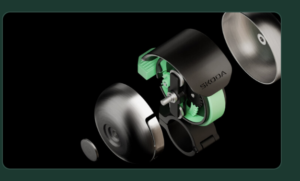
All of which is just a way of said that the Škoda Duobell, a bicycle bell that can get an alert even into noise-cancelling headphones, looks like a welcome innovation. What’s even cooler about it is that it provides an analogue solution to a digital problem. It’s a mechanical device that deceives ‘smart’ headphone algorithms and increases the probability that pedestrians will detect its sound.
So what I want to know now is where I can buy one. It doesn’t seem to be on sale yet. Growl.
Chart of the Day
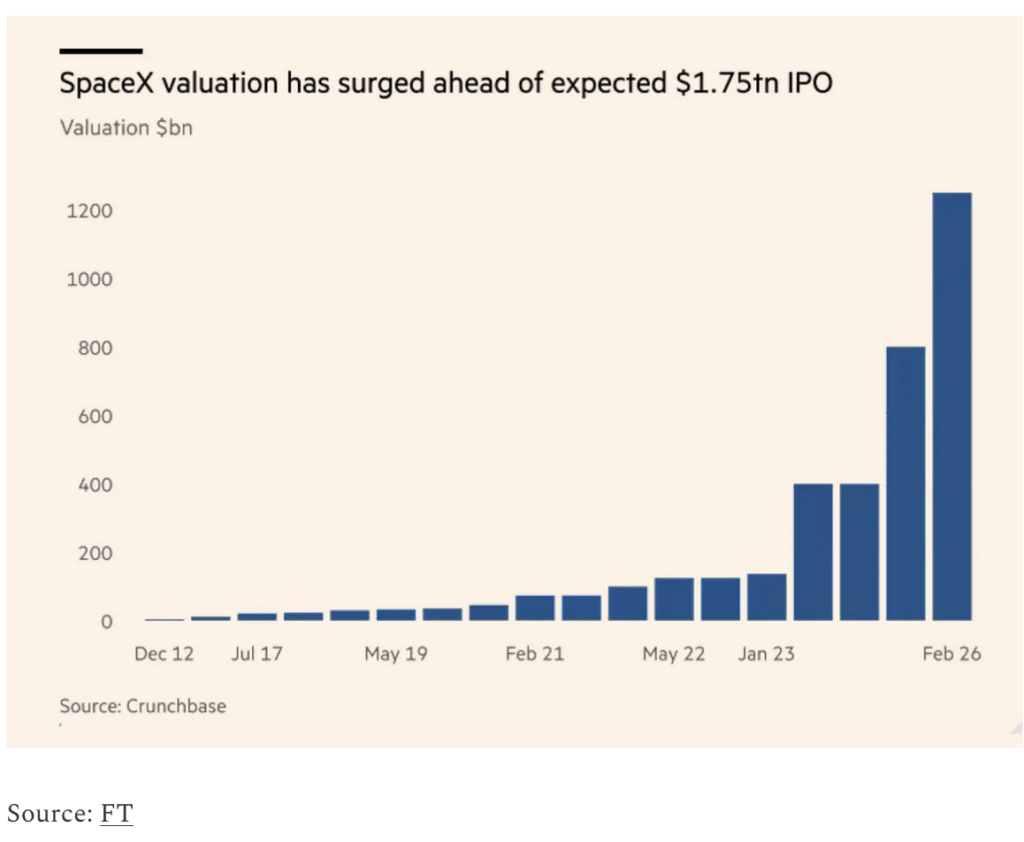
I think it was Keynes who said that markets can remain buoyant for longer than you can remain solvent. But the current insane discrepancy between corporate valuations and reality goes way beyond that. The SpaceX IPO filing says, at one point, “We have a history of net losses and may not achieve profitability in the future.” .
(h/t Adam Tooze)
This Blog is also available as an email three days a week. If you think that might suit you better, why not subscribe? One email on Mondays, Wednesdays and Fridays delivered to your inbox at 5am UK time. It’s free, and you can always unsubscribe if you conclude your inbox is full enough already!