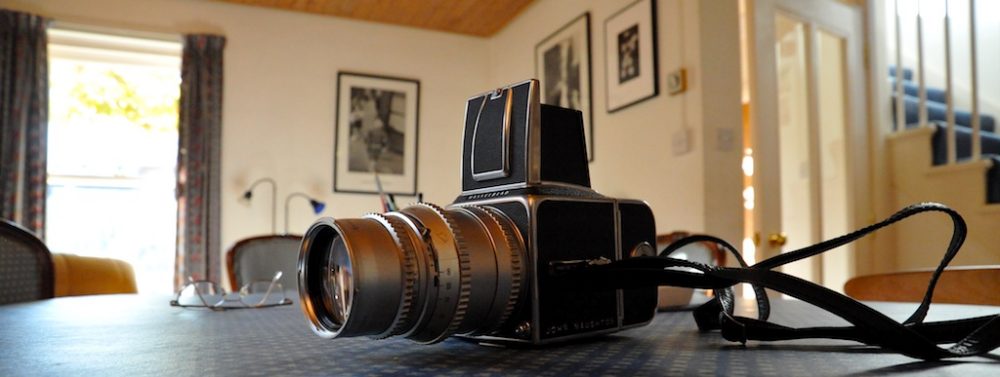
Fontenay on an August evening.
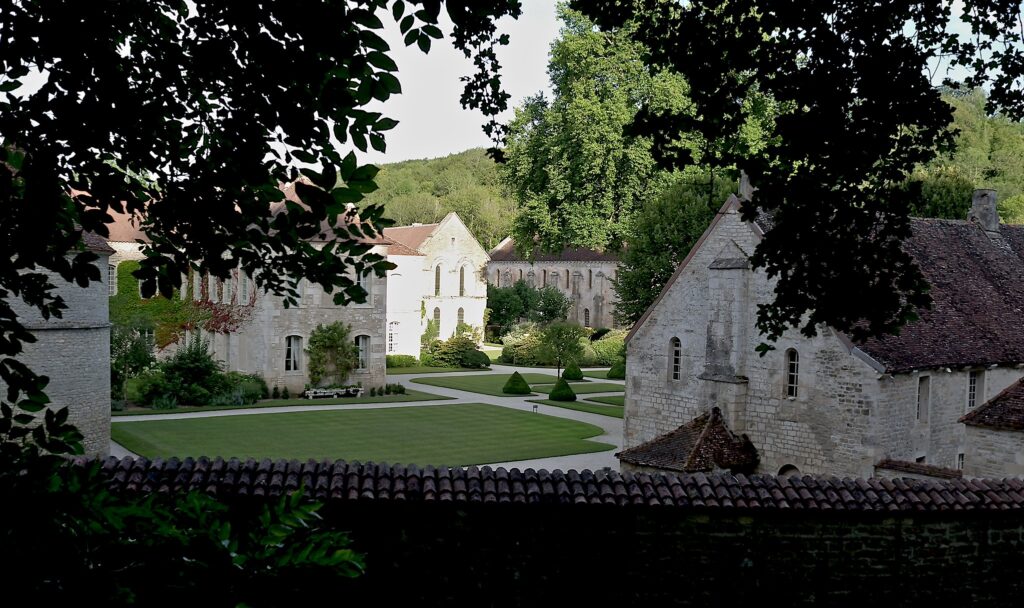
The Abbey of Fontenay in Burgundy is one of the most peaceful and serene places I’ve ever visited. Last time I was here was in 1988 and it hasn’t changed. It was closed by the time we reached it, so we climbed a bank in the wood to get this shot over the wall.
Quote of the Day
”On some great and glorious day the plain folks of the land will reach their heart’s desire at last, and the White House will be adorned by a downright moron.”
- H. L. Mencken
Musical alternative to the morning’s radio news
Bob Dylan | Like A Rolling Stone (Live at Newport 1965)
Long Read of the Day
A property developer’s view of Greenland
Heather Cox Richardson’s Substack is an unfailing source of historically-informed sanity. Her edition for January 16 contained a particularly revealing report on a conversation between Trump and some journalists.
Sample:
In an interview with New York Times reporters on January 7, Trump explained that he wants not simply to work with Greenland, as the U.S. has done successfully for decades, but to own it. “Ownership is very important,” he told David E. Sanger.
“Why is ownership important here?” Sanger asked.
“Because that’s what I feel is psychologically needed for success,” Trump answered. “I think that ownership gives you a thing that you can’t do, whether you’re talking about a lease or a treaty. Ownership gives you things and elements that you can’t get from just signing a document, that you can have a base.”
Katie Rogers asked: “Psychologically important to you or to the United States?”
Trump answered: “Psychologically important for me. Now, maybe another president would feel differently, but so far I’ve been right about everything.”
In a different part of the interview, Rogers asked Trump: “Do you see any checks on your power on the world stage? Is there anything that could stop you if you wanted to?” Trump answered: “Yeah, there is one thing. My own morality. My own mind. It’s the only thing that can stop me, and that’s very good.”
“Not international law?” asked Zolan Kanno-Youngs. “I don’t need international law,” Trump answered. “I’m not looking to hurt people. I’m not looking to kill people. I’ve ended—remember this, I’ve ended eight wars. Nobody else has ever done that. I’ve ended eight wars and didn’t get the Nobel Peace Prize. Pretty amazing.” After more discussion of his fantasy that he has ended eight wars,” Kanno-Youngs followed up: “But do you feel your administration needs to abide by international law on the global stage?”
“Yeah, I do,” Trump said. “You know, I do, but it depends what your definition of international law is.”
My question: how did the republic get to this: a toddler as president?
My commonplace booklet
When I launched this newsletter in 2020 — at the beginning of the Covid lockdown — I guessed (correctly) that the daily news would be dispiriting and I stopped listening to Radio 4’s Today programme. And I decided that the newsletter should always have a musical alternative to the morning’s news as a kind of antidote.
It turned out to have been a good idea: the musical link is — still — often the most popular item on a day’s edition. In 2025, being hooked on mainstream media has definitely been bad for one’s mental equilibrium: it leaves one with a warped view of humanity.
This point was cogently argued by Martin Kettle, the Guardian columnist, in his final column for the paper, in which he relates what happened when he lost his wallet on a train.
There is no way around the fact that the media – traditional and social alike – are sleepless drivers of our reflexive collective pessimism. We live in a country where failure, risk and danger are deemed ever present and on the increase. Our media endlessly reports terrible cases of cruelty, exploitation, greed and anger. As a result, no one in my profession would ever think my wallet story was worth sharing, except perhaps at Christmas.
I think that description of mainstream media as the “sleepless drivers of our reflexive collective pessimism” is spot on. It’s a big problem for contemporary democracies.
(Many thanks to John Seeley for alerting me to Kettle’s column.)
Feedback
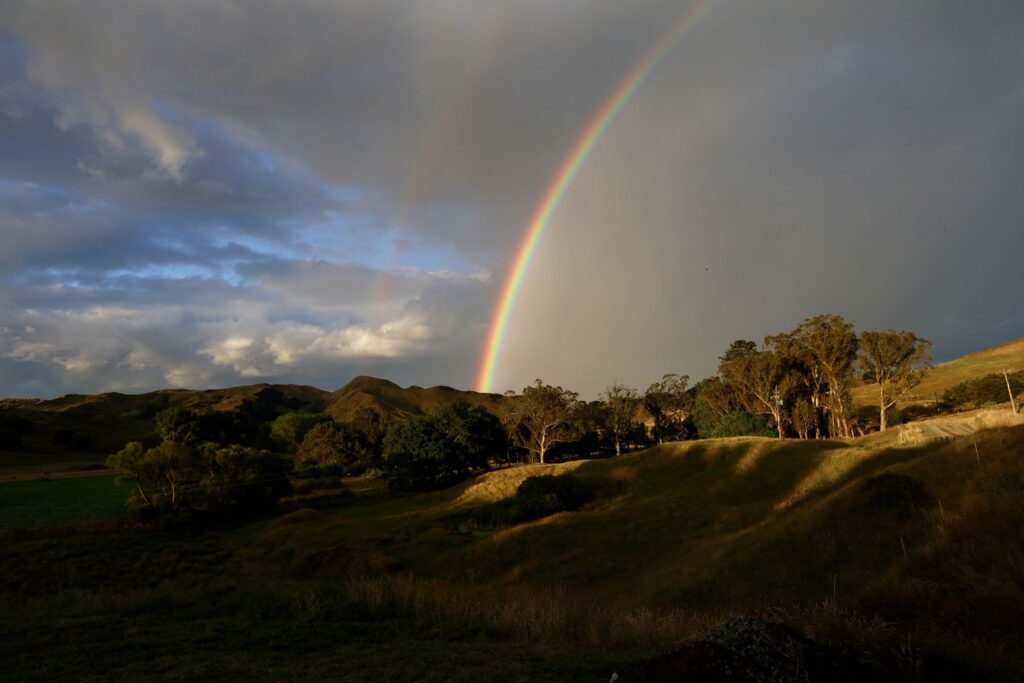
The East Anglian double rainbow in Monday’s edition prompted Don Higgins to go “snap!” and attach this photograph he had taken at Hawkes Bay, New Zealand. “I hadn’t realised until I took this pic,” he writes, “that the colours in the outer rainbow are in the reverse order to the main one”.
I hadn’t ever noticed that, so asked ChatGPT about it.
The two rainbows are formed by different numbers of internal reflections inside raindrops: * The primary rainbow comes from one internal reflection. * The secondary rainbow comes from two internal reflections, which flips the order of the colours and also makes the rainbow dimmer (more light escapes the drop).
This Blog is also available as an email three days a week. If you think that might suit you better, why not subscribe? One email on Mondays, Wednesdays and Fridays delivered to your inbox at 5am UK time. It’s free, and you can always unsubscribe if you conclude your inbox is full enough already!