
Doggy sense
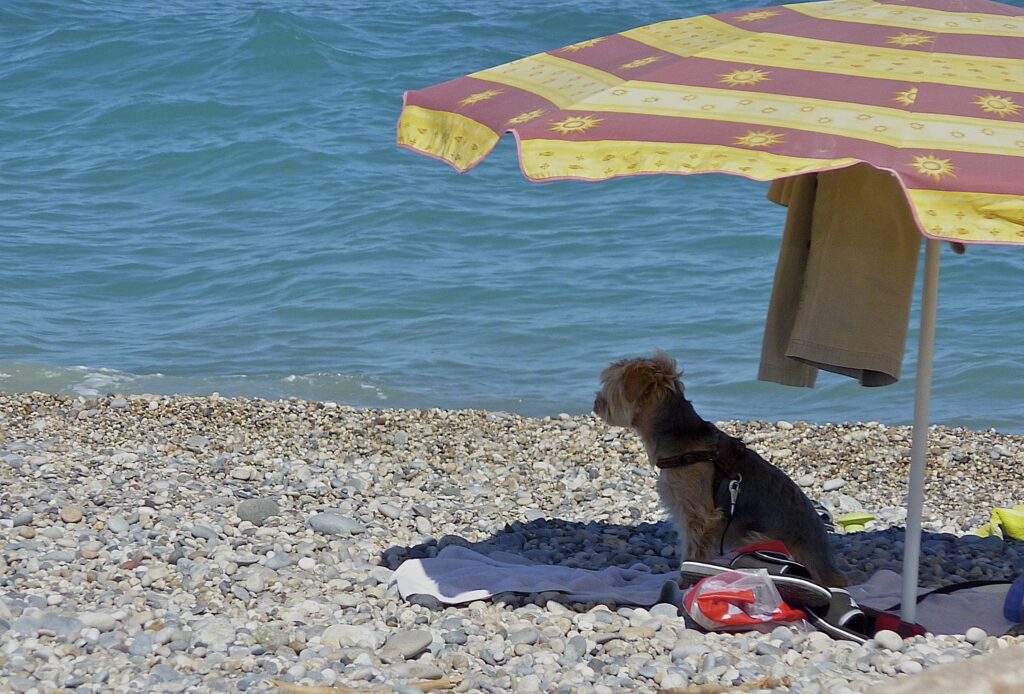
This is one of my all-time favourite photographs. We were driving along the seafront in Antibes one sweltering Sunday afternoon when I saw a small dog sitting in the shade of a beach umbrella looking at his master and mistress who were both sunbathing, baking like sausages on a spit. And I guessed that their dog was thinking: “Jeez, humans are weird, sometimes”. I stopped the car, got out and pressed the shutter.
It’s a picture that has delighted friends and visitors for years. One friend was so touched by it that I gave her a copy, and I think it was on her bedroom wall when she passed away.
Quote of the Day
”Be isolated, be ignored, be attacked, be in doubt, be frightened, but do not be silenced.”
- Bertrand Russell
Musical alternative to the morning’s radio news
The Traveling Wilburys | End Of The Line
Long Read of the Day
** AI: a very human tragedy; Mankind will always overreach
Terry Eagleton writing (entertainingly, as usual) on on what people are beginning to call “AIpocalypse”.
The word “Doomsday” suggests a punctual event, whereas one of the problems with alerting the public to the urgency of climate change is that it’s a gradual process. And we don’t tend to think of catastrophes as gradual. AI, however, is a different affair. There may come a world-shaking moment when a squad of terrifyingly brainy robots actually takes over, swarming our garden paths and emitting lethal rays, just as there may come a point in time when weapons of mass destruction are unleashed. Well, actually slightly more than a moment. It’s been estimated that such warfare could wipe out humanity in 17 minutes, time enough to try on a number of tweed suits, take the dog for a disappointingly brief walk or tell the boss what a contemptible little creep he is. The Apocalypse has traditionally been thought of as a dramatic event, an irruption of the timeless into time; in fact, some years ago, an American evangelical TV station drew up plans to broadcast Christ’s Second Coming, with cameras placed strategically at the poles and the Equator. It’s hard to know who would have taken out ads.
What the literature of Apocalypse never really took account of, however, was that we ourselves might be responsible for winding up our own history — that the disaster might constitute mass suicide rather than an outrage inflicted upon us by the Antichrist, an exasperated Almighty or a bunch of well-aimed asteroids. Diffident creatures that we are, it never struck us that we might pull off the end of the world all by ourselves, without a helping hand from the powers of darkness or a deity at the end of his tether. In accumulating the power to destroy itself altogether, humanity has finally come of age. There’s something grimly amusing about the idea of an animal that is scuppered by its own sovereignty — one which is wiped from the evolutionary record by its own eminently civilised achievements. Power becomes weakness, and progress a stealthy self-unmaking. As Freud was aware, the very forces that make life are secretly in love with death.
Like Sophocles’s Oedipus, and with just the same stiff-necked self-blindness, we bring our fate down on our own heads while priding ourselves on our sovereignty and intelligence…
Great read.
Books, etc.
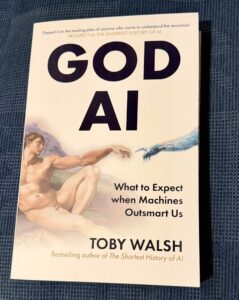
This has just arrived. Note the subtitle: “What to Expect when Machines Outsmart Us”. Toby Walsh is a distinguished AI researcher who’s become worried about the future. “Our problem”, he writes, “isn’t only artificial intelligence. It is also human intelligence. How good is our capacity to recognise and respond to existential risks before they become existential realities? Is humanity wise enough to respond in time?
If climate is anything to go by, the answer isn’t reassuring. So I’m looking forward to reading the book.
My commonplace booklet
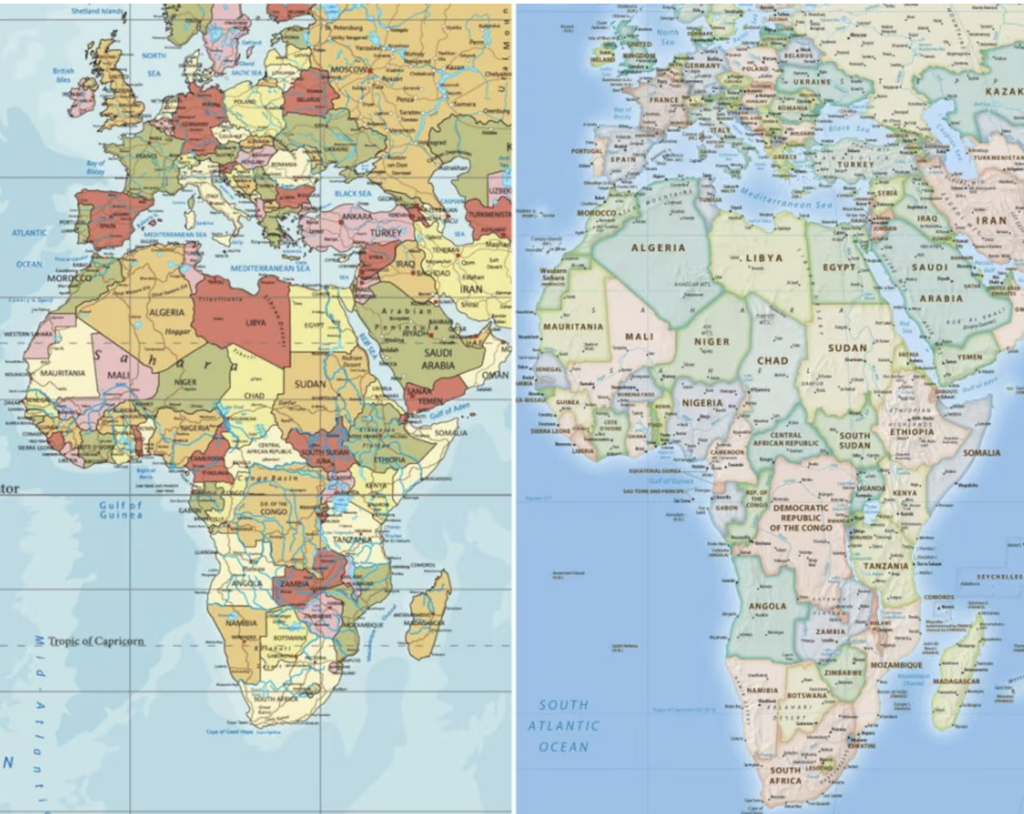 Mercator projection on the left
News Flash! Ireland is no longer the centre of the world!
Fintan O’Toole has a nice column in the Irish Times (sadly, behind a paywall) on the revelation that Ireland’s place in the world is less elevated than we tend to assume. This bombshell has been dropped on us by the United Nations which has released the ‘Equal Earth Map’ — which is not based on the Mercator projection that shaped our understanding to the world.
You may have noticed that Ireland just got a lot smaller. The United Nations has formally endorsed the Equal Earth map that corrects the distortions of the one we’ve all used for centuries. Among these misrepresentations was the bigging-up of the Emerald Isle. Ireland is now being brought down to size.
For 500 years, the atlas represented the globe in two dimensions by using the Mercator projection. It shows the northern hemisphere much bigger than the southern, and the western continents far more prominent than the eastern. As a consequence, it imprinted on our brains an inflated notion of Ireland’s place in the world. It gave us notions.
On this old map, for example, Ireland looks about two-thirds the size of Madagascar. Ireland is 84,421sq km. Madagascar is 587,041sq km – seven times our size. Which, on the new map, is pretty much how it looks.
But this shift in perspective is not just a matter of relative scale. It’s about position. The Mercator map has us slap bang in the middle of the planet. On the Equal Earth map, Ireland looks a lot more northerly and a lot less central. Because it gives a truer picture of the size of the southern hemisphere, it pushes Ireland upwards, much closer to the fringes of the Arctic.
The Arctic!!! What about the Gulf Stream, eh? On second thoughts, but if the GS were to switch off (which I think some climate scientists think is a possibility), then we would discover that Dublin is on the same latitude as Edmonton, where the temperature regularly drops to −20°C in winter.
Feedback
After seeing my note about the FT’s acronym for “How To Spend It”, Nigel Kellaway wrote that
”KFC is no different. When ‘Fried’ became a synonym for fatty food it too had to be hidden”.
This Blog is also available as an email three days a week. If you think that might suit you better, why not subscribe? One email on Mondays, Wednesdays and Fridays delivered to your inbox at 5am UK time. It’s free, and you can always unsubscribe if you conclude your inbox is full enough already!