It’s a quagmire — official

Yep. Now we have the official confirmation.

UK premier Tony Blair has endorsed US President George Bush’s assertion that coalition troops must stay in Iraq as long as necessary to defeat terrorism.
Mr Blair told the Associated Press it was “vital” the US-led coalition remained until the country stabilised.

Defeating “insurgents and terrorists” there would lead to the destruction of terrorism across the globe, he said.

The big lie

The root cause of Tony Blair’s credibility problem is that he took Britain to war on a false prospectus. But the really interesting question is how he got into the mess in the first place. The answer is, in essence, simple. The Bush administration had decided soon after the 9/11 attacks (or perhaps even before that) to attack Iraq. Blair, for reasons still unclear, had decided that whatever the US did, the UK would support. From that single decision, everything then followed. But since there was no rational justification for Bush’s deteremination to oust Saddam, Blair had to thrash around for a justification he could sell to the British parliament, and the British people.

What I hadn’t realised, until I read this remarkable piece by Mark Danner, is how early the decision to go with the Yanks was being discussed in Whitehall.

Danner’s piece is based round a leaked minute of a meeting held in Downing Street on 23 July 2002 (yep — 2002) in which the entire thing was discussed. Here’s an extract which gives the flavour of the discussion:

C [Sir Richard Dearlove, Head of MI6] reported on his recent talks in Washington. There was a perceptible shift in attitude. Military action was now seen as inevitable. Bush wanted to remove Saddam, through military action, justified by the conjunction of terrorism and WMD. But the intelligence and facts were being fixed around the policy. The NSC had no patience with the UN route, and no enthusiasm for publishing material on the Iraqi regime’s record. There was little discussion in Washington of the aftermath after military action.

(Emphasis added.)

The Iraqi quagmire

It may not be top of the news agenda any more, but the situation in Iraq is terrible. This week’s Economist has a sobering Special Report. Here’s an extract on how the home-grown Iraqi security forces (on which the Bush Administration bases its fantasies about early withdrawal) are faring:

A recent night-time raid with Iraqi soldiers and police commandos in Khalis, a mostly Sunni district north of Baghdad, illustrated both progress and shortcomings. The Iraqi officers were stirred to issue orders to move only on learning that their American mentors—part of a new scheme to embed 10,000 American troops in the ISF—were on the way. The orders then sparked terror in the ranks. Soldiers asked to be excused from the mission, complaining of sore limbs or faulty weapons. Many took sedatives, which Iraqi troops use to control their panic. “Better they take drugs than run away,” an Iraqi officer explained. “Most of these guys haven’t had much military experience or training and the insurgents are ferocious.”

Having encircled the first target-house, the stoned warriors charged, firing their Kalashnikov assault rifles into the night sky. Inside the house, they grabbed two youths and shot a third in the shoulder as he tried to escape. They then ransacked every room, found a video camera and several cassettes and threatened the prisoners with summary execution. The youths admitted to having filmed insurgent attacks. Both were soldiers of the old regime and former residents of Fallujah. The injured prisoner received no medical attention as the ISF rampaged on to the next target.

It gets worse…

No wonder they were scared. The past two months have seen a staggering explosion in violence, even by Iraq’s standards. Over 1,000 people have been killed, mostly by some 160 suicide bombers. On June 14th, a suicide bomber killed 22 people and injured more than 80 in Kirkuk, an oil-rich city disputed between Kurds and Arabs. Throughout this week, dozens of bodies of soldiers and government contractors were found littered across western Iraq, most of them shot in the head.

So much for the notion that Iraq’s elections in January had quelled the insurgency—a delusion to which some American officials are still prone. “I think everyone understands that it’s getting better every day,” said Lieutenant-Colonel Michael Gibler last week in Mosul, which was hit by over 30 suicide bombers in April and early May. “Of course, every nation that’s got IEDs [improvised explosive devices] and drive-by shootings and suicide bombers has definitely got some security issues, and this country has got those. But we’re working to change that.” The colonel received a phone call minutes later, informing him that four of his men had been injured by a suicide bomber.

There’s no way out. If the Americans pull out (as Bush and Co would like to do), the country will rapidly degenerate into worse violence. If they stay, the only way to make progress is to pour in yet more troops. That’s my definition of a quagmire.

Microsoft deletes ‘freedom’ and ‘democracy’ in China

From a Register story:

Microsoft has bowed to Beijing’s political censors and has banned the use of the words “freedom” and “democracy” on some areas of its Chinese internet portal, along with a host of other politically sensitive words such as “Taiwan independence” and “demonstration”.

According to the Financial Times, portal operators have imposed the restriction on the names users give their blogs, although the words can still be used within blog’s text. Users who try to use the offensive terminology are met with error messages informing them that they have used “forbidden speech”, which they are asked to delete from the item.

Microsoft’s statement on ‘Corporate Citizenship’ says:

Microsoft is committed to being a responsible industry partner. We work with businesses, communities, and governments to help advance social and economic well–being, and to enable people around the world to realize their full potential.

Er, except, it seems, in China.

Gorgeous George

Nicely balanced column by Gerard Baker in the Times about George Galloway’s bravura performance before the US Senate. On the one hand…

When mortals appear before Senate panels, they are expected to show proper deference to these lawgivers of the American republic. But while senators may consider themselves Solons, Pericles they most assuredly are not. Going through life in an impregnable carapace of sycophancy is agreeable, no doubt, but as Marie Antoinette discovered, it does not tend to sharpen one’s skills in public argument. So when a feisty member such as Mr Galloway shows up in the midst of these august figures, the effect is a little like a character from a Damon Runyon novel let loose among the Gatsbys.

The average MP, schooled in the knockabout tactics of the House of Commons, is far better equipped to score points and persuade undecided minds. And Mr Galloway’s performance duly earned him some rave reviews, not least from startled American journalists who wouldn’t dare treat their betters this way.

On the other hand…

But forgive me if I don’t participate in the adulation. As I watched, it wasn’t a grudging respect for the perfectly tailored and coiffed tribune of the masses that filled me, but a wave of nausea. His testimony left me with a renewed understanding of just how uniquely repellent Mr Galloway is.

That “Non!” vote

Neil Kinnock, the former Labour leader and ex-EU Commissioner was interesting on Radio 4’s Today programme.

Talking about the French referendum result, he outlined a cogent case for regarding it as a wholly French-made shambles. He blamed Jacques Chirac for mismanaging the disastrous Nice summit which launched the thing on the world, and pointed out that instead of a simple document setting out the rules needed to make workable an EU of 25 countries, it had ballooned (under the tutelage of Valery Giscard d’Estaing, a former French President) into a bloated half-assed attempt to do for Europe what the Founding Fathers once did for the United States.

As for the interpretation that the Non vote was an expression of dissatisfaction with Chirac, Kinnock pointed out that it was the French Left who had put Chirac where he is today. Their failure to agree on, and support, a viable left-wing candidate in the last Presidential election led them in a panic to vote for Chirac in order to keep the fascist Jean Marie le Pen from winning. But on Sunday, those same leftists allied with fascists, racists, Europhobes and sundry discontents to ‘rebuke’ the guy they had installed in power. It was a truly great rant. If only Kinnock had been that sharp when he was Leader of the labour Party.

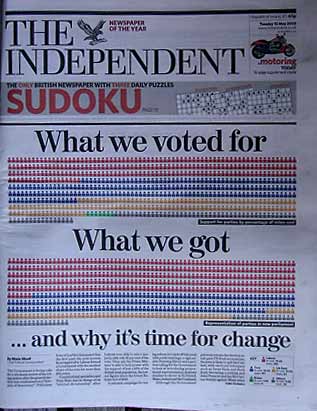
The election in a nutshell

Front page of today’s Independent. Brilliant encapsulation of a crazy electoral system that gives one party the powers of an “elected dictatorship” (to use Quintin Hogg’s famous phrase) with a minority of the popular vote. Labour got 35.22% of the votes, but 356 MPs. The Lib-Dems got 22.05% but only 62 seats.

Common sense about the election

From David Aaronovitch’s column

Now the Prime Minister threatens us with listening. Nothing makes me more worried than the demand that politicians should listen. For a start, some people talk much louder than others and are far easier to hear. Take top-up fees, an issue on which the Lib Dems probably gained tens of thousands of Labour votes. Nowhere during the campaign did I hear or see the question of support for poorer students raised with candidates or in the media. I would think that most people simply have no idea that these students will not have to pay fees and will receive, for the first time for years, a substantial maintenance grant.

The issue didn’t come up because the parents of such poor students don’t work in journalism and they won’t write to the papers or go on marches. The redistributive nature of top-up fees has been successfully obscured by middle-class self-interest. In the same way, the Iraqis who want British troops to remain while they build their country are not heard with the same Lib Dems arguing for withdrawal, no matter what the situation is.

Smart lad, that Leviathan

Well, well. Before the election, I thought that the best result would be a Labour government returned with a workable but drastically reduced majority. Difficult to arrange in the UK’s patchwork of constituencies. But now that most of the results are in, it looks as though Labour is back with a majority in the mid-60s. And a BBC analysis this morning reported on Radio 4 that 58 of those Labour MPs who rebelled against the party whip on critical issues have been returned. Given that the British system amounts to legislative dictatorship (in that a Prime Minister with a large majority can do as s/he damn well pleases), this is a terrific outcome. Blair & Co cannot now behave over national security, ID cards etc. with the arrogance that characterised their second term. Interesting times ahead. Yippee!