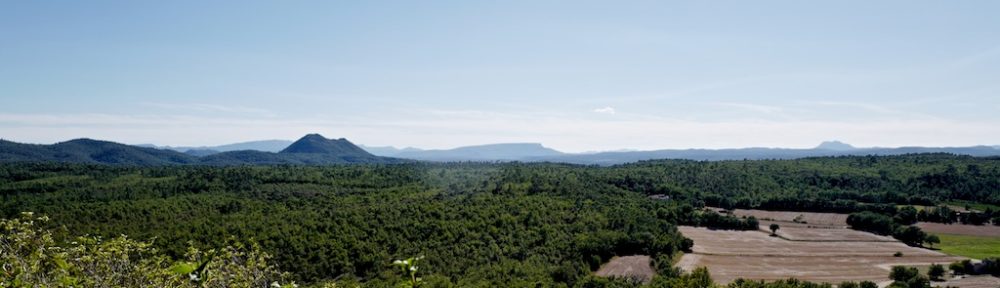
Bill Thompson’s back from WSIS and has posted lots of interesting photographs on Flickr.
Category Archives: Politics
Robert Mugabe: Internet expert
Comic relief time. Robert Mugabe made a ponderous speech to WSIS on the subject of “How Western states abuse the Internet”. Zimbabwe was concerned, he said,
that information communication technology (ICT) continues to be used negatively – mainly by developed countries – to undermine national sovereignty, social and cultural values.
The President also challenged the still undemocratic issue of Internet governance, saying one or two countries insisted on being world policemen on the management and administration of the Internet, a worldwide network of computers which facilitates data transmission and exchange.
The admiring report of his speech in the Harare Herald (written by the appropriately named Innocent Gore) goes on to say that
the Internet was developed by an American company called Internet Corporation on Assigned Names and Numbers (ICANN) and the company managed it in consultation with the United States Department of Commerce.
Developing countries were proposing that this function be managed by an inter-governmental authority, but the US government was against such an arrangement as this would result in it losing control of the Internet and all revenue associated with the information superhighway.
African countries wanted the composition and role of the present governing body to be a fully representative authority and wanted to be accorded the opportunity to actively participate in international organisations dealing with Internet governance.
Truly, you couldn’t make this up. I wonder if the aforementioned Innocent is by any chance related to Al Gore, who famously once claimed to have invented the Internet.
I particularly like Mugabe’s concern about the “still undemocratic issue of Internet governance”. Myself, I am concerned about the still undemocratic issue of Zimbabwean governance.
[Thanks to Richard Synge for the link.]
Correction… Bill Thompson writes to say that Al Gore never made that assertion. It was, he says, “a slander put about by the Republicans – see Seth Finkelstein’s analysis“.
Once Upon a Time…
Extraordinarily perceptive essay by Arthur Silber on the pathological mindset of those now ruling the US. He starts from Dick Cheney’s vicious outburst the other day about those who dare to criticise the Iraq adventure.
The Bush-Cheney attack, at this moment and in this context, reeks of desperation. They behave like cornered rats. Their tactics are not wise in terms of any political strategy. They are no longer convincing, and they are no longer believed. And without much trouble, they could have taken another course entirely. They could have admitted that certain of the information they relied upon turned out to be inaccurate. They could have expressed their deep regrets on that issue, and their determination to correct what led to the errors. And then they could have said that since we are now in this situation, however much we might regret it, we must persevere, at least to the extent of making Iraq reasonably stable within a reasonable period of time.
Why can’t Bush-Cheney (and, by implication btw, Tony Blair) admit this? Silber continues:
Their behavior is completely unreasonable. It serves no purpose whatsoever that is comprehensible to any degree. So we can fairly and justifiably say this much: they are behaving completely irrationally, even on their own terms and if their stated aims are in fact their aims. So those aims cannot be the real ones. The purpose lies in another direction. From all the evidence, I would say that the refusal to admit error is the key. These people cannot bear to contemplate even the possibility that they’ve been wrong. The threat appears to be experienced as one to their entire worldview, and to their deepest view of themselves. This is the faith that Ron Suskind described in his article about Bush, but it is faith of a particular kind. It is absolutist, entirely and with regard to every specific. To admit error in one part, is to admit error about the whole. If a single beam is removed, the complete structure collapses.
The faith must be maintained, no matter what. All the negative consequences of the Iraq disaster don’t matter; all the deaths and destroyed lives don’t matter; the weakening of our military doesn’t matter; the mounting and increasingly ominous financial costs don’t matter. None of it matters. The faith itself is everything. You see the identical phenomenon in the most dedicated of the administration’s defenders.
This is not normal, says Silber; it doesn’t come within even the outermost boundaries of what is normal.
This is pathological, in that it deliberately discards huge parts of reality and pretends that they don’t exist. It does all this not out of a commitment to a provably reasonable alternative or anything close to it, but out of a psychological imperative.
This kind of pathology is extraordinarily dangerous. Facts don’t matter and, in the worst case, deaths don’t matter. More deaths and on a still wider scale don’t matter. This is why I continue to believe that these people are entirely capable of unleashing Armageddon. You can raise all the objections indicated in that post and many more, and they won’t matter. The faith must be maintained. But this faith is a lethal one as we continue to see every day, and we may not have seen its worst results yet. Pray that we never do.
Amen. This is a fine piece, reminding one of the extent to which the US now seems to be stuck, and it’s not clear how it will extract itself from this mess — which encompasses not just Iraq, but the country’s media, its Congress and even its judiciary.
bin Laden 1 – democracies nil
From Timothy Garton-Ash’s column today…
The erosion of liberty. Four words sum up four years. Since the attacks of September 11 2001, we have seen an erosion of liberty in most established democracies. If he’s still alive, Osama bin Laden must be laughing into his beard. For this is exactly what al-Qaida-type terrorists want: that democracies should overreact, reveal their “true” oppressive face, and therefore win more recruits to the suicide bombers’ cause. We should not play his game. In the always difficult trade-off between liberty and security, we are erring too much on the side of security. Worse still: we are becoming less safe as a result…
Blair abolishes elections:
“too dangerous” say police chiefs
Lovely spoof from Owen Barder’s Blog.
And another thing…
… about the vote on the Terror Bill. I’m tired of all the media hyperbole about ‘defeat’. The scandal is not that Blair lost the vote, but that this is the first one he’s lost since he became Prime Minister in 1997. A sure sign that a deliberative democracy is working is occasional — or even regular — defeats of governments in Commons debates. It means that issues are being decided on the basis of MPs making up their own minds, rather than voting to the Whips’ instructions. But Blair’s first two (huge) parliamentary majorities meant that Britain was governed for nearly a decade by an elected dictatorship. Now at last we have something a little more representative — and possibly also a bit more reflective. Hooray!
The madness of King Tony

All political careers end in failure, as the old adage goes. What is less often remarked is that most Prime Ministers go mad eventually. And the longer they are in power, the madder they get. By the time she was finally ejected, Margaret Thatcher was barmy. Watching the crazed run-up to yesterday’s government defeat in the House of Commons over the length of detention without charge to be allowed under the new Terror Bill, the thing that struck me most was how Blair steadily escalated the issue to the point where it was all about his ‘authority’. And that, of course is a dead giveaway. That, and his increasingly pop-eyed appearance in TV interview after TV interview in which he argues that He Knows Best. In that, he greatly resembles Thatcher — but with one important difference: whereas she always believed that she was Right, Blair believes that he is not only Right but Good.
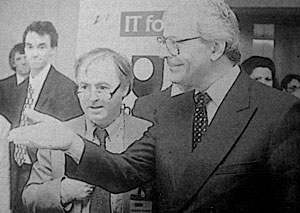
The reason Prime Ministers go mad is simple. They live inside a bubble which comprehensively insulates them from the real world. I first discovered this when I met John Major, the last Tory Prime Minister, towards the end of his premiership (see fuzzy newspaper picture). At that time he was, to all intents and purposes, a busted flush — head of a sleazy, incompetent, incoherent, tired administration which was falling apart. Yet when I met him he was surrounded by four Cabinet ministers, and a phalanx of security people, flunkeys, secretaries and runners. I noticed that everyone, but everyone, around him was smiling, agreeing with him and generally being eager to please. It was “Prime Minister this” and “Prime Minister that”. If you didn’t know any better, you’d have assumed he was Caesar at the height of his powers. Yet, as I say, it was patently obvious that, electorally speaking, the man was dead meat.
That’s how British Prime Ministers live — with a coterie of lackeys who treat them like Gods and insulate them from the real world. It’s basically a reality-distortion field. Tony Blair’s been inside such a field since 1997, and boy is it beginning to show.
Saeva Indignatio
Fine example of savage indignation in the current issue of The Economist. Excerpt from a rant, er, Leader on the importance of free trade:
In Washington, DC, home of a fabled “consensus” about poor countries’ economic policies, a bill before Congress devised by one of New York’s senators, Charles Schumer, threatens a 27.5% tariff on imports from China if that country does not revalue its currency by an equivalent amount. In Mr Schumer’s view, presumably, far too many Chinese peasants are escaping poverty. On November 4th George Bush will escape the febrile atmosphere along Pennsylvania Avenue by visiting Argentina to attend the 34-country Summit of the Americas. There he will be greeted by a rally against “imperialism”, by which is meant him personally, the Iraq war and the Free Trade Area of the Americas which he espouses. Among the hoped-for 50,000 demonstrators will be Diego Maradona, who as a footballer became rich through the game’s global market and as a cocaine-addict was dependent on barrier-busting international trade; and naturally his fellow-summiteer, Hugo Chávez, who is using trade in high-priced oil to finance his “21st-century socialism” in Venezuela.
I like that, er, crack about Maradona.
New Labour’s latest dog’s breakfast
Wonderful column by Ted Wragg in today’s Education Guardian on the new Education Bill. Excerpt:
Let me work out the logic. There will be a verbal IQ test, on the basis of which final-year primary school pupils will be assigned to one of nine ability bands. Then equal numbers from each band, about 11% a time, will go to each school. Ah, so children will actually be assigned to a secondary school. Fine.
No, wait a minute. Parental choice is paramount. Parents will choose which of 10 types of specialist school they would like their child to attend. So it’s all about choice then. Except that the government wants schools to opt out from local authority control and decide their own admissions policy. I’ve got it, at last. Schools will decide.
Hang on. Parents can even start up their own school. They will really be in the driving seat in schools. Yes, yes, I see now. It is parent power, after all. Yet if your children are outside the quota for their band, then a fleet of buses will ferry them across town, presumably to a school they didn’t want to go to.
Er, I’m confused again. I think I’ll just brush up my Spanish and get my “linguist” scout badge instead.
Kenneth Baker, sorry, Tony Blair, is very keen on grant-maintained schools, oops, silly me, trust schools, and wants to set up city technology colleges galore, er, I mean, city academies.
He goes on…
To call these proposals “a dog’s breakfast” would be to insult Britain’s pet owners, who take care to feed Bowser a balanced diet. They are the ultimate disaster from the No 10 wheeze factory. Leave Tony Zoffis free all summer to dream up a barrel of monumental bollocks, and this is what ensues.
The battle for control
Forceful piece in today’s International Herald Tribune by Carl Biltd, former Prime Minister of Sweden. Sample:
Beyond the headlines, a critically important battle for control of the Internet is being played out.
On the one side is the United States, which wants to retain supervision of the Internet and has managed to get the reluctant support of most of the global Internet community, which sees America as the least bad of the possible ultimate guardians of the system.
On the other side is a collection of states keen on getting as much as control as possible in order to curtail the Internet’s power to undermine their regimes. With the theocracy of Iran as the standard-bearer, this group brings together Saudi Arabia, China, Cuba and Venezuela. North Korea is probably keen to join in as well.
The European Union seems to be in the middle, wavering back and forth – and in its wavering it has recently come down with a position that has brought it enthusiastic applause from Tehran, Beijing and Havana.
Bildt thinks that the European Commission doesn’t know what it’s doing here, and I agree with him. In the end, the Americans will block this, and, for once, we may have reason to be grateful for their obduracy.
Thanks to Gerard for the link.