The rendition artist

Lovely post on OpenDemocracy.net by Fred Halliday on Alberto Gonzales’s performance at the IISS on March 7. Sample:

Gonzales was evasive on matters of substance, jocular in response to questions touching on matters of human suffering. Asked if he thought that setting dogs on naked prisoners was a form of torture, he said he did not give opinions on individual detention practices. He shifted responsibility – and hence blame – from the department of justice to the department of defence when it suited him. Above all, he was apparently oblivious and indifferent to the consternation, rage and concern which recent US policies – enacted following the 11 September 2001 attacks in New York and Washington – have occasioned.

There is nearly always something slightly chilling when groups of mid-Atlantic government officials, arrayed in phalanxes of grey suits, get together to discuss their security concerns. But never, in more than thirty years of observing such occasions, have I seen such an appalling, collusive, complacent and – in its own understated way – evil, performance as this.

That the US – its officials and citizens – has been, and will continue to be for a long time, the object of violent attacks, at home and abroad, is not in question. Nor is the right, and responsibility, of any state to protect itself as it can, including by taking anticipatory measures abroad. The issue, and what has become a matter of worldwide alarm and criticism, is the flouting of international law, the laws and norms of combat and international opinion, as well as the disdain in which the Bush administration, from the president downwards, continues to hold international law and the institutions in which it is embodied. In this regard, the performance by Gonzales, on a sunny March morning in London, was true to form…

A transcript of Gonzales’s address (in Microsoft Word format — yuck) is available from a link on this page.

Blair declares war on Brown

That’s how Jackie Ashley interprets his admission that last Autumn’s announcement of his intention to retire may have been a mistake. She writes:

His real intent, confirmed in off-the-record briefings, was to win a further delay, to signal that he would not be bumped into retirement by newspapers, cartoonists, backbenchers or indeed the chancellor. He has a date in his head but, the nods and winks suggest, this is likelier to be in 2008 than any time soon. He wants to wait until the health service is fixed – and you can’t kick a ball into the long grass further than that.

So this is a fightback, a gauntlet thrown down, an apparently modest admission of mistaken candour that is really a declaration of war. Interestingly, like the original announcement, this was made when prime minister and chancellor were thousands of miles apart and arrived like a bolt from the blue. The chancellor had no advance warning.

It changes everything. It means that Brown’s appeasement of No 10 has yet again won him nothing at all. It gives a signal to those, such as Charles Clarke, who feel that by 2008 they might have a good chance of taking on the chancellor. So it removes both imminence and certainty. The whole future leadership question is thrown wide open. Judging by past performance, Blair may now add to the confusion by saying something placatory about Brown inheriting in due course. If so, it will be meant only to avoid an immediate eruption from the Treasury, to buy a little more time. It won’t mean anything really. The prime minister is going to stay as long as he possibly can; and if he can hand over to someone who isn’t his old friend and old enemy Gordon Brown, then he would be delighted.

Er, one doesn’t want to boast, but this is what I wrote on the matter last December:

If — as is widely believed — there is some kind of deal between him and Gordon Brown that the latter is the anointed successor, then Blair’s declared intention of serving “a full term” as Prime Minister seems bizarre. If he really wanted Brown to succeed and have a fighting chance of winning the next election, then there must be an orderly transition fairly soon (and certainly no more than 18 months from now). But this is not how Blair — steaming fanatically ahead with his reform-or-bust agenda — is behaving. Why?

Watching Brown in action this week as Adair Turner’s sensible report on the pensions crisis was published, an obvious thought occurred to me (I’m slow on the uptake, alas). It’s this: Blair doesn’t want Brown to succeed him, and he’s going to do everything in his power to stop him becoming leader!

Bush makes an elementary mistake

I saw a clip of the Bush press conference the other day, in which he indicated that he would take a question from Helen Thomas, a veteran White House reporter he’s been studiously ignoring for most of his term in office. She warned him that he’d be sorry, and he was. But the TV clip only skimmed the surface. Here’s the transcript.

Thanks to James Miller for finding it.

Blair’s credibility deficit

“Funny paper, the Guardian“, remarks Simon Jenkins at the end of his (Guardian) column arguing that Blair is the best bet Labour has. What’s really funny is that the paper pays Jenkins something like £200k a year for his increasingly-jaded rants. Meanwhile, in another part of the forest, the paper argued, in an editorial, that Blair’s time was up. And, today, Jonathan Freedland argued that the Prime Minister’s credibility is shot. He’s right.

The crude, harsh truth is that no one can take what Blair says on foreign policy seriously, because he is responsible for the greatest foreign-policy disaster in half a century of British history. No matter that he emerged as a major world leader during the Kosovo war, or that he won international admiration after the Good Friday agreement. Now, because of that one fateful decision, his credibility is shot.

And it is not just in international affairs that Blair is overwhelmed by Iraq. Take the current sleaze affair. A useful law of scandal is that charges only bite when they confirm a pre-existing suspicion. In the 1990s Britons believed the Major government was decayed; the Hamilton and Aitken revelations duly validated that belief. When the Bernie Ecclestone affair broke in 1997, voters didn’t see Blair or New Labour as financially corrupt (even though the charge then, of cash-for-policy, was much graver than anything revealed now). Today’s scandal bites because it plays into something Britons do now believe about their government: that it is not honest and cannot be trusted.

And the explanation for that, once again, is Iraq. Polls show that Blair was broadly trusted before the invasion. But he told the nation that Saddam had weapons of destruction when he didn’t, and Blair has never been trusted since. In this sense, removing Blair over a few undisclosed loans would be like jailing Al Capone for tax evasion: he will be punished for a small offence because the system couldn’t get him for the much larger one.

Don’t mention the war

The US Ambassador came to College today, to give a talk to the Gates Scholars, and I sat in on the proceedings.

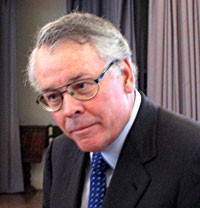
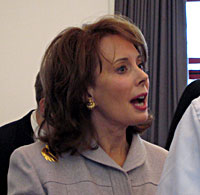
Robert Holmes Tuttle is a genial cove who apparently continues to be Co-Managing Partner of Tuttle-Click Automotive Group, described by the embassy as “one of the largest automobile dealer organizations in the United States”, while still representing his country. (Wonder what he does when questions about automobile emissions come up.) Mrs. Tuttle, a corporate lawyer, also came along and lent a touch of glamour to an otherwise drab occasion.

Tuttle’s talk was stupendously banal — partly a paen of praise to his country’s enlightened tax system (eh?), and partly a sermonette on the importance of giving (prompted in part, I guess, by the fact that most of his listeners were in Cambridge because of a huge benefaction made by Bill Gates to the university to establish the Gates Scholars scheme).

The Q&A session with the students was similarly banal. The questions were uniformly respectful and mostly vague. There was not a single mention of the war in Iraq. (John Cleese, where are you when we need you?) A question about anti-Americanism abroad was skilfully deflected by the Ambassador with anecdotal guff about how English visitors to the US are always overwhelmed by the hospitality and friendliness of the natives. He dealt rather well with a questioner who asked whether released US prisoners should have the right to vote (apparently they don’t), by explaining that sometimes there was a conflict between his personal views and the fact that he had to represent his government. Asked what he regarded as the two biggest problems facing the world, he replied “poverty and bad governance”, which I thought was a pretty intelligent answer — especially as I had expected him to trot out the party line about global terrorism.

As he gave his talk, a couple of thoughts came to mind. One was Ambrose Bierce’s definition of an ambassador as “a person who, having failed to secure an office from the people, is given one by the Administration on condition that he leave the country.” Mr Tuttle is a substantial donor to the Republican party, and served as Ronald Reagan’s Director of Personnel. The other thought was that this genial, agreeable chap is essentially the acceptable face of Rumsfeld, Cheney and all the other right-wing nutters who have driven the US into its current cul de sac. He is, in other words, the velvet glove for their mailed fist.

Innocent as charged

Following up on Andrew Brown’s scarifying tale of being stopped and searched on exiting from a London Tube station, I came on David Mery’s web site on which he keeps a wonderfully detailed account of what happened to him — and of the aftermath.

Like Andrew, David was stopped and searched for preposterous reasons (e.g. his jacket was “too warm for the season” and he was checking his mobile phone for messages); unlike Andrew, he was arrested, had his laptop and possessions confiscated and his flat was searched. With the aid of a solicitor, he gradually extracted retractions from the Met but the scary bit is that the fact that he was (wrongly) arrested cannot be expunged. This means, for example, that he is likely to have difficulties getting a visa to travel to the US (which could affect his career prospects), because you are required to disclose any arrests when applying for a visa. The more one thinks about this, the worse it gets. Bin Laden has won, hands down.

Common sense on l’affaire Jowell

Martin Kettle in today’s Guardian

I am more interested in a larger issue, which is whether left and liberal politics in this country can learn to be more honest, more modern and more consistent about the balance between individual and collective wealth in the kind of society we are all likely to live in for the foreseeable future. The elephant in the room in the Jowell affair is not really Silvio Berlusconi. It is the fact that a Labour minister is married to someone who moves with assurance, and makes a very large amount of money, in a world that is alien (though not necessarily unacceptable) to most Labour voters.

With his network of directorships, off-shore investments, tax avoidance schemes and hedge funds, Mills (and thus Jowell) appear to many to inhabit a world in which it can sometimes seem that taxes are for the little people, greed is good, and there are no proper limits to how much an individual can earn or possess. Many in the Labour party take the traditional roundhead view of such cavaliers, expressing outrage that any Labour person should have anything to do with them. For them, Jowell is literally sleeping with the enemy.

This is, though, a world to which very many people aspire in some way, including Labour voters.

Thanks to Pete for the link.

Tales from Securitania

Amazing account on Andrew Brown’s Blog of his recent experience in London.

OK, so I looked a bit rough. I haven’t cut my hair in six weeks and I was wearing black jeans, a lumberjack shirt, a North Face jacket, and a rucksack for my laptop. When I came out of the tube at Liverpool Street, I noticed two cops in the main exit from the tube, but I took, as I usually do, the side exit past the shops, where there were two more cops, one black, and one white. I just had time to think this was to reassure us when the black one stopped me. Would I mind being searched under section 44 of the Prevention of Terrorism Act?

It’s worth reading the entire post. It provides a deeply depressing insight into the cluelessness of New Labour’s national security state.

En passant… It also explains why I have stopped bringing my black laptop rucksack to London…

More on Fukuyama

Good review by Jacob Weisberg in Slate of Francis Fukuyama’s new book. Needless to say, Christopher Hitchens doesn’t think much of Fukuyama’s critical view of the neocons. But then you wouldn’t expect turkeys to be keen on Christmas, and in this context Hitch has become a rather tiresome turkey. Like the Bush regime, he’s running out of excuses, and it shows in the extent to which his piece is an ad hominen attack rather than a serious rebuttal of Fukuyama’s argument. Personal abuse, like patriotism, is often the last refuge of a scoundrel, as Dr Johnson might have said.

After Neoconservatism — what?

Interesting New York Times essay by Francis Fukuyama (he of The End of History and the Last Man fame) on how the US neocons over-reached themselves.

He starts from the position that “the so-called Bush Doctrine that set the framework for the administration’s first term is now in shambles.”

It is the idealistic effort to use American power to promote democracy and human rights abroad that may suffer the greatest setback. Perceived failure in Iraq has restored the authority of foreign policy “realists” in the tradition of Henry Kissinger. Already there is a host of books and articles decrying America’s naïve Wilsonianism and attacking the notion of trying to democratize the world. The administration’s second-term efforts to push for greater Middle Eastern democracy, introduced with the soaring rhetoric of Bush’s second Inaugural Address, have borne very problematic fruits. The Islamist Muslim Brotherhood made a strong showing in Egypt’s parliamentary elections in November and December. While the holding of elections in Iraq this past December was an achievement in itself, the vote led to the ascendance of a Shiite bloc with close ties to Iran (following on the election of the conservative Mahmoud Ahmadinejad as president of Iran in June). But the clincher was the decisive Hamas victory in the Palestinian election last month, which brought to power a movement overtly dedicated to the destruction of Israel.

In his second inaugural, Bush said that “America’s vital interests and our deepest beliefs are now one,” but the charge will be made with increasing frequency that the Bush administration made a big mistake when it stirred the pot, and that the United States would have done better to stick by its traditional authoritarian friends in the Middle East. Indeed, the effort to promote democracy around the world has been attacked as an illegitimate activity both by people on the left like Jeffrey Sachs and by traditional conservatives like Pat Buchanan.

He goes on to argue that

overoptimism about postwar transitions to democracy helps explain the Bush administration’s incomprehensible failure to plan adequately for the insurgency that subsequently emerged in Iraq. The war’s supporters seemed to think that democracy was a kind of default condition to which societies reverted once the heavy lifting of coercive regime change occurred, rather than a long-term process of institution-building and reform. While they now assert that they knew all along that the democratic transformation of Iraq would be long and hard, they were clearly taken by surprise. According to George Packer’s recent book on Iraq, “The Assassins’ Gate,” the Pentagon planned a drawdown of American forces to some 25,000 troops by the end of the summer following the invasion.

Fukuyama concludes:

More than any other group, it was the neoconservatives both inside and outside the Bush administration who pushed for democratizing Iraq and the broader Middle East. They are widely credited (or blamed) for being the decisive voices promoting regime change in Iraq, and yet it is their idealistic agenda that in the coming months and years will be the most directly threatened. Were the United States to retreat from the world stage, following a drawdown in Iraq, it would in my view be a huge tragedy, because American power and influence have been critical to the maintenance of an open and increasingly democratic order around the world. The problem with neoconservatism’s agenda lies not in its ends, which are as American as apple pie, but rather in the overmilitarized means by which it has sought to accomplish them. What American foreign policy needs is not a return to a narrow and cynical realism, but rather the formulation of a “realistic Wilsonianism” that better matches means to ends.

He also has this illuminating insight:

We need in the first instance to understand that promoting democracy and modernization in the Middle East is not a solution to the problem of jihadist terrorism; in all likelihood it will make the short-term problem worse, as we have seen in the case of the Palestinian election bringing Hamas to power. Radical Islamism is a byproduct of modernization itself, arising from the loss of identity that accompanies the transition to a modern, pluralist society. It is no accident that so many recent terrorists, from Sept. 11’s Mohamed Atta to the murderer of the Dutch filmmaker Theo van Gogh to the London subway bombers, were radicalized in democratic Europe and intimately familiar with all of democracy’s blessings. More democracy will mean more alienation, radicalization and — yes, unfortunately — terrorism.

The most amusing part of the essay is a quote from a book written by two leading neocons, Willam Kristol and Robert Kagan: “It is precisely because American foreign policy is infused with an unusually high degree of morality”, they wrote, “that other nations find they have less to fear from its otherwise daunting power.” What kind of stuff do these guys smoke?