
Great Depression 2.0

Willem Buiter’s been thinking about what happens next if the US Congress balks again. Here’s his scenario:

# The US stock market tanks. Bank shares collapse, as do the valuations of all highly leveraged financial institutions. Weaker versions of this occur in Europe, in Japan and in the emerging markets.
# CDS spreads for banks explode, as will those of all highly leveraged financial institutions. Credits spreads generally take on loan-shark proportions, even for reputable borrowers. Again the rest of the world will experience a slightly milder version of this.
# No US bank will lend to any other US bank or any other highly leveraged institution. The same will happen elsewhere. Remaining sources of external finance for banks, other than the facilities created by the central banks and the Treasuries, will dry up.
# Banks and other highly leveraged institutions will try to unload assets at fire-sale prices in illiquid markets. Even assets not viewed as toxic before will become unsaleable at any price.
# The interaction of a growing lack of funding liquidity and increasing market illiquidity will destroy the banks’ business models.
# Banks will stop providing credit to households and to non-financial enterprises.
# Banks will collapse, both through balance sheet insolvency and through liquidity insolvency. No bank will be safe, not even the household names for whom the crisis has thus far brought more opportunities than disasters.
# Other highly leveraged financial institutions collapse on a large scale.
# Households and non-financial businesses revert to financial autarky, among wide-spread defaults and insolvencies.
# Consumer demand and investment demand collapse. Unemployment shoots up.
# The government suspends all trading in financial stocks until further notice.
# The government nationalises all US banks and other highly leveraged financial institutions. The shareholders get nothing up front and have to wait for an eventual re-privatisation or liquididation to find out whether they are left with anything at all. Holders of bank debt get a sizeable haircut ‘up front’ on the face value of the debt and have part of the remainder converted into equity that shares the fate of the old equity.

None of this is unavoidable, he thinks, “provided the US Congress grows up and adopts forthwith something close to the Emergency Economic Stabilization Act as a first, modest but necessary step towards re-establishing functioning securitisation markets and restoring financial health to the banking sector. Cutting off your nose to spite your face is not a sensible alternative.”

And, he adds:

PS. My remaining financial wealth is now kept in a (small) old sock in an undisclosed location.

Now, where did I put those socks?
Revolt of the Nihilists

David Brooks on the authority vacuum now paralysing Washington.

I’ve spoken with several House Republicans over the past few days and most admirably believe in free-market principles. What’s sad is that they still think it’s 1984. They still think the biggest threat comes from socialism and Walter Mondale liberalism. They seem not to have noticed how global capital flows have transformed our political economy.

We’re living in an age when a vast excess of capital sloshes around the world fueling cycles of bubble and bust. When the capital floods into a sector or economy, it washes away sober business practices, and habits of discipline and self-denial. Then the money managers panic and it sloshes out, punishing the just and unjust alike.

What we need in this situation is authority. Not heavy-handed government regulation, but the steady and powerful hand of some public institutions that can guard against the corrupting influences of sloppy money and then prevent destructive contagions when the credit dries up.

The Congressional plan was nobody’s darling, but it was an effort to assert some authority. It was an effort to alter the psychology of the markets. People don’t trust the banks; the bankers don’t trust each other. It was an effort to address the crisis of authority in Washington…

The 3 A.M. Call

Paul Krugman is wondering which candidate is best placed to handle the 3 a.m. call informing him that major hedge fund has failed. He’s pretty sure it isn’t McCain.

We’ve known for a long time, of course, that Mr. McCain doesn’t know much about economics — he’s said so himself, although he’s also denied having said it. That wouldn’t matter too much if he had good taste in advisers — but he doesn’t.

Remember, his chief mentor on economics is Phil Gramm, the arch-deregulator, who took special care in his Senate days to prevent oversight of financial derivatives — the very instruments that sank Lehman and A.I.G., and brought the credit markets to the edge of collapse. Mr. Gramm hasn’t had an official role in the McCain campaign since he pronounced America a “nation of whiners,” but he’s still considered a likely choice as Treasury secretary.

And last year, when the McCain campaign announced that the candidate had assembled “an impressive collection of economists, professors, and prominent conservative policy leaders” to advise him on economic policy, who was prominently featured? Kevin Hassett, the co-author of “Dow 36,000.” Enough said.

Now, to a large extent the poor quality of Mr. McCain’s advisers reflects the tattered intellectual state of his party. Has there ever been a more pathetic economic proposal than the suggestion of House Republicans that we try to solve the financial crisis by eliminating capital gains taxes? (Troubled financial institutions, by definition, don’t have capital gains to tax.)

But even President Bush has, in the twilight of his administration, turned to relatively sensible people to make economic decisions: I’m not a fan of Mr. Paulson, but he’s a vast improvement over his predecessor. At this point, one has the suspicion that a McCain administration would have us longing for Bush-era competence…

And while we’re on the subject of McCain’s economic gurus, here’s Bob Herbert on Phil Gramm:

Where is Mr. Gramm now? Would you believe that he’s the vice chairman of UBS Securities, the investment banking arm of the Swiss bank UBS? Of course you would. A New York Times article last spring noted that the “elite private bankers” of UBS “built a lucrative business in recent years by discreetly tending the fortunes of American millionaires and billionaires.”

Toadying to the rich while sabotaging the interests of working people was always Mr. Gramm’s specialty. He was considered a likely choice to be treasury secretary in a McCain administration until he made his impolitic “mental recession” comment. He also said the U.S. was a “nation of whiners.”

The tone-deaf remarks in the midst of severe economic hard times undermined Senator McCain’s convoluted efforts to reinvent himself as some kind of populist. But they were wholly in keeping with the economic worldview of conservative Republicans.

The inescapable disconnect between rhetoric and reality is often stark. Senator McCain has been ranting recently about the excessive pay and “bloated golden parachutes” of failed corporate executives. And yet one of his closest advisers on economic matters is Carly Fiorina, who was forced out as chief executive of Hewlett-Packard. Her golden parachute was an estimated $42 million.

Democracy 1, Wall Street 0

Nice openDemocracy piece by Godfrey Hodgson.

The amount Paulson proposed to disburse to his former colleagues and rivals was bold in its immensity: $700 billion – or more, if that’s what it would take. The work would be undertaken by the treasury department. There would be the lightest supervision, no higher authority to judge whether the rescue was being carried out competently or even honestly. The three-page scheme was wrapped up and popped out over a weekend, to minimise public scrutiny (see Saskia Sassen, “The new new deal”, 23 September 2008).

In retrospect, it could never have worked – for even in the George W Bush administration, it was recognised that such a vast government expenditure would have to pass Congress. True, the government’s placemen expressed the administration’s trademark arrogance and contempt for democracy at this stage (most notably the Republican leader in the House of Representatives, John Boehner: “We don’t need 535 members of Congress adding their best idea. We need to keep it clean, simple, move it through the House and Senate, and get it on the president’s desk.”) But from millions of Americans came a clean, simple response of their own which their elected representatives have found it impossible to ignore: no.

En passant, one of the most worrying things about the coverage of this story is the extent to which most of the TV and radio specialists — like the sing-song Robert Peston of the BBC — have bought into the Wall Street mindset. Watching Peston shaking his head mournfully at the folly of American politicians and warning of the dire cataclysms attendant upon their misguided votes just underlined how far the disease has spread.

The real menace of Palin

Terrific piece by Sam Harris.

We have all now witnessed apparently sentient human beings, once provoked by a reporter’s microphone, saying things like, “I’m voting for Sarah because she’s a mom. She knows what it’s like to be a mom.” Such sentiments suggest an uncanny (and, one fears, especially American) detachment from the real problems of today. The next administration must immediately confront issues like nuclear proliferation, ongoing wars in Iraq and Afghanistan (and covert wars elsewhere), global climate change, a convulsing economy, Russian belligerence, the rise of China, emerging epidemics, Islamism on a hundred fronts, a defunct United Nations, the deterioration of American schools, failures of energy, infrastructure and Internet security … the list is long, and Sarah Palin does not seem competent even to rank these items in order of importance, much less address any one of them.

Palin’s most conspicuous gaffe in her interview with Gibson has been widely discussed. The truth is, I didn’t much care that she did not know the meaning of the phrase “Bush doctrine.” And I am quite sure that her supporters didn’t care, either. Most people view such an ambush as a journalistic gimmick. What I do care about are all the other things Palin is guaranteed not to know—or will be glossing only under the frenzied tutelage of John McCain’s advisers. What doesn’t she know about financial markets, Islam, the history of the Middle East, the cold war, modern weapons systems, medical research, environmental science or emerging technology? Her relative ignorance is guaranteed on these fronts and most others, not because she was put on the spot, or got nervous, or just happened to miss the newspaper on any given morning. Sarah Palin’s ignorance is guaranteed because of how she has spent the past 44 years on earth.

I care even more about the many things Palin thinks she knows but doesn’t: like her conviction that the Biblical God consciously directs world events. Needless to say, she shares this belief with mil-lions of Americans—but we shouldn’t be eager to give these people our nuclear codes, either. There is no question that if President McCain chokes on a spare rib and Palin becomes the first woman president, she and her supporters will believe that God, in all his majesty and wisdom, has brought it to pass. Why would God give Sarah Palin a job she isn’t ready for? He wouldn’t. Everything happens for a reason. Palin seems perfectly willing to stake the welfare of our country—even the welfare of our species—as collateral in her own personal journey of faith. Of course, McCain has made the same unconscionable wager on his personal journey to the White House…

Thanks to James Miller for the link.

Two-timing

“So let me get this straight – hours before the vote McCain was taking credit for making it happen and moments after its failure he’s blaming Obama, who has remained hands off on any creit or blame, because Republicans in the House didn’t deliver enough votes to pass it.

And he’s accusing Obama and Pelosi of putting politics ahead of the country?”

A comment on the WSJ site on its report of McCain’s increasingly erratic behaviour over the $700 billion ‘bailout’.

Dave the Hedge-Hog

Well, well. Guess who’s funding the Cameroonians.

The Tories were accused last night of being bankrolled by a City ‘wolf pack’ after it emerged that the party was receiving hundreds of thousands of pounds from hedge fund managers who have been making vast sums of money from plunging bank shares.

After the Financial Services Authority had, in effect, barred the controversial practice of short-selling bank stocks and the Treasury was forced to draw up a rescue package for Bradford and Bingley, it emerged that a small group of City financiers who have made fortunes from falling stock markets are paying at least £50,000 a year to the party.

Their donations entitle them to membership of an elite supporters club called the Leaders Group, which bestows invitations to functions attended by David Cameron, something that has prompted allegations that the Tory leader is supporting ‘cash for access’. Last night, in an attempt to quell a mounting row over the party’s finances ahead of this week’s conference, the party put details of the Leaders Group on its website…

I’ve just looked through the site and I can’t find any mention of these generous short-sellers.

McCain’s Blizzard of Lies

From Paul Krugman’s NYT column

Dishonesty is nothing new in politics. I spent much of 2000 — my first year at The Times — trying to alert readers to the blatant dishonesty of the Bush campaign’s claims about taxes, spending and Social Security.

But I can’t think of any precedent, at least in America, for the blizzard of lies since the Republican convention. The Bush campaign’s lies in 2000 were artful — you needed some grasp of arithmetic to realize that you were being conned. This year, however, the McCain campaign keeps making assertions that anyone with an Internet connection can disprove in a minute, and repeating these assertions over and over again.

Take the case of the Bridge to Nowhere, which supposedly gives Ms. Palin credentials as a reformer. Well, when campaigning for governor, Ms. Palin didn’t say “no thanks” — she was all for the bridge, even though it had already become a national scandal, insisting that she would “not allow the spinmeisters to turn this project or any other into something that’s so negative.”

Oh, and when she finally did decide to cancel the project, she didn’t righteously reject a handout from Washington: she accepted the handout, but spent it on something else. You see, long before she decided to cancel the bridge, Congress had told Alaska that it could keep the federal money originally earmarked for that project and use it elsewhere.

So the whole story of Ms. Palin’s alleged heroic stand against wasteful spending is fiction…

Krugman’s point — that if people campaign like this then you get some idea of how they’re going to govern. In other words, it’s all about

the relationship between the character of a campaign and that of the administration that follows. Thus, the deceptive and dishonest 2000 Bush-Cheney campaign provided an all-too-revealing preview of things to come. In fact, my early suspicion that we were being misled about the threat from Iraq came from the way the political tactics being used to sell the war resembled the tactics that had earlier been used to sell the Bush tax cuts.

And now the team that hopes to form the next administration is running a campaign that makes Bush-Cheney 2000 look like something out of a civics class. What does that say about how that team would run the country?

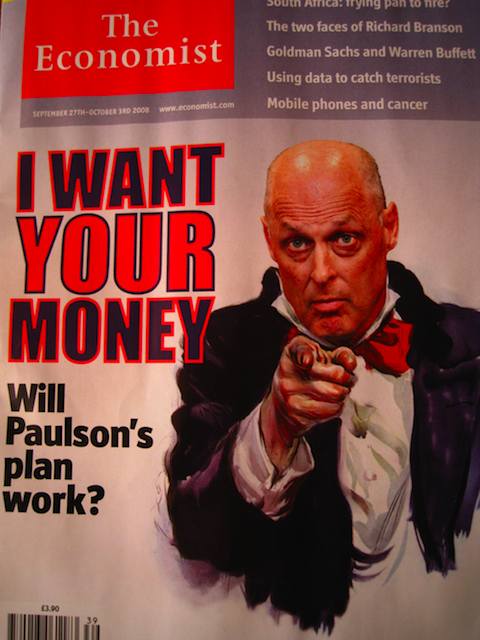
You want fries with that $700 billion, Mr Paulson?

A few days ago I mentioned that the markets were thinking about the possibility of the US government defaulting on its debts. Professor Charles Goodhart, a noted UK economist, then came on BBC Radio explaining that it was impossible for a government to default in this way, and I assumed I had simply misunderstood the signals. But in today’s Financial Times, Gillian Tett reports as follows:

This week, the cost of insuring against a US default via credit derivatives hit record levels. Yesterday, London dealers were quoting between 23 and 28 basis points, meaning it costs €23,000 ($33,600) to €28,000 a year to insure €10m in bonds. But the quotes for McDonald’s were about 25bp-26bp.

Yes, you read that right: the entity that brought us big fries and the floppy clown commands as much gravitas in the credit world as the mighty US of A.

These CDS prices might seem weird: it is extremely unlikely the US will default. But there are at least two factors making investors jittery. One is the rising cost of US bail-out plans. If you spend $50bn here (to support money market funds), $85bn there (to rescue AIG), another $30bn (to complete the Bear Stearns deal) and then $700bn (for a bail-out), soon you are talking serious numbers.

More specifically, the rescue proposals from Hank Paulson, US Treasury secretary, are threatening to push gross US debt well above 70 per cent of GDP for the first time since 1954…

Interesting, eh?

Evening in America

[McCain] tried to remind viewers of his greater experience and heroic combat career, while also casting himself as a maverick outsider ready to storm the barricades. Mr. McCain wanted to be the true revolutionary in the room, but his is the Reagan revolution, and for a lot of people right now, it doesn’t look like morning in America.

The New York Times, summing up last night’s Presidential campaign debate.