
What might go wrong tomorrow

From Ed Felten

Long lines to vote: Polling places will be strained by the number of voters. In some places the wait will be long – especially where voting requires the use of machines. Many voters will be willing and able to wait, but some will have to leave without casting votes. Polls will be kept open late, and results will be reported later than expected, because of long lines.

Registration problems: Quite a few voters will arrive at the polling place to find that they are not on the voter rolls, because of official error, or problems with voter registration databases, or simply because the voter went to the wrong polling place. New voters will be especially likely to have such problems. Voters who think they should be on the rolls in a polling place can file provisional ballots there. Afterward, officials must judge whether each provisional voter was in fact eligible, a time-consuming process which, given the relative flood of provisional ballots, will strain official resources.

Voting machine problems: Electronic voting machines will fail somewhere. This is virtually inevitable, given the sheer number of machines and polling places, the variety of voting machines, and the often poor reliability and security engineering of the machines. If we’re lucky, the problems can be addressed using a paper trail or other records. If not, we’ll have a mess on our hands.

How serious the mess might be depends on how close the election is. If the margin of victory is large, as some polls suggest it may be, then it will be easy to write off problems as “minor” and move on to the next stage in our collective political life. If the election is close, we could see a big fight. The worse case is an ultra-close election like in 2000, with long lines, provisional ballots, or voting machine failures putting the outcome in doubt.

Let’s hope the opinion polls are right. The omens are not good on the voting machine front.
Drop the CiC cliche

Terrific Glenn Greenwald piece in Salon.com arguing that the modern craze for preferring to the US President as “Commander in Chief” is not only unconstitutional but dangerous.

If I could be granted one small political wish, it would be the permanent elimination of this widespread, execrable Orwellian fetish of reverently referring to the President as “our commander in chief.” And Biden’s formulation here is a particularly creepy rendition, since he’s taunting opponents of Obama that, come Tuesday, they will be forced to refer to him as “our commander in chief Barack Obama” (Sarah Palin, in the very first speech she delivered after being unveiled as the Vice Presidential candidate, said of John McCain: “that’s the kind of man I want as our commander in chief,” and she’s been delivering that same line in her stump speech ever since).

The CiC usage has been assiduously promoted by George W Bush as a way of boosting his view of untramelled presidential power (the so-called ‘unitary executive’ doctrine). After all, in the military, the CiC is someone who must be obeyed. And that’s fine in the armed forces. But the president is a civilian who happens to have been elected to the highest office in the land. His authority is constitutional, not military. If George Bush ordered me to do anything I would tell him to get stuffed — unless I worked for the executive branch of the US government (where he really is the ultimate Boss of Bosses). And so should every American citizen.

Editorial endorsements

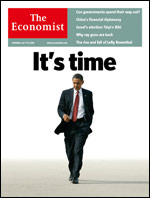
The Economist has made up its mind. I’d forgotten how it ‘voted’ in 2004 and went to check in the archive. Turns out that the magazine had anticipated the question and provided a page on previous endorsements.

Here’s how they went:

2004: John Kerry
2000: George W. Bush
1996: Bob Dole
1992: Bill Clinton
1988: No endorsement
1984: No endorsement
1980: Ronald Reagan

The only thing that’s slightly weird is the standfirst on this year’s endorsement. “America should take a chance and make Barack Obama the next leader of the free world.” Er, does that mean that electing a 72 year-old unstable ignoramus with a VP who couldn’t locate most countries on a map would be a safe bet?

I love the Economist. Its journalism is terrific. But its editorial line is often potty.

Run baby, run

Photograph of Palin as Miss Wasilla by Timroff. From Daily Kos.

Most people think that Saturday Night Live has terminated Sarah Palin’s political ambitions. I wouldn’t be too sure about that. The McCain campaign is probably doomed, but I’d put money on the proposition that Ms Palin sees herself as succeeding where Hillary Clinton failed. After all, she’s probably now the most famous woman in America. This hunch is confirmed by a fascinating New Yorker piece by Jane Mayer on the background to McCain’s ‘choice’ of Palin as running mate, and by this Guardian piece. Mayer writes that

Palin’s sudden rise to prominence … owes more to members of the Washington élite than her rhetoric has suggested. Paulette Simpson, the head of the Alaska Federation of Republican Women, who has known Palin since 2002, said, “From the beginning, she’s been underestimated. She’s very smart. She’s ambitious.” John Bitney, a top policy adviser on Palin’s 2006 gubernatorial campaign, said, “Sarah’s very conscientious about crafting the story of Sarah. She’s all about the hockey mom and Mrs. Palin Goes to Washington—the anti-politician politician.” Bitney is from Wasilla, Palin’s home town, and has known her since junior high school, where they both played in the band. He considers Palin a friend, even though after becoming governor, in December, 2006, she dismissed him. He is now the chief of staff to the speaker of the Alaska House.

Upon being elected governor, Palin began developing relationships with Washington insiders, who later championed the idea of putting her on the 2008 ticket. “There’s some political opportunism on her part,” Bitney said. For years, “she’s had D.C. in mind.” He added, “She’s not interested in being on the junior-varsity team.”

The article has fascinating detail of how Palin wooed a whole clique of right-wing commentators, some of who were as moved by her shapely legs as much as they were impressed by her, er, ideas. Rush Limbaugh’s first reaction was to say that she was a “babe”. And of course there’s nothing quite like a “gun-toting hottie” to turn on your average member of the National Rifle Association.

I’m not impressed by Palin in her current role. She’s way out of her depth at the moment. But on the other hand there is something deeply suspicious about media groupthink. Palin is probably smarter and more cunning than she has been made to appear so far by her Republican handlers. Her fellow-Alaskans know her as someone who is ambitious, organised and determined/ruthless (depending on your point of view). She has had the kind of media exposure and name recognition that money simply cannot buy. And she has four years to build on that base.

So what price Palin as the Republican candidate in 2012?

Palin’s local newspaper endorses Obama!

From the Anchorage Daily News

Obama for president

Palin’s rise captivates us but nation needs a steady hand

Alaska enters its 50th-anniversary year in the glow of an improbable and highly memorable event: the nomination of Gov. Sarah Palin as the Republican vice presidential candidate. For the first time ever, an Alaskan is making a serious bid for national office, and in doing so she brings broad attention and recognition not only to herself, but also to the state she leads.

[…]

Gov. Palin’s nomination clearly alters the landscape for Alaskans as we survey this race for the presidency — but it does not overwhelm all other judgment. The election, after all is said and done, is not about Sarah Palin, and our sober view is that her running mate, Sen. John McCain, is the wrong choice for president at this critical time for our nation.

Sen. Barack Obama, the Democratic nominee, brings far more promise to the office. In a time of grave economic crisis, he displays thoughtful analysis, enlists wise counsel and operates with a cool, steady hand. The same cannot be said of Sen. McCain.
[…]

Yet despite her formidable gifts, few who have worked closely with the governor would argue she is truly ready to assume command of the most important, powerful nation on earth. To step in and juggle the demands of an economic meltdown, two deadly wars and a deteriorating climate crisis would stretch the governor beyond her range. Like picking Sen. McCain for president, putting her one 72-year-old heartbeat from the leadership of the free world is just too risky at this time.

Amen!

What’s at stake on November 4

It’s not just about the economy or the wars in Iraq & Afghanistan. It’s also about the Supreme Court. Here’s Gary Wills writing in the New York Review of Books.

When Charles Gibson was questioning Governor Palin, he should not have asked about the Bush Doctrine (a wavering concept, and touching only one matter, war). He should have asked for her views on the unitary executive—the question Cheney asked the Court nominees. That is what matters most to the Bush people. It affects all the executive usurpations of the last seven years—not only the right of the president to wage undeclared wars, but his right to create military courts, to authorize extraordinary renditions, secret prisons, more severely coercive interrogation, trials with undisclosed evidence, domestic surveillance, and the overriding of congressional oversight in every aspect of government from energy policy to health services.

All these policies were driven by the unitary executive theory of the Constitution, which emanated from David Addington in Vice President Cheney’s office. Charlie Savage has documented that four Supreme Court justices are already enthusiastic supporters of the unitary theory—Roberts, Alito, Scalia, and Thomas.[16] It takes only a fifth justice to solder that theory into place for the foreseeable future. This would be the most thorough reworking and distortion of the Constitution in all our history.

The stakes are staggering. That is why the Republicans are so desperate to win this year. If they fail, not only will their previous encroachments be endangered, but the investigation of illegal acts will be removed from protection by presidential veto. Nothing short of wholesale pardons by the outgoing president can give many people cover for acts they undertook on the assurance that the unitary executive was exempt from congressional action. This prospect is so terrifying that John McCain has taken over the thuggish tactics that defeated him in 2000. The Republicans have everything to lose.

The unitary executive theory was elaborated in Edwin Meese’s Justice Department under Ronald Reagan. In its first form, it asserted that Congress can have nothing to do with an agency once it has set it up. Everything after that is an executive task, and only the president can determine executive personnel and conduct.

Wills thinks that “There is something terrifying in the fact that a sweeping presidential power … is now accepted by four of the nine Supreme Court justices. Add a fifth justice to them, and the Constitution will be under the severest siege in its history. There can be no higher stakes.”

He’s right.

Politics, US-style

From FiveThirtyEight.com

So a canvasser goes to a woman’s door in Washington, Pennsylvania. Knocks. Woman answers. Knocker asks who she’s planning to vote for. She isn’t sure, has to ask her husband who she’s voting for. Husband is off in another room watching some game. Canvasser hears him yell back, “We’re votin’ for the n***er!”

Woman turns back to canvasser, and says brightly and matter of factly: “We’re voting for the n***er.”