China’s “Green Dam” censorware opens the door to malware

From Technology Review.

Controversy erupted this week over reports that the Chinese government plans to require all computers sold in the country to come with software that screens for objectionable websites. Although initial criticism came from privacy advocates and those most concerned about censorship, experts have also now found that the software could introduce critical security risks to computers across the country.

According to the BBC, the software communicates in plain text with central servers at its parent company. Not only does this potentially place personal information in the hands of eavesdroppers, but it could also allow hackers to take over PCs running the software, creating a massive zombie network that could deliver spam or attack other computers across the globe…

Ed Felten has followed up on this, drawing attention to an investigation by security researchers which confirms the story. Ed concludes:

This is a serious blow to the Chinese government’s mandatory censorware plan. Green Dam’s insecurity is a show-stopper — no responsible PC maker will want to preinstall such dangerous software. The software can be fixed, but it will take a while to test the fix, and there is no guarantee that the next version won’t have other flaws, especially in light of the blatant errors in the current version.

Electorate rounds on Fianna Fáil

Epochal election results from Ireland. This from today’s Irish Times.

FIANNA FÁIL has suffered the worst defeat in its history, and Irish politics will never be the same again. How a Government that has taken such a drubbing can continue to govern and take the decisions necessary to restore the economy to health is now the critical issue facing the political system.

The decision of Fine Gael to table a motion of no confidence in the Government was the obvious move, given its historic breakthrough as the biggest party in the country. More importantly, it is an attempt to focus minds on the profound implications of the election results.

Probably the most striking symbol of the reversal suffered by Fianna Fáil was the fate of Maurice Ahern, brother of the former Taoiseach, who was beaten into a humiliating fifth place in the Dublin Central byelection with just 12 per cent of the first preference vote.

Just two years after Bertie Ahern led Fianna Fáil to an amazing three-in-a-row general election victorysh Times, his inability to deliver even a modestly respectable vote for his brother showed how the mighty have fallen. To rub salt into the wound, Maurice Ahern lost his city council seat to party colleague Mary Fitzpatrick, who had been so cruelly stitched up by the Ahern machine two years ago.

My sister sent me this lovely Death Announcement:

“Fianna Fail. The Soldiers of Disaster (formerly the Soldiers of Destiny*), 1926-2009. Savaged to death at local and European elections. Deeply regretted by builders, developers, bankers and cowboys everywhere.** Remains reposing in large tent on Galway Racecourse. Funeral Mass in Church of St Bertie the Chancer. Burial afterwards in the Golden Circle Cemetery. No flowers, please. Brown envelopes only!”

Footnotes:
* Fianna Fail is the Irish for soldiers of destiny
** Fianna Fail was once memorably described as “the political wing of the construction industry”.

MPs are sheep; political journalists are hyenas

Diane Abbott MP said something interesting on the radio the other day, namely that the atmosphere among her fellow-MPs was “hysterical”. And the cause of the hysteria? Why the expenses scandal (mainly) plus fear of losing their seats. In the circumstances, Abbott worried about her colleagues’ ability to make any rational decisions about Gordon Brown’s future. She might be right.

But what would such a ‘rational’ strategy be like? Answer: it would involve calming down and letting Brown survive subject to conditions about sorting out the expenses shambles and a modicum of attainable constitutional reform (like fixed-term Parliaments, reductions in the volume of legislation, relaxation of the Party whip system and giving MPs the right to choose membership and chairmanship of Select Committees).

Switching leaders now — however emotionally satisfying it might be — would be suicidal, not just for Labour MPs but also for the country. It would provoke an emergency General Election which, if held at the moment, would produce crazy results. In fact, if MPs wanted to ensure a few Westminster seats for the BNP to add to the two European Parliament seats they picked up last night, then provoking an election is the best way to go about it. What should be in everybody’s minds now is what happened in Holland after the murder of Pim Fortuyn — when the Dutch elected a parliament of fruitcakes and rendered their country virtually ungovernable for several years.

As for political journalists… well their orgasmic delight at being able to cover such a juicy story is becoming nauseating. They really are like hyenas closing in on a wounded beast. And apart from anything else, most of them are adding little if any value to the story. And yet BBC TV (and no doubt ITV and Sky too) persist in wasting energy, fuel, time and money ferrying their big name reporters to Downing Street instead of sticking them in a studio or keeping them in Westminster where they can get on with real investigation and reporting.

It’s really irritating, for example, to see the ludicrous way the Beeb is mis-using its Political Editor, Nick Robinson. He’s very useful as a summarising, contextualising commentator after others have done the leg-work. But the most value-adding contribution he’s made over the last few frantic days was a piece to camera recorded at his desk. Dragging him to Downing Street to say exactly the same thing would have been daft. But that’s what they do most of the time.

Obama’s Cairo speech…

… was by all accounts terrific. Here’s Robert Kaplan’s report in The Atlantic, for example:

(June 4, 2009).

One can take apart President Barack Obama’s speech to the Muslim world delivered at Cairo University today, and subject its sentences to all manner of criticism and analysis, but its overall effect was magnificent. It employed the forward-looking optimism of the American Dream in the service of the hopes and frustrations of youth throughout the Islamic cultural continuum. It also restored the kind of public relations magic that America possessed overseas in the years immediately after World War II. Obama is no doubt more popular among Muslim youth than many of their own leaders.

The President spoke of a “new beginning,” about not being “prisoners of the past,” about how the “enduring faith of a billion should not be hostage to a few extremists.” He spoke about religious freedom, not only for Muslims, but for the Christian minorities in their midst – like the Copts in Egypt and the Maronites in Lebanon. He spoke about women’s rights, and how “education and innovation,” as practiced by Muslim states like Malaysia and the United Arab Emirates, are the “currencies of the 21st century.” He didn’t defend the forcible implementation of democracy, but he did defend good government and civil society in all countries. Thus, he spoke of democracy in philosophical terms rather than in legalistic ones. And he consistently addressed the hopes of his audiences rather than their fears.

The gift that keeps on taking

Reagan did it. That’s the headline on Paul Krugmans’s NYTimes column.

“This bill is the most important legislation for financial institutions in the last 50 years. It provides a long-term solution for troubled thrift institutions. … All in all, I think we hit the jackpot.” So declared Ronald Reagan in 1982, as he signed the Garn-St. Germain Depository Institutions Act.

He was, as it happened, wrong about solving the problems of the thrifts. On the contrary, the bill turned the modest-sized troubles of savings-and-loan institutions into an utter catastrophe. But he was right about the legislation’s significance. And as for that jackpot — well, it finally came more than 25 years later, in the form of the worst economic crisis since the Great Depression.

For the more one looks into the origins of the current disaster, the clearer it becomes that the key wrong turn — the turn that made crisis inevitable — took place in the early 1980s, during the Reagan years.

Interesting column. The US media’s failure to detect the Savings and Loans catastrophe in the 1980s was a dry run for their failure to spot Enron and, later still, our current financial meltdown.

The Homburg Factor redux

Whenever politicians start talking about their ‘vision’ for the country, it is time to start counting the spoons. I remember thinking that when Gordon Brown bottled out of calling an election in the first Autumn of his premiership and went on TV saying that he just wanted time to spell out his ‘vision’ for Britain. I was surprised at the time that so many commentators were willing to take him at face value. But it seems that even the Guardian has finally had enough. Here’s its Leader today:

The truth is that there is no vision from him, no plan, no argument for the future and no support. The public see it. His party sees it. The cabinet must see it too, although they are not yet bold enough to say so. The prime minister demands loyalty, but that has become too much to ask of a party, and a country, that was never given the chance to vote for him. Had there been a contest for the leadership in 2007 – and had Mr Brown called a general election – he would probably have won. He decided not to do these things. And he has largely failed since.

I always thought Brown would make a terrible Prime Minister. He’s secretive, indecisive, obsessive and a control freak. That combination might work in the Treasury. But it would never have worked in Number Ten. And I always had the feeling that Tony Blair had similar thoughts about Brown’s suitability for the highest office — hence my original Homburg Factor post of long ago. Which leads to another thought. Remember the famous ‘Granola Deal’ in which Brown and Blair allegedly decided that Blair would run for the leadership following the death of John Smith? New Labour’s great stroke of luck was that Blair became Leader. If it had been Brown, Labour would have won the 1997 election — for the simple reason that a “dog with a mallet up its arse” (to use a colourful Irish phrase) would have beaten the Tories in 1997 (just as a similarly-equipped mongrel will beat Labour in 2010). But I doubt that Labour would have won a second term with Brown in charge.

For a control freak, the disintegration of his government must be a galling experience. But I’ll be very surprised if he goes voluntarily. Meanwhile, his MPs have nobody to blame but themselves. They, after all, lacked the cojones to have a leadership election after Blair stepped down.

And Enoch Powell was right: all political careers end in failure.

The Conservative opportunity

“Never waste a good crisis” is what the Obama crowd always say. Watching David Cameron saying that anyone interested in public service should consider applying to become a Tory parliamentary candidate made me think that the expenses row may be a Godsend for him. After all, what he needs to do to complete the modernisation of the party is to get rid of all those reactionary toffs with their moated piles and Mayfair flats — and until now they have proved rather difficult to eject. But now…?

Labour’s affair with bankers


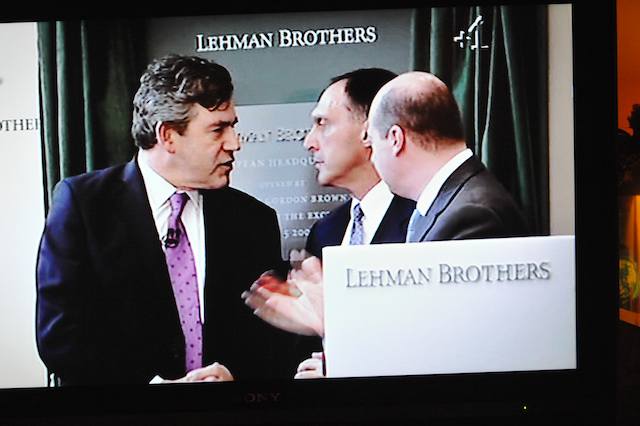
Gordon Brown sucking up to Richard S. Fuld, CEO of Lehman Bros, just after opening Lehman’s new London HQ. Photograph from tonight’s ‘Dispatches’ on Channel 4.

Terrific FT.com column by John Kay.

What would have happened if the Financial Services Authority or Bank of England had sought to block the competing bids from RBS and Barclays for ABN Amro – a contest which, we now know, would bankrupt the bank that won the race? The phones in Downing Street would have been ringing insistently and it is easy to imagine the government’s response.

Little has changed. The government continues to see financial services through the eyes of the financial services industry, for which the priority is to restore business as usual. For a time in 2008, it seemed possible to argue that a package of temporary support for the banking industry, combined with substantial recapitalisation of the weaker players, might stabilise the financial sector and prevent serious knock-on effects.

But the problems of banks are much deeper than were then acknowledged and the destabilisation of the real economy has happened anyway. Government now provides taxpayers’ money to financial services businesses in previously unimaginable quantities. But there is no control over the use of the money, no insistence on structural reform or management reorganisation, no safeguarding of the essential economic functions of the financial services industry and no accountability for the damage that has been done.

It is as though the teenage children and their friends were to wreck the house and then demand that the grown-ups clean up before the next party. Their parents are too intimidated to do anything more than ask Uncle Adair to keep an eye on them and excoriate the hapless Fred who made off with some of the silver.

Farewell my Darling: the fall guy’s final budget

The Economist thinks that it was a dishonest, politicking effort. It’s hard to disagree.

The wheel of fortune turns swiftly in politics. Gordon Brown pulled off the G20 meeting in London on April 2nd, emerging with a plausible aura of global statesmanship. After a handful of Labour sleaze stories and a misguided statement on YouTube, the prime minister looked more like Richard Nixon: shifty, angry and with a list of enemies to smear. And that was before a downright dishonest budget on April 22nd.

The budget was a crucial one, for two reasons. First, Mr Brown is running out of time—he has to hold an election by June 2010—and Britain seems increasingly fed up with him. The public regards his party with distaste (see article). That’s partly because a dozen years in power tends to tarnish: when the home secretary’s husband charges the taxpayer for the porn he watches, one gets an inkling that a government’s time is up. But it’s also because of Mr Brown’s character. His strength, which the G20 meeting displayed, is dour pragmatism. Too often, though, he resorts to tribal politics, in a way that seems both scheming and incompetent.

Second, the budget marks the government’s attempts to deal with the fiscal consequences of the worst slowdown since the second world war. Mr Brown is partly to blame for this mess, but crisis management should have played to his strengths; instead, it revealed his worst side…

I’ve always thought that the key factor has little or nothing to do with politics. The British electorate isn’t much interested in politics, but when a regime has been in power for a while the public simply gets bored with it. And when that happens, the game is up.

Tony Blair always thought that Brown would be a disaster as Prime Minister (see The Homburg Factor), and in that at least he turns out to have been right. I’ve never met Brown, but he’s always seemed fishy. What’s especially creepy is all that sanctimonious crap about being “a son of the Manse”, as if somehow that elevated him onto a higher moral plane than the rest of us — not to mention the rest of the political class. The Damien McBride episode exposed this moralistic posturing for what it was — hypocritical baloney. McBride has been close to Brown for years. Everyone who ever came into contact with McB knew what he was like. Brown not only knew, but obviously approved — otherwise why would he have kept him on (and brought him with him to Number Ten)?

The ubiquitous commentator Will Hutton has done a two-part TV documentary for Dispatches on how the financial crisis happened. The first part was screened last night, and although it’s clear that Hutton is riding his own hobby-horse (i.e. the view that the British government and regulators proved deeply incompetent when it came to the crunch), his film did include three toe-curling video clips.

The first shows Brown, newly-installed as Chancellor, explaining smugly to the House of Commons how his shiny new tripartite system for ‘light’ regulation of the banking system was a world beater — while, behind him, Tony Blair smirks complacently on the government front bench. The second clip shows Brown giving his first speech to the Lord Mayor’s Banquet and sucking up in a nauseating way to the assembled members of the City elite. The final clip shows him opening the London office of Lehman Brothers: he unveils a plaque and then begins fawning on Richard Fuld, CEO of the bank and arguably the creepiest-looking dude since Boris Karloff hung up his mask. What these clips illustrate above all is the extent to which Brown was in awe of the soi-disant ‘masters of the universe’. They should be on a permanent loop. Perhaps they already are — on YouTube.