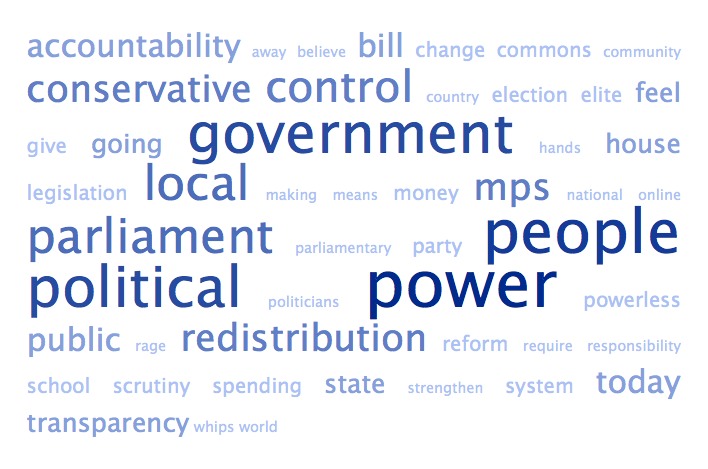
This is a wordcloud (generated using tagcrowd) from the text of a major speech made by the Tory Leader at the Open University on May 26 this year. Might be an interesting tool for tracking changes in rhetoric — and perhaps even policy.

This is a wordcloud (generated using tagcrowd) from the text of a major speech made by the Tory Leader at the Open University on May 26 this year. Might be an interesting tool for tracking changes in rhetoric — and perhaps even policy.
Nice idea, well executed by the Huffington Post.
Nothing dramatic is the answer. Part of the problem is that they don’t understand a lot of the issues. See, for example, this sharp Media Blog account of last night’s Polis Seminar on Digital Britain.
Speakers at the event included Culture Secretary-in-waiting Jeremy Hunt. And what did we learn from the man who will surely assume control of the UK media following the next general election?
Well, we learned Hunt appears not to fully understand the controversial implications of "net neutrality", though he gamely attempted to answer a question from the floor which he thought was about illegal file sharing, defending in the process the rights of content owners who may ultimately feel the pinch of a tiered internet themselves (check out the BBC iPlayer effect to understand what first brought the net neutrality debate to the UK – clue: it’s nothing to do with file-sharing.)
Remember all those stories about how Dave ‘Vote-Blue-to-get-Green’ Cameron insisted that there should be no conspicious consumption of Bollinger at his party conference? Well, a Mirror photographer spotted the Supreme Leader in flagrante. The paper’s report reads:
David Cameron quaffs £140-a-bottle bubbly with his rich chums just hours before the Tories announced a pay freeze for millions of ordinary workers.
Mr Cameron flouted a champagne ban imposed by his own party chairman who was keen to avoid accusations the Tories believe the election is in the bag.
When we caught him sipping fizz at an exclusive party, heavy-handed minders immediately moved in and tried to stop us leaving with the embarrassing snap.
I watched Gordon Brown’s ghastly Conference speech and thought that Simon Hoggart got it right.
But there was a dreamlike quality to the whole speech. The gist of it was, that after nearly 13 years, Labour wants a crack at government. Having constructed a short, sanitised version of a past that did happen, he launched into a future that probably never will: whimpering bankers flee from the wrath of the British people, grateful old folk get free care at home, sinister-sounding “action squads” will sort out troublemakers on problem estates, no more hereditary peers, a plebiscite on PR, green jobs for green people, as he almost said, and a weird Victorian notion of an institution for fallen women – a barracks for single teenage mothers. There will be “family intervention projects” for the most “chaotic” families. “Blimey, it’s the fip-man at the door. Put that spliff out and get the dog off the baby’s tea.”
And asbos will be strictly enforced, no doubt by the same action squads that will stop binge drinking and bankers’ bonuses. But as the late Linda Smith said: “Don’t knock asbos – for some of these kids it’s the only qualification they’ve got.”
The whole fantasy, that Labour has another five years in office to do all the things it never quite got round to in the last 13, pleased the conference mightily.
They’re going to dream massive buy-two-get-one-free dreams and reach deep inside themselves like the monster from Alien. They loved it.
As regular readers know, I’ve thought for a long time that the reason Tony Blair hung on for so long was that he knew Brown would be a disaster. In that, at least, he was dead right.
What’s going on in the US now is really scary. The attacks on Obama make the ‘Revd’ Ian Paisley — even in his bigoted heyday — look like a bleeding-heart liberal. At the root of it is a sense of frustrated entitlement: it’s as if the Right in America simply cannot believe that its God-given right to run the country has been denied as a result of a liberal swindle. We saw some of this in the Clinton era (witness the continuous campaigns to harass and even impeach him), but what we’re seeing now is something else. It’s psychotic.
In that context, Andrew Sullivan has an interesting blog post this morning. Sample:
The pattern is now clear: the imperative to play the political game has won on the right. The longer-term pattern is just as clear: a faction of congressional Democrats sometimes backed Bush on his initiatives (such as his tax cuts). No one in the Congressional Limbaugh-run GOP will back anything this president does. Not only that; they will assault him, race-bait him and insult him in a continuous reel of populist bile.
It seems to me that the GOP was once recognizable as a human personality. It had an id; but it also had a series of responsible egos – Eisenhower, Reagan, Bush I and, to some extent, Bush II; and it had a super-ego – some kind of conscience that made it think of the broader society over partisan warfare. What we've seen in the last few years is the removal of both ego and super-ego.
What you have now is just the rage at the world and its confounding trade-offs and compromises. The knowledge of the Rove right’s total failure in the last eight years has only made the far right more fervent in its theo-ideology. Do they have a plan to balance the budget? To salvage or cut losses in Afghanistan? To integrate illegal immigrants rather than use their lives as political fodder? To get the working middle classes reliable healthcare insurance? Not that I can see beyond utopian platitudes.
But they do know that anything this president does is a threat to them. And the noise they can make and violence they can foment is out of all proportion to their numbers…
It reminds me of the old definition of ‘fanatic’ as someone who keeps bombing after he has forgotten the objectives that bombing was supposed to achieve.
Incredible as it may seem. Gordon Brown (well, his office) is on Twitter. His tweets are exactly in character, that is to say, cringe-making. Here’s the latest one, for example:
PM: Many congratulations to Fabio Capello & England team for qualifying for the 2010 World Cup Finals with an emphatic win against Croatia.
It’s the kind of thing he would write, too. This, after all, is the guy who could take time to congratulate the England cricketers on winning the ashes while being unable to comment on the decision to release the Lockerbie bomber.
My two-pennyworth in today’s Times .
The consultation document says the Carter plan would take too long to implement “given the pressure put on the creative industries by piracy”. Instead, ISPs would be obliged to block access to download sites, throttle broadband connections or even temporarily cut off access for repeat offenders. It is clearly envisaged that the new measures will be bundled into the Bill, which will implement the main proposals of the Digital Britain report.
If that does indeed happen, then the nearest legal precedent is the Dangerous Dogs Act of 1991, an unworkable statute passed in response to tabloid hysteria about pitbull terriers. There’s no evidence that anyone in Lord Mandelson’s department has thought through the implications of giving in to the content industries. For one thing, there are the technical, financial and legal burdens the proposals would put on ISPs, which would be required not only to act as security officers for the entertainment industry, but also to enter the minefield of terminating people’s internet access on grounds that could be questionable in law.
The only people who think this is simple are either industry lobbyists or those who don’t understand it…
I’m working on a theory of incompetent systems — i.e systems which are in danger of catastrophic failure but which, for various reasons (absence of effective feedback loops, undue power of vested interests, etc.) will not be able to fix themselves in time to avoid catastrophic failure. Climate change looks to me like an incompetent system problem. Intellectual property law is another. And the American healthcare system is yet another. Watching the way the public debate about health reform in the US has been maliciously hijacked by powerful vested interests was reminiscent of the way debates about IP are skewed. But healthcare is far more important, and yet it’s being allowed to happen. It’s unbelievable.
Not surprisingly, therefore, I was struck by this blast from Mark Anderson. Excerpt:
If it were not such a tragic struggle, watching the entrenched interests fighting any change in the U.S. healthcare system would be vaguely amusing, like watching elephant races.
Unfortunately, these aren’t cute elephants, but a cancer on our society: the growth in their wastefulness, and in the value they subtract from the healthcare process every year, is bankrupting good companies, destroying the business foundations of the country, and enriching a few at overwhelming cost to the many.
While the American healthcare system has many problems and parts, it does not defy analysis. And while it will take many different reforms to perfect it, just a single change would bring it back from the dead. The problem is simple: private insurance companies. These groups do not have patient care in mind; they are only focused on extracting money from the system. They do not even operate as part of a healthcare system: with the same basic structure, they could extract money from any supply chain.
The worst part of this scheme is that the real customer, the patient, is essentially prevented from being the customer. She does not know the cost of her care, she has little or no control over those costs, and the result is the vendor is free to drive them to the sky, with everyone getting a cut – except the patient. Why not charge $100 for aspirin? Who cares? Why not charge 2x for a broken leg? Why not run 4x too many MRIs? Who cares? The MRI vendor is happy, the hospital with the new machine needing to be paid off is happy, the doctor getting paid per use, and reviewed for quotas, is happy, and the patient – Who cares?
Most insurance companies learned long ago that their real business is in investment: life insurance companies are the obvious early case. Collecting and paying out premiums and claims is just a sideline, a way to get the cash needed for the investment business. You knew this, right?
So it is with American healthcare. These companies are not in the business of healthcare: they are in the business of extracting as much cash as possible from the system, on a compound annual growth basis which is 3-4x the cost of living. How much would they spend to keep this bloodletting from being interrupted? Well, the bank lobby spent $1B to remove the Glass Steagall protections, just before the banks helped blow up the US economy. I would guess that what we are seeing right now, in Washington, DC, is the largest amount of money ever spent on lobbying a single cause – all in the name of retaining a broken system, one which costs more than twice the next one down, one often classified as something like 37th in the world, just behind Slovenia…
When the US — after eight years of moronic, destructive, wasteful government — succeeded in electing Obama I remember being struck by the country’s extraordinary ability to reinvent itself. Now I’m not so sure. Maybe Obama was just a blip?
On the other hand, if he can succeed in getting meaningful healthcare refore passed, then he will go down as the greatest president since FDR.
Good Op-Ed piece by him in the NYT.
OUR nation is now engaged in a great debate about the future of health care in America. And over the past few weeks, much of the media attention has been focused on the loudest voices. What we haven’t heard are the voices of the millions upon millions of Americans who quietly struggle every day with a system that often works better for the health-insurance companies than it does for them.
And,
Lastly, reform will provide every American with some basic consumer protections that will finally hold insurance companies accountable. A 2007 national survey actually shows that insurance companies discriminated against more than 12 million Americans in the previous three years because they had a pre-existing illness or condition. The companies either refused to cover the person, refused to cover a specific illness or condition or charged a higher premium.
We will put an end to these practices. Our reform will prohibit insurance companies from denying coverage because of your medical history. Nor will they be allowed to drop your coverage if you get sick. They will not be able to water down your coverage when you need it most. They will no longer be able to place some arbitrary cap on the amount of coverage you can receive in a given year or in a lifetime. And we will place a limit on how much you can be charged for out-of-pocket expenses. No one in America should go broke because they get sick.
Most important, we will require insurance companies to cover routine checkups, preventive care and screening tests like mammograms and colonoscopies. There’s no reason that we shouldn’t be catching diseases like breast cancer and prostate cancer on the front end. It makes sense, it saves lives and it can also save money.
This is what reform is about.
Attaboy!